







Question: Within the model we studied in Lecture 1A, suppose that p = P113 = 9,1) = U2 and n' = U2. You are a voter

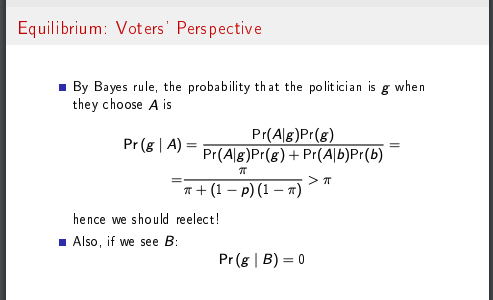
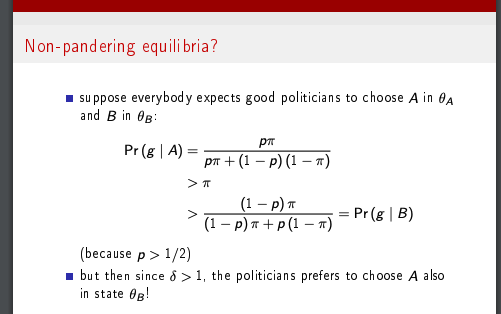

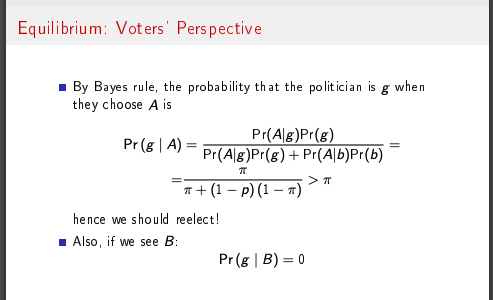
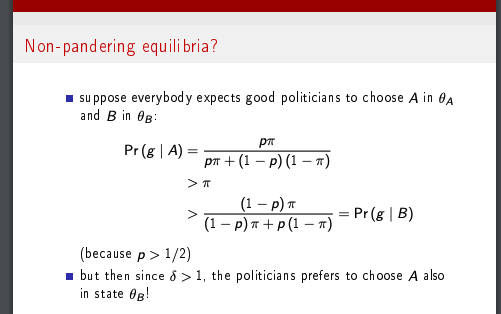
Within the model we studied in Lecture 1A, suppose that p = P113 = 9,1) = U2 and n' = U2. You are a voter and you expect that type 3 politicians always select alternative B. Using Bayes rule, calculate your belief that the politician is type g upon observing that she chose policy B. Please round your answer to the first 3 decimal point. Equilibrium: Voters' Perspective By Bayes rule, the probability that the politician is g when they choose A is Pr (g | A) = Pr(Alg) Pr(g) Pr(A| g) Pr(g) + Pr(A|b)Pr(b) = T+ (1 - p) (1 -") hence we should reelect! Also, if we see B: Pr (g | B) = 0Non-pandering equilibria? I suppose everybody expects good politicians to choose A in dA and B in OB: Pr (g | A) = pa + (1 - p) (1 -*) (1 - P) T > (1 - p) #+ p(1 - 1/2) but then since & > 1, the politicians prefers to choose A also in state Of
Step by Step Solution
There are 3 Steps involved in it

Get step-by-step solutions from verified subject matter experts
 Study Help