







Question: without any software help (R/Matlab or other) Consider the linear regression model with the independent multiplicative exponential errors: Yi = (Bxi) . ci, ci ~
without any software help (R/Matlab or other)
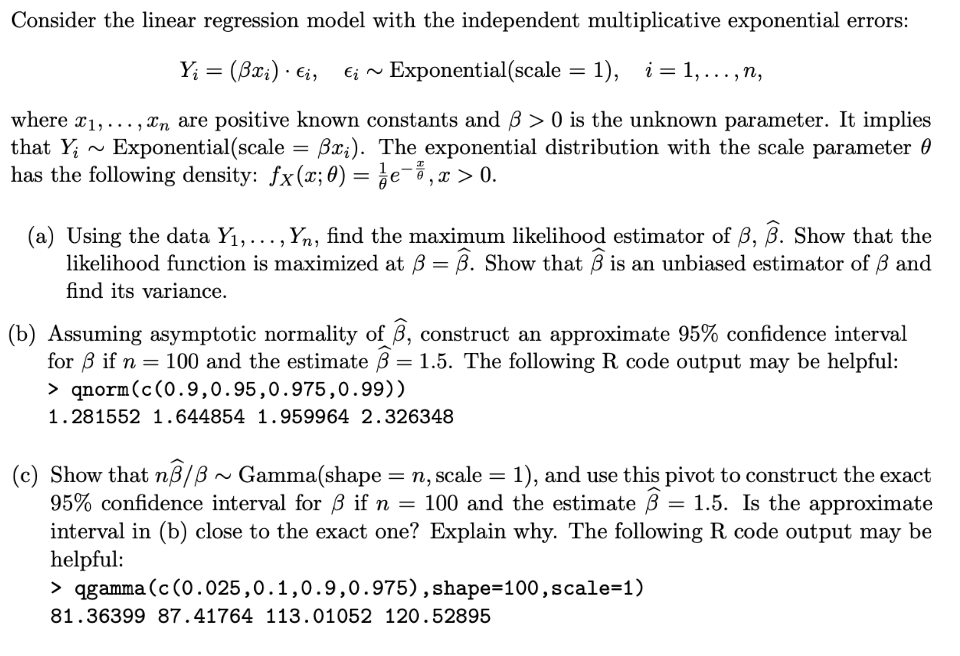
Consider the linear regression model with the independent multiplicative exponential errors: Yi = (Bxi) . ci, ci ~ Exponential(scale = 1), i =1, ..., n, where X1, . .., n are positive known constants and B > 0 is the unknown parameter. It implies that Y; ~ Exponential(scale = Bx;). The exponential distribution with the scale parameter 0 has the following density: fx(x; 0) = ge :,x> 0. (a) Using the data Y1, ..., In, find the maximum likelihood estimator of B, B. Show that the likelihood function is maximized at 8 = B. Show that S is an unbiased estimator of B and find its variance. (b) Assuming asymptotic normality of S, construct an approximate 95% confidence interval for B if n = 100 and the estimate B = 1.5. The following R code output may be helpful: > qnorm (c (0. 9, 0. 95, 0. 975, 0.99)) 1. 281552 1. 644854 1.959964 2. 326348 (c) Show that nB/B ~ Gamma(shape = n, scale = 1), and use this pivot to construct the exact 95% confidence interval for B if n = 100 and the estimate B = 1.5. Is the approximate interval in (b) close to the exact one? Explain why. The following R code output may be helpful: > qgamma (c (0 . 025, 0 . 1, 0.9,0.975) , shape=100, scale=1) 81. 36399 87. 41764 113. 01052 120.52895
Step by Step Solution
There are 3 Steps involved in it

Get step-by-step solutions from verified subject matter experts
 Study Help