







Question: Without using any STL or vector, give the implementation of constructors, destructors, copy constructors, enqueue, dequeue and overloaded assignment operator of these circular buffers by
Without using any STL or vector, give the implementation of constructors, destructors, copy constructors, enqueue, dequeue and overloaded assignment operator of these circular buffers by making .cpp files based on the following .h files below: // file: InnerCB.h // Header file for Inner Circular Buffer. // See project description for details. // #ifndef _INNERCB_H_ #define _INNERCB_H_ class InnerCB { public: // Constructor, default size is 10. InnerCB(int n=10) ; // Copy constructor InnerCB(const InnerCB& other) ; // Destructor ~InnerCB() ; // Add item to circular buffer void enqueue(int data) ; // Remove item from circular buffer int dequeue() ; // True if no space left in buffer bool isFull() ; // True if buffer holds no items bool isEmpty() ; // return maximum number of items this buffer can hold int capacity() ; // return number of items currently held in the buffer int size() ; // overloaded assignment operator const InnerCB& operator=(const InnerCB& rhs) ; // debugging function. Prints out contents. void dump() ; // grading function used to examine private data members. // Do not implement! bool inspect (int* &buf, int &cap, int &size, int &start, int &end) ; private : int *m_buffer ; // pointer to dynamically allocate array for buffer int m_capacity ; // length of the allocated space pointed by m_buffer int m_size ; // # of items in the buffer int m_start ; // index of the first (oldest) item in the buffer int m_end ; // index of the last (newest) item in the buffer } ; #endif-------------------------------------------------------------------------------------------------------------------------------------------
// file: CBofCB.h // Header file for Circular Buffer of Circular Buffer. // See project description for details. // #ifndef _CBOFCB_H_ #define _CBOFCB_H_ #include "InnerCB.h" class CBofCB { public: // default constructor CBofCB() ; // copy constructor CBofCB(const CBofCB& other) ; // destructor ~CBofCB() ; // add item to this data structure void enqueue(int data) ; // remove item from this data structure int dequeue() ; // returns true if cannot add more items bool isFull() ; // returns true if no items stored in data structure bool isEmpty() ; // number of items in the data structure as a whole. // Note: not the number of InnerCB's int size() ; // overloaded assignment operator const CBofCB& operator=(const CBofCB& rhs) ; // debugging function, prints out contents of data structure void dump() ; // grading function. Do not implement! bool inspect (InnerCB** &buf, int &cap, int &size, int &start, int &end) ; private : // max number of Inner Circular Buffers // static const int m_obCapacity=7 ; // array of pointers to InnerCB's. // Each entry of the array is a pointer. // Note: array itself is NOT dynamically allocated InnerCB * m_buffers[m_obCapacity] ; int m_obSize ; // number of inner circular buffers in the outer CB int m_oldest ; // index of the oldest circular buffer (start) int m_newest ; // index of the newest circular buffer (end) } ; #endif------------------------------------------------------------------------------------------------------------------------------------------
This is how these circular buffers queues are visually
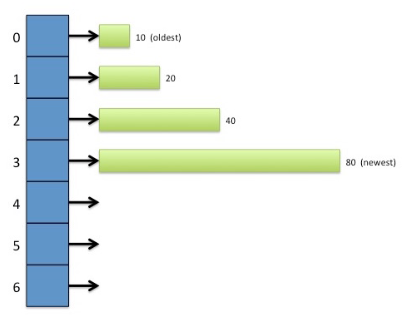
0 10 (oldest) 20 40 80 (newest) 4
Step by Step Solution
There are 3 Steps involved in it
1 Expert Approved Answer
Step: 1 Unlock

Question Has Been Solved by an Expert!
Get step-by-step solutions from verified subject matter experts
Step: 2 Unlock
Step: 3 Unlock
 Study Help