







Question: WOLFRAM MATHEMATICA CODE (Computational Physics, Nicholas Giordano, 2nd Edition) 0.7. Many three-dimensional quantum mechanics problems can be reduced effectively to one- or two-dimensional problems. For
WOLFRAM MATHEMATICA CODE
(Computational Physics, Nicholas Giordano, 2nd Edition)
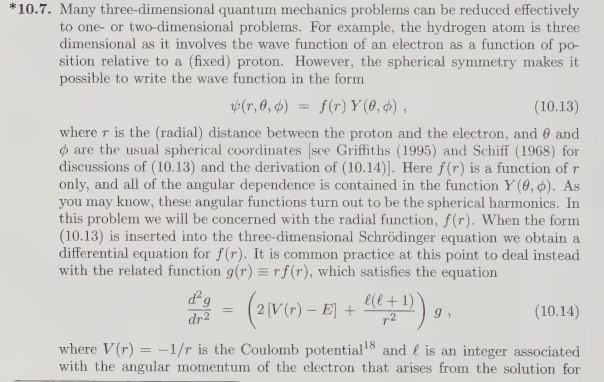

0.7. Many three-dimensional quantum mechanics problems can be reduced effectively to one- or two-dimensional problems. For example, the hydrogen atom is three dimensional as it involves the wave function of an electron as a function of position relative to a (fixed) proton. However, the spherical symmetry makes it possible to write the wave function in the form (r,,)=f(r)Y(,), where r is the (radial) distance between the proton and the electron, and and are the usual spherical coordinates [see Griffiths (1995) and Schiff (1968) for discussions of (10.13) and the derivation of (10.14)]. Here f(r) is a function of r only, and all of the angular dependence is contained in the function Y(,). As you may know, these angular functions turn out to be the spherical harmonics. In this problem we will be concerned with the radial function, f(r). When the form (10.13) is inserted into the three-dimensional Schrdinger equation we obtain a differential equation for f(r). It is common practice at this point to deal instead with the related function g(r)rf(r), which satisfies the equation dr2d2g=(2[V(r)E]+r2(+1))g, where V(r)=1/r is the Coulomb potential 18 and is an integer associated with the angular momentum of the electron that arises from the solution for Y(,). Employ the shooting method to solve (10.14) for g(r) starting your integration at r=0, with the initial value g(0)=0. Consider the cases =0 and =1 and compare your results with the analytic solution for the hydrogen atom. Hint: In the units used here the energies of the bound states are given by 1/2n2, where n is an integer
Step by Step Solution
There are 3 Steps involved in it

Get step-by-step solutions from verified subject matter experts
 Study Help