



Question: Wolson, J. hate ... If free speech means anything, it means that you do not get to sue people because you don't like their opinion
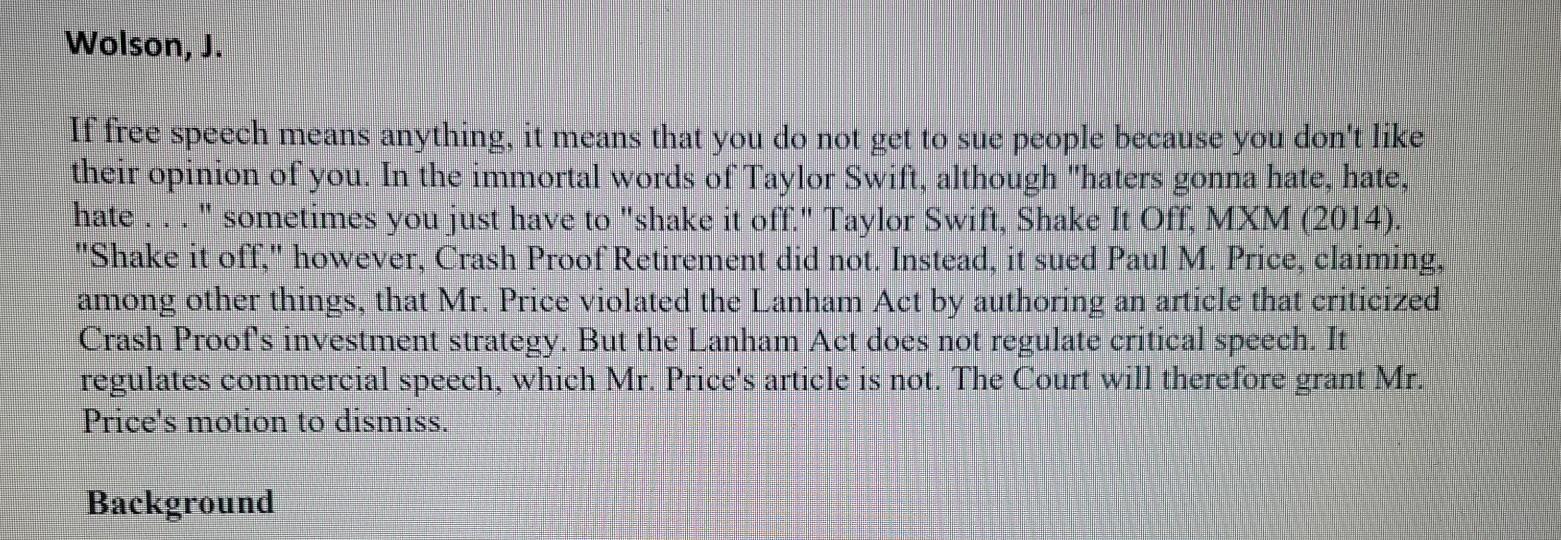
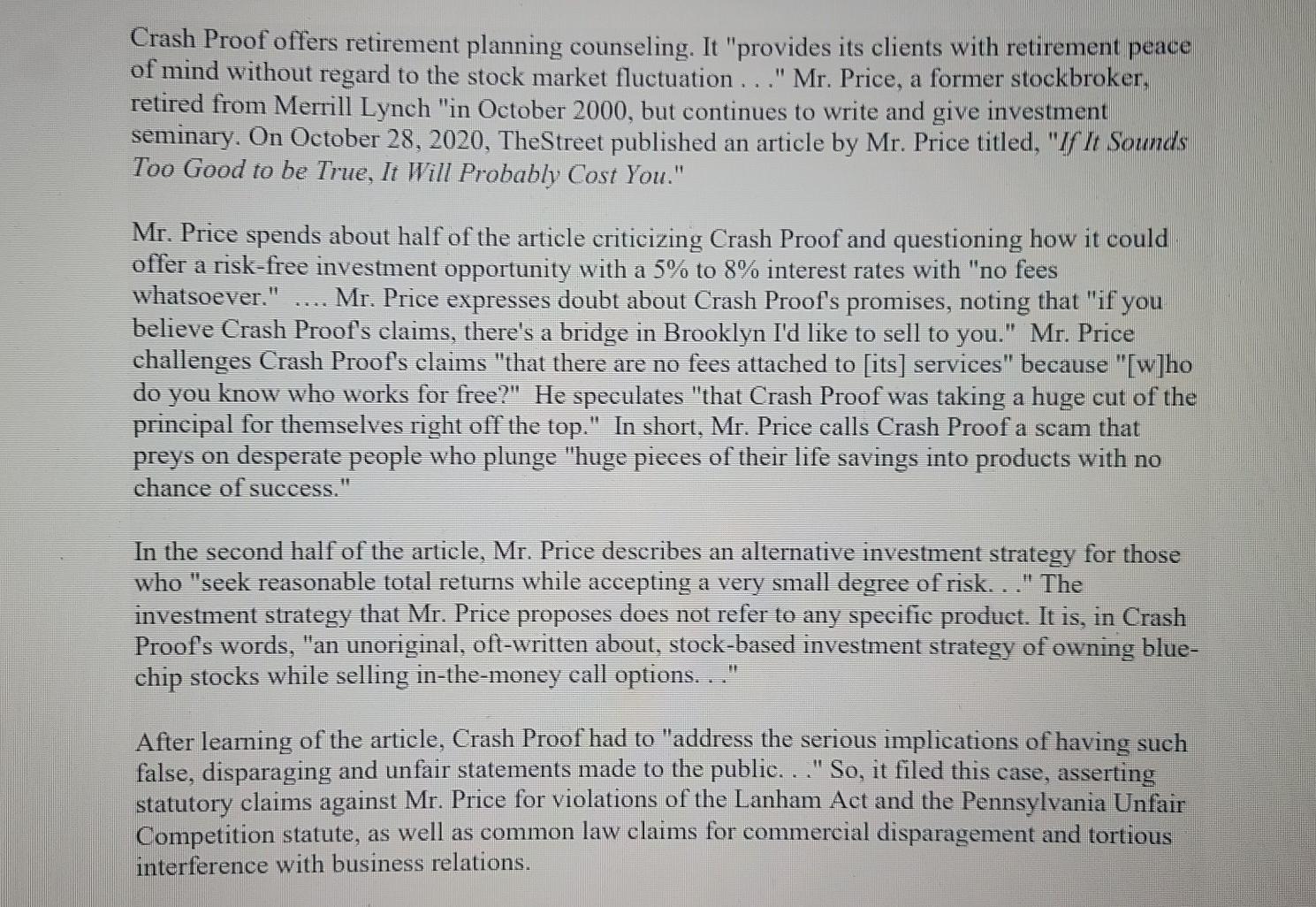
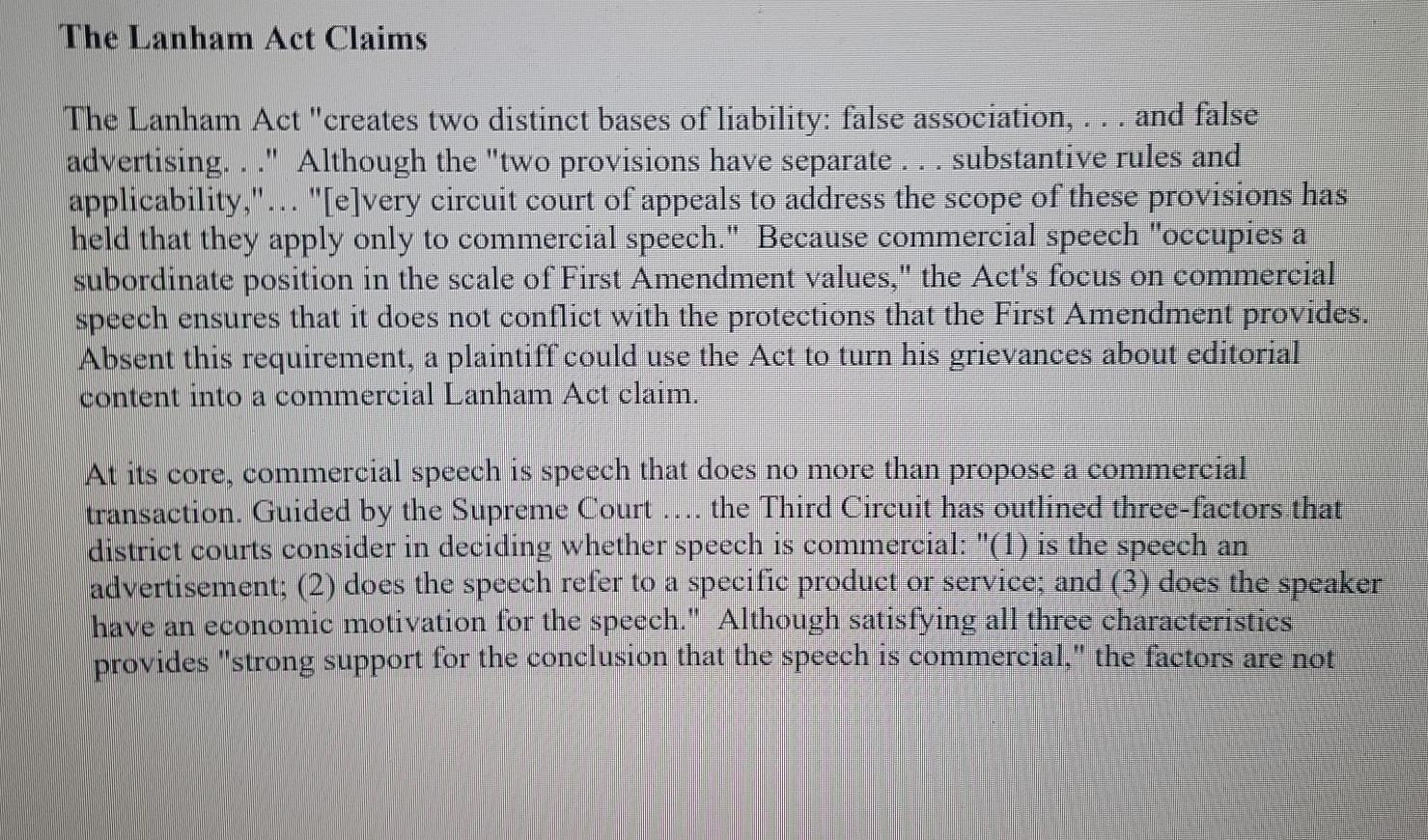
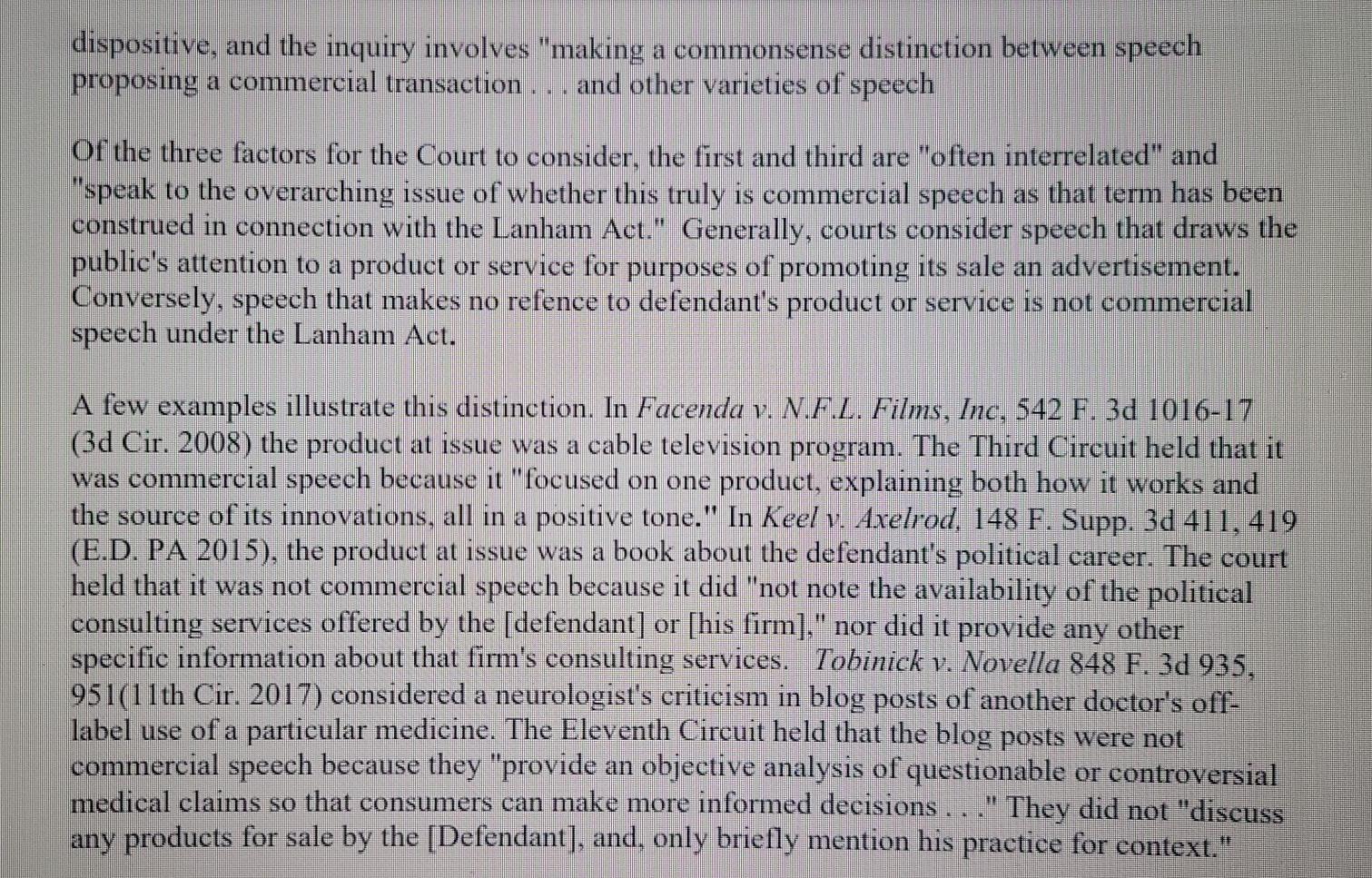
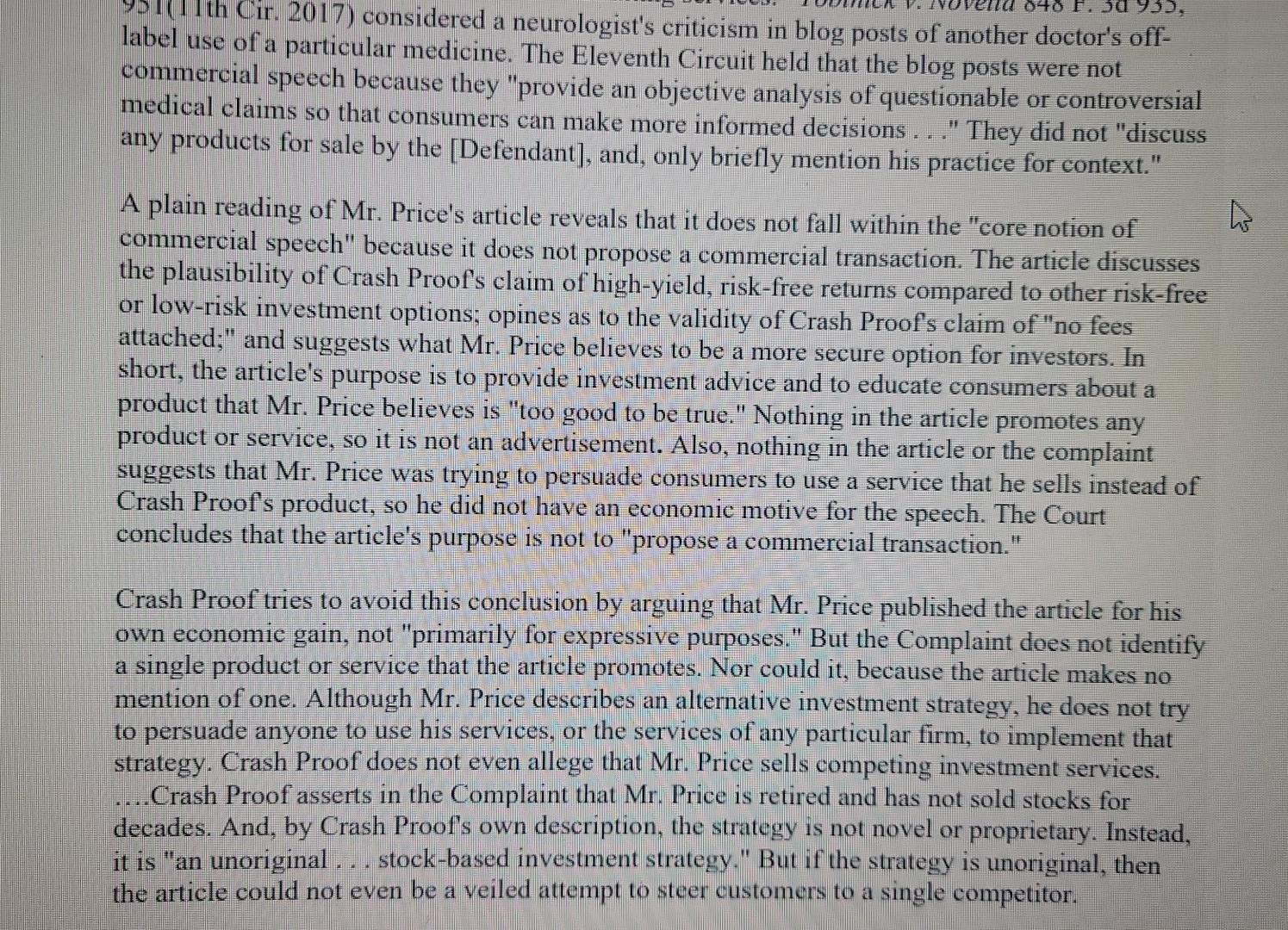
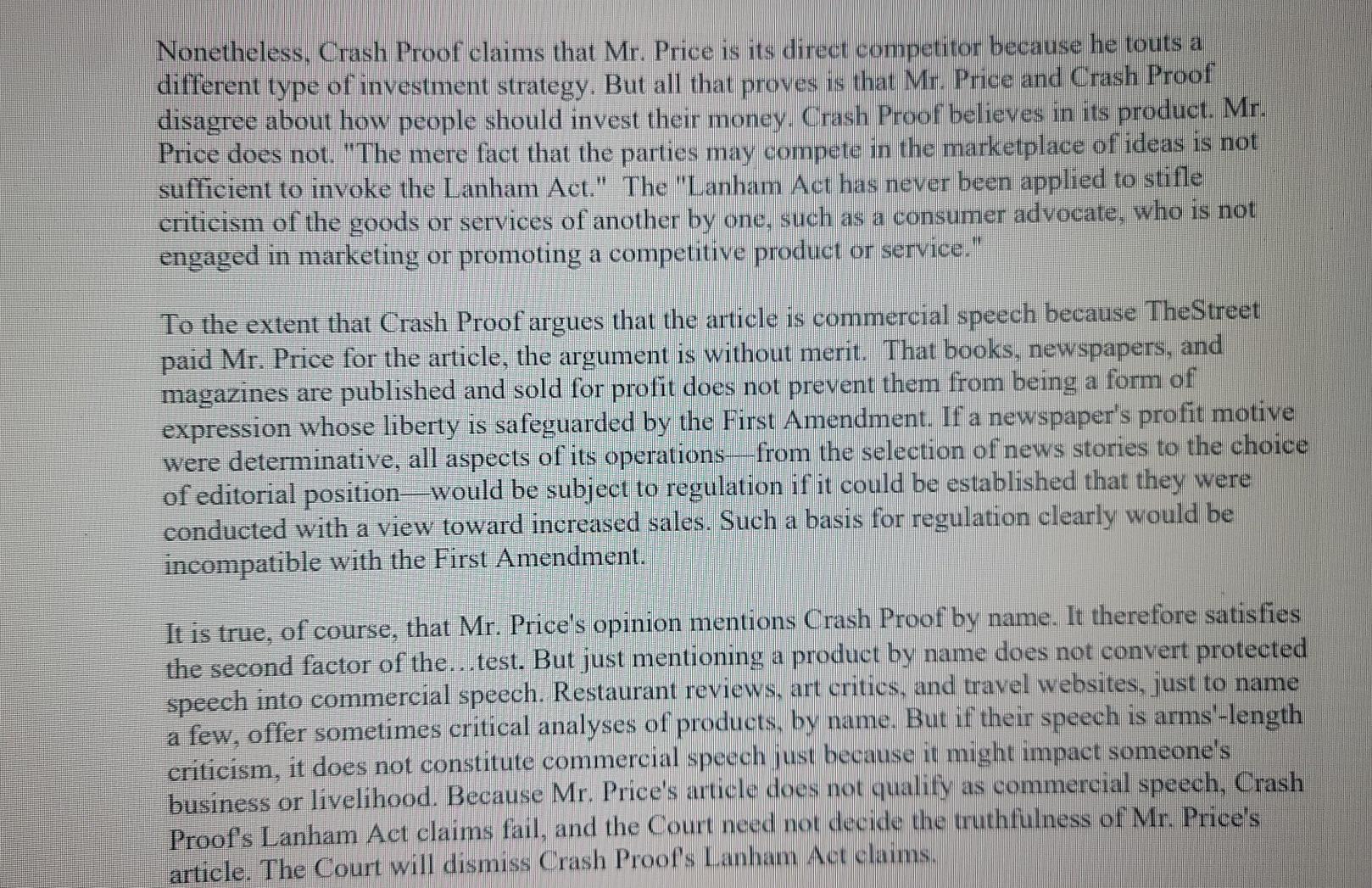
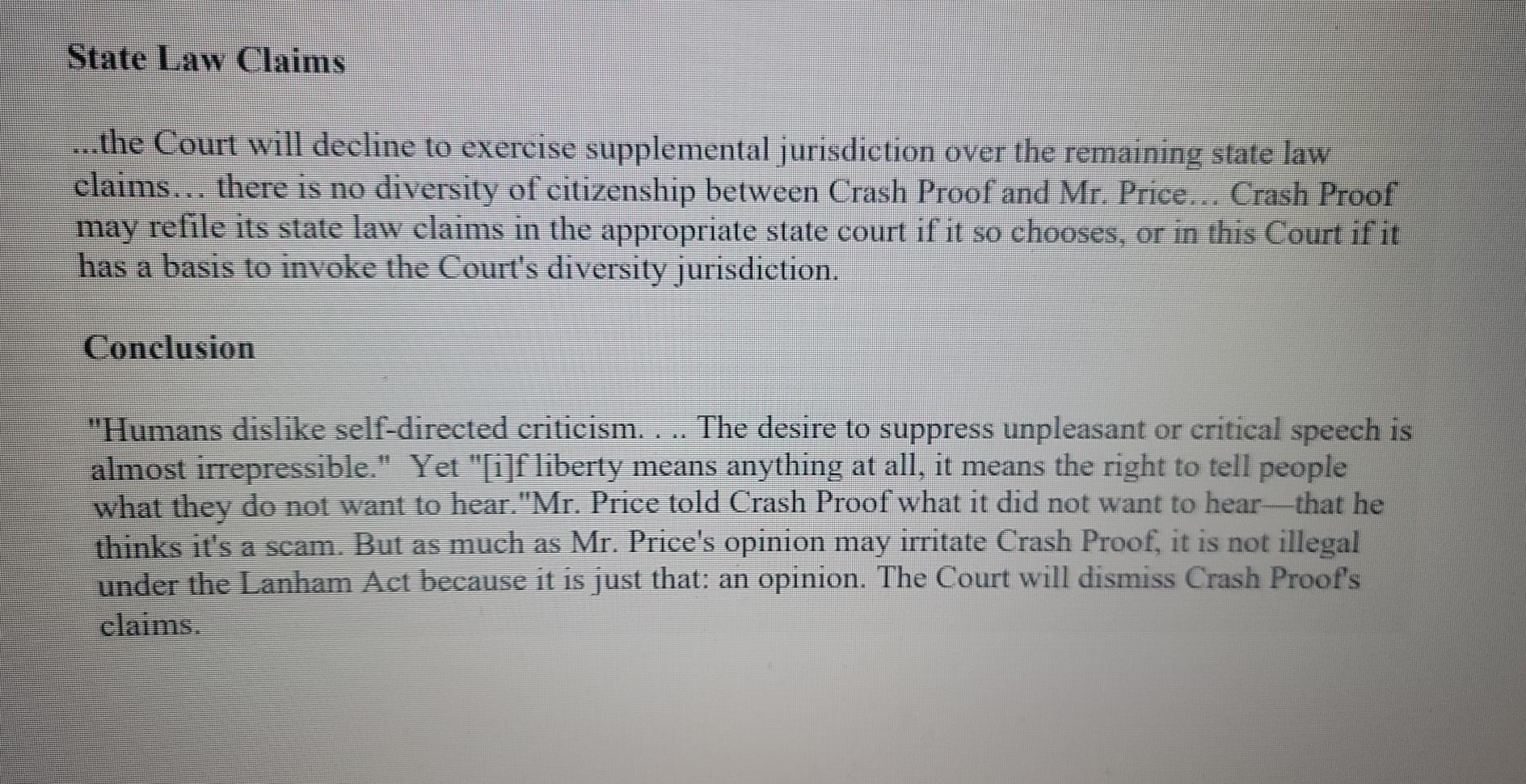

Wolson, J. hate ... If free speech means anything, it means that you do not get to sue people because you don't like their opinion of you. In the immortal words of Taylor Swift, although "haters gonna hate, hate, sometimes you just have to "shake it off." Taylor Swift, Shake It Off, MXM (2014). "Shake it off," however, Crash Proof Retirement did not. Instead, it sued Paul M. Price, claiming, among other things, that Mr. Price violated the Lanham Act by authoring an article that criticized Crash Proof's investment strategy. But the Lanham Act does not regulate critical speech. It regulates commercial speech, which Mr. Price's article is not. The Court will therefore grant Mr. Price's motion to dismiss. Background Crash Proof offers retirement planning counseling. It "provides its clients with retirement peace of mind without regard to the stock market fluctuation..." Mr. Price, a former stockbroker, retired from Merrill Lynch "in October 2000, but continues to write and give investment seminary. On October 28, 2020, TheStreet published an article by Mr. Price titled, "If I Sounds Too Good to be True, It Will Probably Cost You." Mr. Price spends about half of the article criticizing Crash Proof and questioning how it could offer a risk-free investment opportunity with a 5% to 8% interest rates with "no fees whatsoever." Mr. Price expresses doubt about Crash Proof's promises, noting that "if you believe Crash Proof's claims, there's a bridge in Brooklyn I'd like to sell to you." Mr. Price challenges Crash Proof's claims "that there are no fees attached to [its] services" because "[w]ho do you know who works for free?" He speculates that Crash Proof was taking a huge cut of the principal for themselves right off the top." In short, Mr. Price calls Crash Proof a scam that preys on desperate people who plunge "huge pieces of their life savings into products with no chance of success." In the second half of the article, Mr. Price describes an alternative investment strategy for those who "seek reasonable total returns while accepting a very small degree of risk. .." The investment strategy that Mr. Price proposes does not refer to any specific product. It is, in Crash Proof's words, "an unoriginal, oft-written about, stock-based investment strategy of owning blue- chip stocks while selling in-the-money call options...." After learning of the article, Crash Proof had to "address the serious implications of having such false, disparaging and unfair statements made to the public..." So, it filed this case, asserting statutory claims against Mr. Price for violations of the Lanham Act and the Pennsylvania Unfair Competition statute, as well as common law claims for commercial disparagement and tortious interference with business relations. The Lanham Act Claims The Lanham Act "creates two distinct bases of liability: false association, ... and false advertising..." Although the "two provisions have separate ... substantive rules and applicability,"... "[e]very circuit court of appeals to address the scope of these provisions has held that they apply only to commercial speech." Because commercial speech "occupies a subordinate position in the scale of First Amendment values," the Act's focus on commercial speech ensures that it does not conflict with the protections that the First Amendment provides. Absent this requirement, a plaintiff could use the Act to turn his grievances about editorial content into a commercial Lanham Act claim. . At its core, commercial speech is speech that does no more than propose a commercial transaction. Guided by the Supreme Court the Third Circuit has outlined three-factors that district courts consider in deciding whether speech is commercial: "(1) is the speech an advertisement; (2) does the speech refer to a specific product or service; and (3) does the speaker have an economic motivation for the speech." Although satisfying all three characteristics provides 'strong support for the conclusion that the speech is commercial," the factors are not dispositive, and the inquiry involves "making a commonsense distinction between speech proposing a commercial transaction ... and other varieties of speech of the three factors for the Court to consider, the first and third are "often interrelated" and "speak to the overarching issue of whether this truly is commercial speech as that term has been construed in connection with the Lanham Act." Generally, courts consider speech that draws the public's attention to a product or service for purposes of promoting its sale an advertisement. Conversely, speech that makes no refence to defendant's product or service is not commercial speech under the Lanham Act. A few examples illustrate this distinction. In Facenda v. N.F.L. Films, Inc, 542 F.3d 1016-17 (3d Cir. 2008) the product at issue was a cable television program. The Third Circuit held that it was commercial speech because it "focused on one product, explaining both how it works and the source of its innovations, all in a positive tone." In Keel v. Axelrod, 148 F. Supp. 3d 411, 419 (E.D. PA 2015), the product at issue was a book about the defendant's political career. The court held that it was not commercial speech because it did "not note the availability of the political consulting services offered by the [defendant] or [his firm]," nor did it provide any other specific information about that firm's consulting services. Tobinick v. Novella 848 F. 3d 935, 951(11th Cir. 2017) considered a neurologist's criticism in blog posts of another doctor's off- label use of a particular medicine. The Eleventh Circuit held that the blog posts were not commercial speech because they "provide an objective analysis of questionable or controversial medical claims so that consumers can make more informed decisions. They did not "discuss any products for sale by the [Defendant], and, only briefly mention his practice for context." Cir. 2017) considered a neurologist's criticism in blog posts of another doctor's off- label use of a particular medicine. The Eleventh Circuit held that the blog posts were not commercial speech because they provide an objective analysis of questionable or controversial medical claims so that consumers can make more informed decisions..." They did not "discuss any products for sale by the [Defendant), and, only briefly mention his practice for context." A plain reading of Mr. Price's article reveals that it does not fall within the "core notion of commercial speech" because it does not propose a commercial transaction. The article discusses the plausibility of Crash Proof's claim of high-yield, risk-free returns compared to other risk-free or low-risk investment options, opines as to the validity of Crash Proof's claim of "no fees attached;" and suggests what Mr. Price believes to be a more secure option for investors. In short, the article's purpose is to provide investment advice and to educate consumers about a product that Mr. Price believes is "too good to be true." Nothing in the article promotes any product or service, so it is not an advertisement. Also, nothing in the article or the complaint suggests that Mr. Price was trying to persuade consumers to use a service that he sells instead of Crash Proof's product, so he did not have an economic motive for the speech. The Court concludes that the article's purpose is not to "propose a commercial transaction." 1 Crash Proof tries to avoid this conclusion by arguing that Mr. Price published the article for his own economic gain, not "primarily for expressive purposes." But the Complaint does not identify a single product or service that the article promotes. Nor could it, because the article makes no mention of one. Although Mr. Price describes an alternative investment strategy, he does not try to persuade anyone to use his services, or the services of any particular firm, to implement that strategy. Crash Proof does not even allege that Mr. Price sells competing investment services. ....Crash Proof asserts in the Complaint that Mr. Price is retired and has not sold stocks for decades. And, by Crash Proof's own description, the strategy is not novel or proprietary. Instead, it is "an unoriginal ... stock-based investment strategy." But if the strategy is unoriginal, then the article could not even be a veiled attempt to steer customers to a single competitor. Nonetheless, Crash Proof claims that Mr. Price is its direct competitor because he touts a different type of investment strategy. But all that proves is that Mr. Price and Crash Proof disagree about how people should invest their money. Crash Proof believes in its product. Mr. Price does not. "The mere fact that the parties may compete in the marketplace of ideas is not sufficient to invoke the Lanham Act." The "Lanham Act has never been applied to stifle criticism of the goods or services of another by one, such as a consumer advocate, who is not engaged in marketing or promoting a competitive product or service." To the extent that Crash Proof argues that the article is commercial speech because TheStreet paid Mr. Price for the article, the argument is without merit. That books, newspapers, and magazines are published and sold for profit does not prevent them from being a form of expression whose liberty is safeguarded by the First Amendment. If a newspaper's profit motive were determinative, all aspects of its operationsfrom the selection of news stories to the choice of editorial positionwould be subject to regulation if it could be established that they were conducted with a view toward increased sales. Such a basis for regulation clearly would be incompatible with the First Amendment. It is true, of course, that Mr. Price's opinion mentions Crash Proof by name. It therefore satisfies the second factor of the... test. But just mentioning a product by name does not convert protected speech into commercial speech. Restaurant reviews, art critics, and travel websites, just to name a few, offer sometimes critical analyses of products, by name. But if their speech is arms'-length criticism, it does not constitute commercial speech just because it might impact someone's business or livelihood. Because Mr. Price's article does not qualify as commercial speech, Crash Proof's Lanham Act claims fail, and the Court need not decide the truthfulness of Mr. Price's article. The Court will dismiss Crash Proof's Lanham Act claims. State Law Claims ...the Court will decline to exercise supplemental jurisdiction over the remaining state law claims... there is no diversity of citizenship between Crash Proof and Mr. Price... Crash Proof may refile its state law claims in the appropriate state court if it so chooses, or in this Court if it has a basis to invoke the Court's diversity jurisdiction. Conclusion "Humans dislike self-directed criticism. ... The desire to suppress unpleasant or critical speech is almost irrepressible." Yet "[ijf liberty means anything at all, it means the right to tell people what they do not want to hear."Mr. Price told Crash Proof what it did not want to hear--that he thinks it's a scam. But as much as Mr. Price's opinion may irritate Crash Proof, it is not illegal under the Lanham Act because it is just that: an opinion. The Court will dismiss Crash Proof's claims. Brief Crash Proof Retirement v Price utilizing the IRAG methodology that can be found in Appendix A of the course textbook. (approximately one page)
Step by Step Solution
There are 3 Steps involved in it
1 Expert Approved Answer
Step: 1 Unlock

Question Has Been Solved by an Expert!
Get step-by-step solutions from verified subject matter experts
Step: 2 Unlock
Step: 3 Unlock