







Question: WORK ARLA Assume that is a variable that has been declared as a double and been given a value. Write an expression to compute the
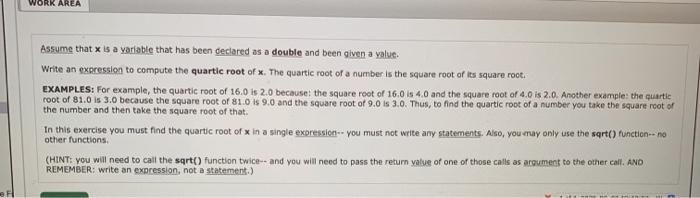
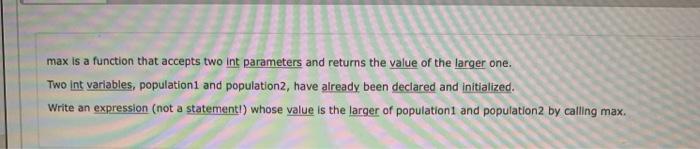

WORK ARLA Assume that is a variable that has been declared as a double and been given a value. Write an expression to compute the quartie root of . The quartic root of a number is the square root of its square root. EXAMPLES: For example, the quartic root of 16.0 is 2.0 because the square root of 16.0 s 4.0 and the square root of 4.0 is 2.0. Another example: the quartie root of 81.0 ls 3.0 because the square root of 81.0 is 9.0 and the square root of 9.0 is 3.0. Thus, to find the quartic root of a number you take the square root of the number and then take the square root of that. In this exercise you must find the quartic root of in a single expression -- you must not write any statements. Also, you may only use the sart() function - no other functions (HINT: you will need to call the sqrt() function twice- and you will need to pass the return value of one of those calls as argument to the other call. AND REMEMBER: write an expression, not a statement.) max is a function that accepts two int parameters and returns the value of the larger one. Two int variables, populations and population, have already been declared and initialized. Write an expression (not a statement!) whose value is the larger of population and population by calling max. Write the definition of a function half, which receives an integer parameter and returns an integer that is half the value of the parameter. (Use integer division) So if the parameter's value is 7, the function returns the value 3. If the parameter's value happens to be 44, the functions retums the value 22 9
Step by Step Solution
There are 3 Steps involved in it

Get step-by-step solutions from verified subject matter experts
 Study Help