







Question: work does need to be shown You are the analyst for a Pistol Pete's Pizza Palace, a restaurant that is thinking of expanding their business
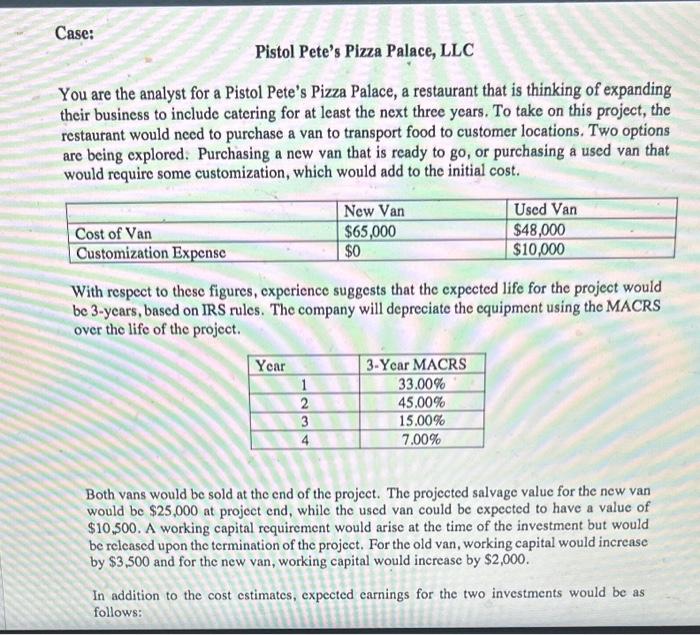
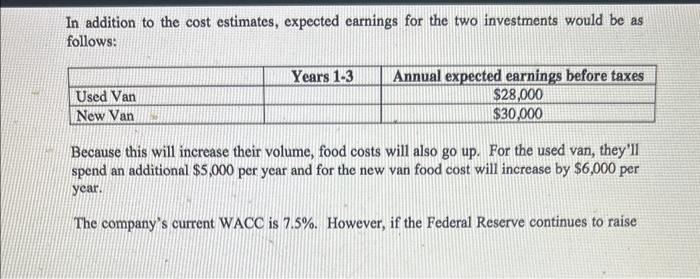
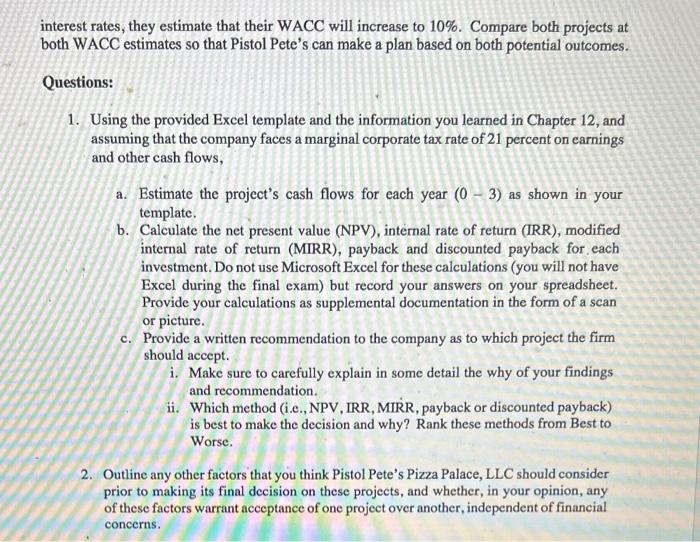
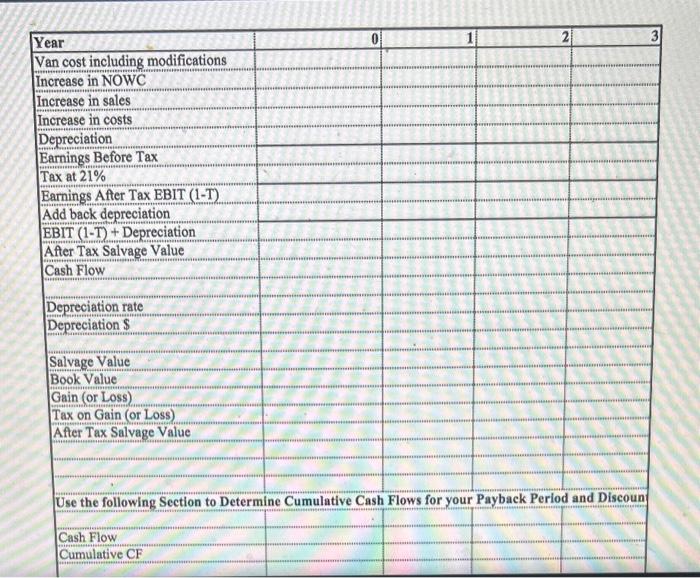
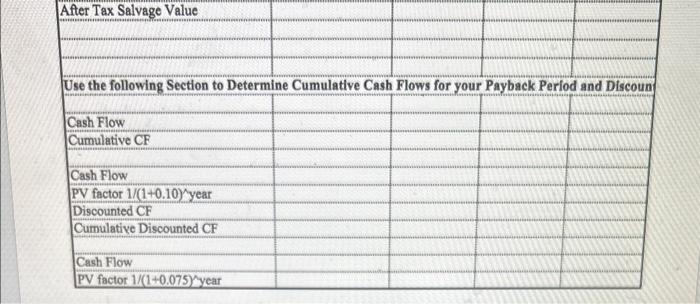
You are the analyst for a Pistol Pete's Pizza Palace, a restaurant that is thinking of expanding their business to include catering for at least the next three years. To take on this project, the restaurant would need to purchase a van to transport food to customer locations. Two options are being explored. Purchasing a new van that is ready to go, or purchasing a used van that would require some customization, which would add to the initial cost. With respect to these figures, experience suggests that the expected life for the project would be 3-years, based on IRS rules. The company will depreciate the equipment using the MACRS over the life of the project. Both vans would be sold at the end of the project. The projected salvage value for the new van would be $25,000 at project end, while the used van could be expected to have a value of $10,500. A working capital requirement would arise at the time of the investment but would be released upon the termination of the project. For the old van, working capital would increase by $3,500 and for the new van, working capital would increase by $2,000. In addition to the cost estimates, expected earnings for the two investments would be as follows: In addition to the cost estimates, expected earnings for the two investments would be as follows: Because this will increase their volume, food costs will also go up. For the used van, they'll spend an additional $5,000 per year and for the new van food cost will increase by $6,000 per year. The company's current WACC is 7.5\%. However, if the Federal Reserve continues to raise erest rates, they estimate that their WACC will increase to 10%. Compare both projects at th WACC estimates so that Pistol Pete's can make a plan based on both potential outcomes. lestions: 1. Using the provided Excel template and the information you learned in Chapter 12, and assuming that the company faces a marginal corporate tax rate of 21 percent on earnings and other cash flows, a. Estimate the project's cash flows for each year (03) as shown in your template. b. Calculate the net present value (NPV), internal rate of return (IRR), modified internal rate of return (MIRR), payback and discounted payback for each investment. Do not use Microsoft Excel for these calculations (you will not have Excel during the final exam) but record your answers on your spreadsheet. Provide your calculations as supplemental documentation in the form of a scan or picture. c. Provide a written recommendation to the company as to which project the firm should accept. i. Make sure to carefully explain in some detail the why of your findings and recommendation. ii. Which method (i.e., NPV, IRR, MIRR, payback or discounted payback) is best to make the decision and why? Rank these methods from Best to Worse. 2. Outline any other factors that you think Pistol Pete's Pizza Palace, LLC should consider prior to making its final decision on these projects, and whether, in your opinion, any of these factors warrant acceptance of one project over another, independent of financial concerns. \begin{tabular}{|l|l|l|l|l|} \hline Year & & & \\ \hline Van cost including modifications & & & \\ \hline Increase in NOWC & & & \\ \hline Increase in sales & & & \\ \hline Increase in costs & & & \\ \hline Depreciation & & & \\ \hline Earnings Before Tax & & & \\ \hline Tax at 21\% & & & \\ \hline Earnings After Tax EBIT (1-T) & & & \\ \hline Add back depreciation & & & \\ \hline EBIT (1-T) + Depreciation & & & \\ \hline After Tax Salvage Value & & & \\ \hline Cash Flow & & & \\ \hline & & & \\ \hline Depreciation rate & & & \\ \hline Depreciation \$ & & & \\ \hline Salvage Value & & & \\ \hline Book Value & & & \\ \hline Gain (or Loss) \\ \hline Tax on Gain (or Loss) & & & \\ \hline After Tax Salvage Value & & & \\ \hline \end{tabular} After Tax Salvage Value Use the following Section to Determine Cumulative Cash Flows for your Payback Period and Discoun Cash Flow Cumulative CF Cash Flow PV factor 1/(1+0.10)4 year Discounted CF Cumulative Discounted CF Cash Flow PV factor 1/(1+0.075) year
Step by Step Solution
There are 3 Steps involved in it

Get step-by-step solutions from verified subject matter experts
 Study Help