







Question: WORK, POWER, AND ENERGY-Practice Exercises 10. A system containing a frictionless pulley is illustrated in the diagram. If this system is released, at what
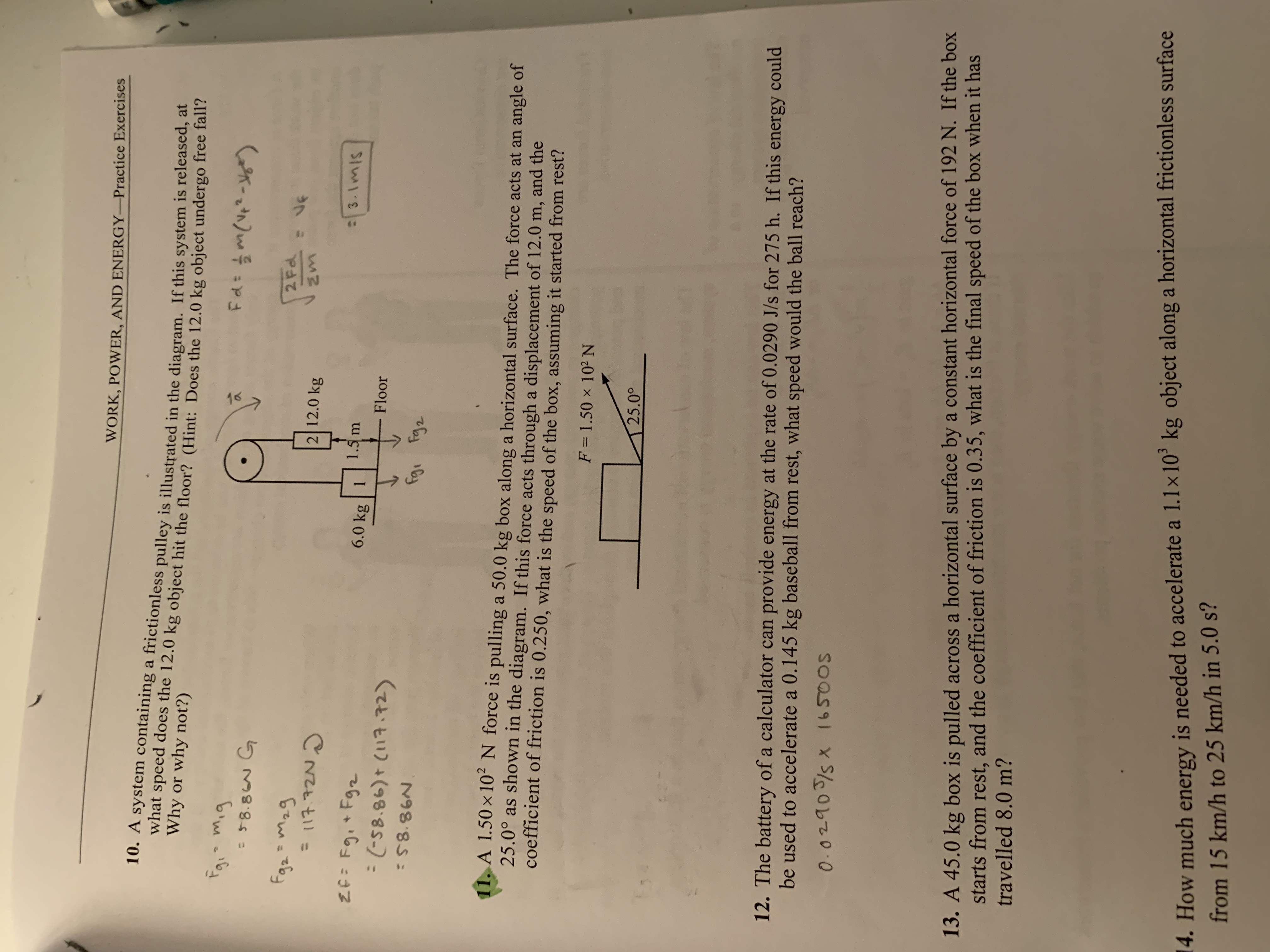
WORK, POWER, AND ENERGY-Practice Exercises 10. A system containing a frictionless pulley is illustrated in the diagram. If this system is released, at what speed does the 12.0 kg object hit the floor? (Hint: Does the 12.0 kg object undergo free fall? Why or why not?) Fg = mig = 58.86 G Fg = mg Fd: m (4+-16+) 2Fd M = VF 2 12.0 kg 1.5 m Ef = Fg, + Fgz 6.0 kg 1 Floor = (-58.86) + (117.72) =58.864 Fg, Fg = 117.72NJ 3.1m/s A 1.50102 N force is pulling a 50.0 kg box along a horizontal surface. The force acts at an angle of 25.0 as shown in the diagram. If this force acts through a displacement of 12.0 m, and the coefficient of friction is 0.250, what is the speed of the box, assuming it started from rest? F = 1.50 10 N 25.0 12. The battery of a calculator can provide energy at the rate of 0.0290 J/s for 275 h. If this energy could be used to accelerate a 0.145 kg baseball from rest, what speed would the ball reach? 0.02905/5 x 16500S 13. A 45.0 kg box is pulled across a horizontal surface by a constant horizontal force of 192 N. If the box starts from rest, and the coefficient of friction is 0.35, what is the final speed of the box when it has travelled 8.0 m? 4. How much energy is needed to accelerate a 1.110 kg object along a horizontal frictionless surface from 15 km/h to 25 km/h in 5.0 s?
Step by Step Solution
There are 3 Steps involved in it

Get step-by-step solutions from verified subject matter experts
 Study Help