







Question: Working through JOINS I have written notes on working through joins that I have included in your course in D2L. A link to these notes
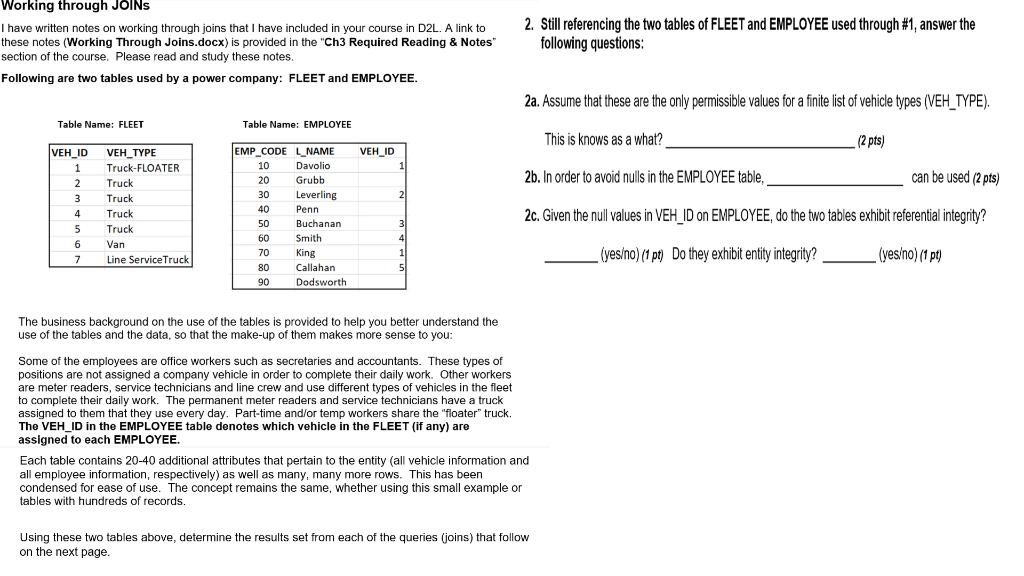
Working through JOINS I have written notes on working through joins that I have included in your course in D2L. A link to these notes (Working Through Joins.docx) is provided in the "Ch3 Required Reading & Notes section of the course. Please read and study these notes. Following are two tables used by a power company: FLEET and EMPLOYEE. 2. Still referencing the two tables of FLEET and EMPLOYEE used through #1, answer the following questions: 2a. Assume that these are the only permissible values for a finite list of vehicle types (VEH_TYPE). Table Name: FLEET Table Name: EMPLOYEE This is knows as a what? ? (2 pts) VEH_ID 1 2b. In order to avoid nulls in the EMPLOYEE table, can be used (2 pts) VEHID 1 2 3 3 4 5 21 VEH_TYPE Truck-FLOATER Truck Truck Truck Truck Van Line Service Truck EMP CODE NAME 10 Davolio 20 Grubb 30 Leverling 40 Penn 50 Buchanan 60 Smith 70 King 80 Callahan 90 Dodsworth 2c. Given the null values in VEH_ID on EMPLOYEE, do the two tables exhibit referential integrity? 6 3 4 1 5 7 (yeso) (1 pt) Do they exhibit entity integrity? (yeso) (1 pt) The business background on the use of the tables is provided to help you better understand the use of the tables and the data, so that the make-up of them makes more sense to you: Some of the employees are office workers such as secretaries and accountants. These types of positions are not assigned a company vehicle in order to complete their daily work. Other workers are meter readers, service technicians and line crew and use different types of vehicles in the fleet to complete their daily work. The permanent meter readers and service technicians have a truck assigned to them that they use every day. Part-time and/or temp workers share the "floater truck. The VEH_ID in the EMPLOYEE table denotes which vehicle in the FLEET (if any) are assigned to each EMPLOYEE. Each table contains 20-40 additional attributes that pertain to the entity (all vehicle information and all employee information, respectively) as well as many, many more rows. This has been condensed for ease of use. The concept remains the same, whether using this small example or tables with hundreds of records. Using these two tables above, determine the results set from each of the queries (joins) that follow on the next page
Step by Step Solution
There are 3 Steps involved in it

Get step-by-step solutions from verified subject matter experts
 Study Help