







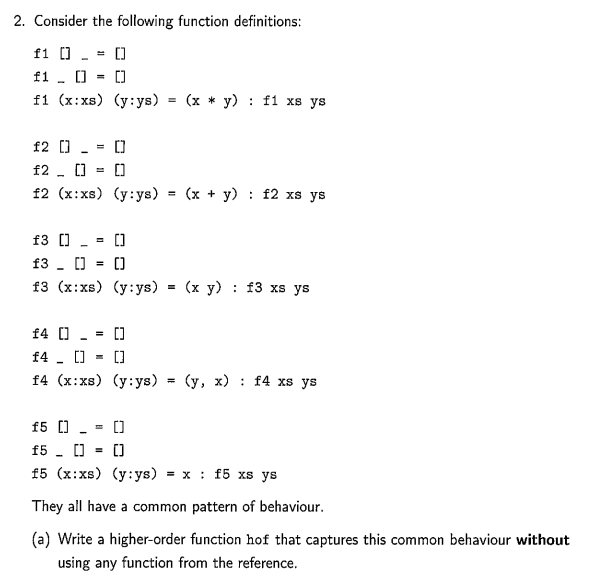
Question: Would it be possible for someone to explain the answer also please. Thank you 2. Consider the following function definitions f1 (x:xs) (y:ys) - (x
Would it be possible for someone to explain the answer also please. Thank you
2. Consider the following function definitions f1 (x:xs) (y:ys) - (x * y) : f1 xs ys f2 (x:xs) (y:ys) - (x + y) : f2 xs ys f3 (x:xs) (y:ys) - (x y) : f3 xs ys f4 (x:xs) (y:ys) (y, x) f4 xs ys = : f5 (x:xs) (y:ys) - x : f5 xs ys They all have a common pattern of behaviour (a) Write a higher-order function hof that captures this common behaviour without using any function from the reference 2. Consider the following function definitions f1 (x:xs) (y:ys) - (x * y) : f1 xs ys f2 (x:xs) (y:ys) - (x + y) : f2 xs ys f3 (x:xs) (y:ys) - (x y) : f3 xs ys f4 (x:xs) (y:ys) (y, x) f4 xs ys = : f5 (x:xs) (y:ys) - x : f5 xs ys They all have a common pattern of behaviour (a) Write a higher-order function hof that captures this common behaviour without using any function from the reference
Step by Step Solution
There are 3 Steps involved in it

Get step-by-step solutions from verified subject matter experts
 Study Help