







Question: Would you be so kind to help me solve problems from section a to c, please? 5. (Obj. 3.3) The data in the table shows
Would you be so kind to help me solve problems from section a to c, please?
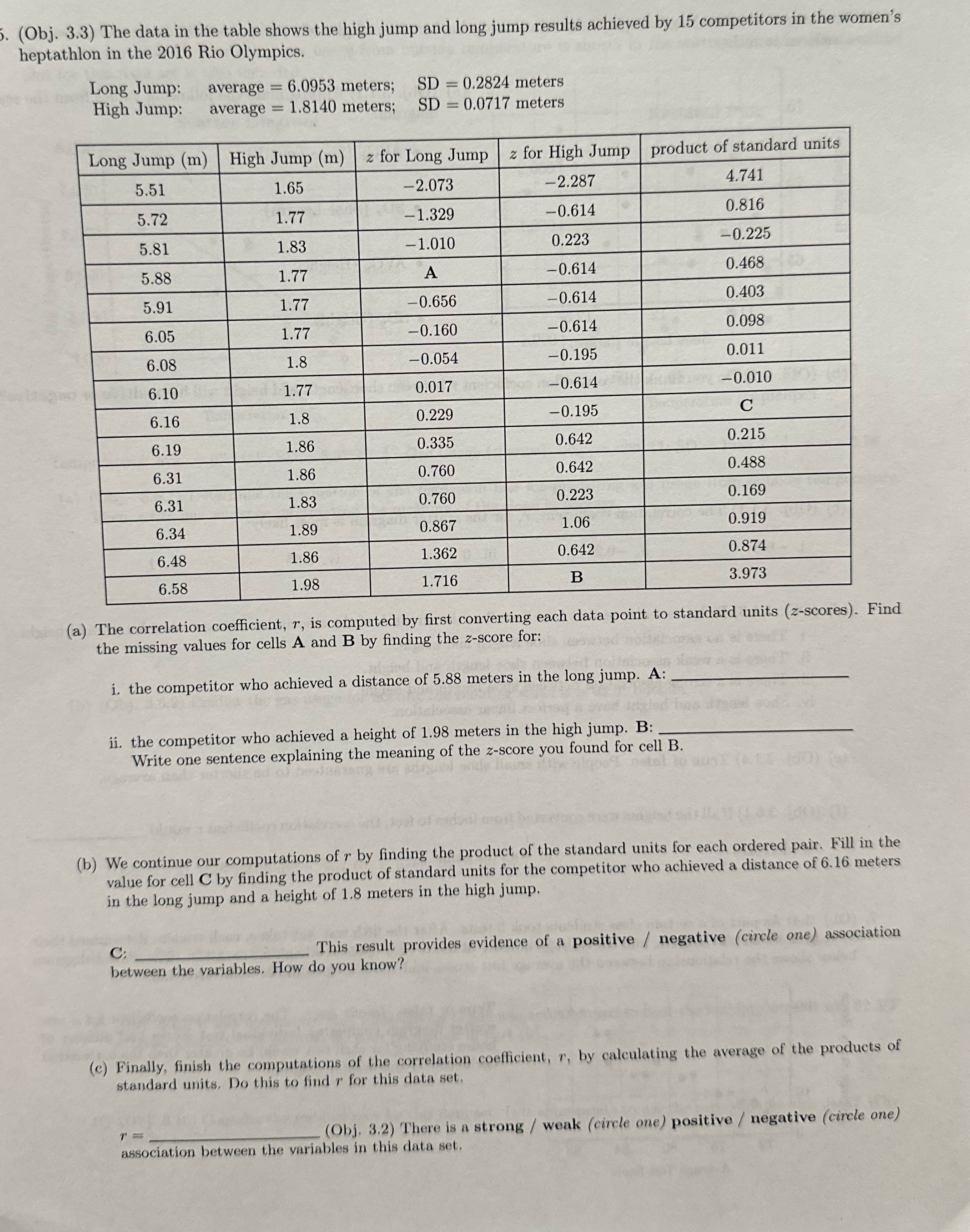
5. (Obj. 3.3) The data in the table shows the high jump and long jump results achieved by 15 competitors in the women''s heptathlon in the 2016 Rio Olympics. ang Jump: average = 6.0953 meters; SD = (0.2824 meters High Jump: average = 1.8140 meters; SD = 0.0717 meters Long Jump (m) | High Jump (m) | z for Long Jump | 2 for High Jump | product of standard units -lo:%ase e (a) The correlation coefficient, 7, is computed by first converting each data point to standard units (z-scores). Find the missing values for cells A and B by finding the z-score for: i. the competitor who achieved a distance of 5.88 meters in the long jump. A: ii. the competitor who achieved a height of 1.98 meters in the high jump. B: Write one sentence explaining the meaning of the z-score you found for cell B. (b) We continue our computations of 7 by finding the product of the standard units for each ordered pair. Fill in the value for cell C by finding the product of standard units for the competitor who achieved a distance of 6.16 meters in the long jump and a height of 1.8 meters in the high jump. C; This result provides evidence of a positive / negative (circle one) association between the variables. How do you know? (c) Finally, finish the computations of the correlation coefficient, , by calculating the average of the products of standard units, Do this to find r for this data set. P = (Obj. 8.2) There is o strong / weak (cirele one) positive / negative (circle one) association between the variables in this data set
Step by Step Solution
There are 3 Steps involved in it

Get step-by-step solutions from verified subject matter experts
 Study Help