







Question: Would you mind explaining how to answer these questions? Thank you! Answer the following questions: a. Consider the model yr = o + ,81351 +
Would you mind explaining how to answer these questions? Thank you!
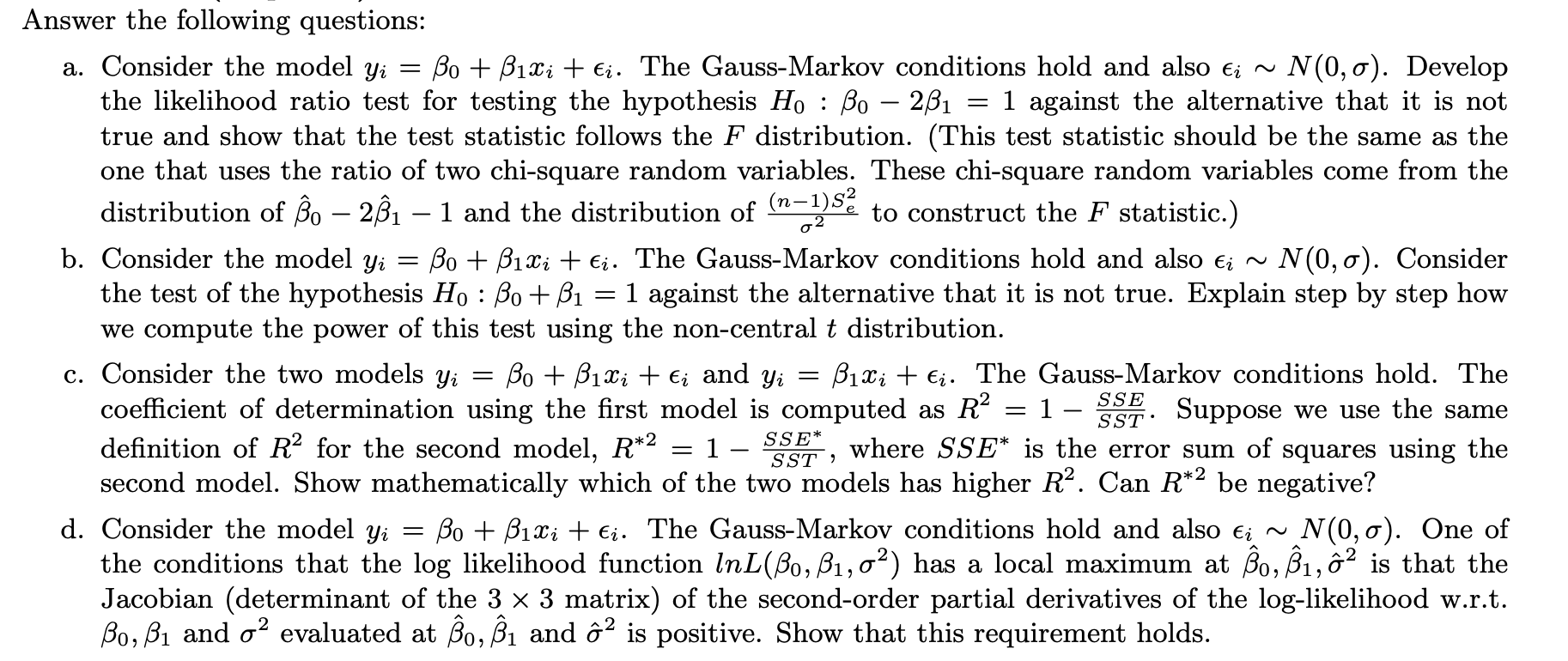
Answer the following questions: a. Consider the model yr = o + ,81351 + 6;. The Gauss-Markov conditions hold and also er N N (O, 0). Develop the likelihood ratio test for testing the hypothesis Ho : [30 231 = 1 against the alternative that it is not true and show that the test statistic follows the F distribution. (This test statistic should be the same as the one that uses the ratio of two chi-square random variables. These chi-square random variables come from the A A 2 distribution of g 2,81 1 and the distribution of (\"jgi to construct the F statistic.) b. Consider the model yr 2 )60 + lm + 6;. The Gauss-Markov conditions hold and also 6.- N N (O, 0). Consider the test of the hypothesis Ho : ,80 + l = 1 against the alternative that it is not true. Explain step by step how we compute the power of this test using the non-central t distribution. c. Consider the two models y.- = g + lm + e. and 311- = 51:61- + 6;. The Gauss-Markov conditions hold. The coeicient of determination using the rst model is computed as R2 = 1 %. Suppose we use the same denition of R2 for the second model, 13*2 = 1 555$? , where SSE* is the error sum of squares using the second model. Show mathematically which of the two models has higher R2. Can R"2 be negative? (1. Consider the model yr 2 e + wi + 61'. The GaussMarkov conditions hold and also 61; ~AN(0,0). One of the conditions that the log likelihood function lnL(o,[31,a'2) has a local maximum at g, ,81,&2 is that the Jacobian (determinant of the I): X 3 matrix) of the second-order partial derivatives of the log-likelihood W.r.t. g, ll and 02 evaluated at 50,161 and (32 is positive. Show that this requirement holds
Step by Step Solution
There are 3 Steps involved in it

Get step-by-step solutions from verified subject matter experts
 Study Help