Question: Write 9 Sentences For Your Response: Do you agree or disagree with the Lucy v. Zehmer case? *** CLASSSIC CASE 8.2 *** Lucy v. Zehmer
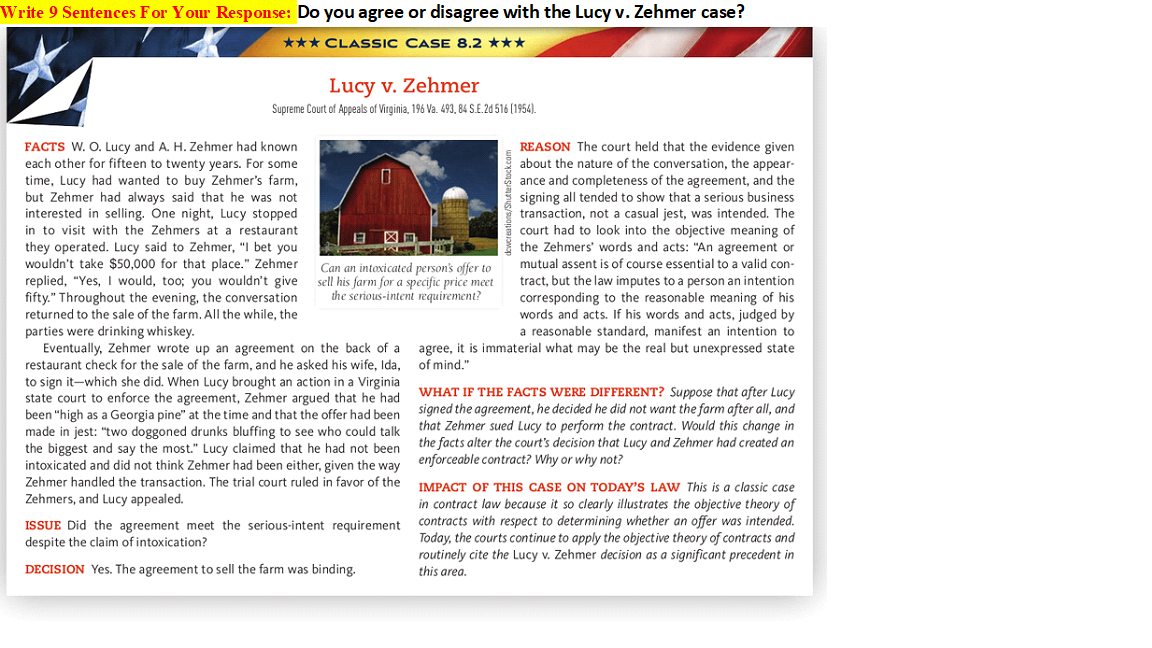
Write 9 Sentences For Your Response: Do you agree or disagree with the Lucy v. Zehmer case? *** CLASSSIC CASE 8.2 *** Lucy v. Zehmer Supreme Court of Appeals of Virginia, 196 Va. 493, 84 S.E.2d 516 (1954). FACTS W. O. Lucy and A. H. Zehmer had known each other for fifteen to twenty years. For some time, Lucy had wanted to buy Zehmer's farm, but Zehmer had always said that he was not interested in selling. One night, Lucy stopped in to visit with the Zehmers at a restaurant REASON The court held that the evidence given about the nature of the conversation, the appear- ance and completeness of the agreement, and the signing all tended to show that a serious business transaction, not a casual jest, was intended. The court had to look into the objective meaning of the Zehmers' words and acts: "An agreement or they operated. Lucy said to Zehmer, "I bet you wouldn't take $50,000 for that place." Zehmer replied, "Yes, I would, too; you wouldn't give fifty." Throughout the evening, the conversation returned to the sale of the farm. All the while, the mutual assent is of course essential to a valid con- Can an intoxicated person's offer to sell his farm for a specific price meet the serious-intent requirement? tract, but the law imputes to a person an intention corresponding to the reasonable meaning of his words and acts. If his words and acts, judged by a reasonable standard, manifest an intention to parties were drinking whiskey. Eventually, Zehmer wrote up an agreement on the back of a restaurant check for the sale of the farm, and he asked his wife, Ida, to sign it-which she did. When Lucy brought an action in a Virginia state court to enforce the agreement, Zehmer argued that he had been "high as a Georgia pine" at the time and that the offer had been made in jest: "two doggoned drunks bluffing to see who could talk the biggest and say the most." Lucy claimed that he had not been intoxicated and did not think Zehmer had been either, given the way Zehmer handled the transaction. The trial court ruled in favor of the agree, it is immaterial what may be the real but unexpressed state of mind." WHAT IF THE FACTS WERE DIFFERENT? Suppose that after Lucy signed the agreement, he decided he did not want the farm after all, and that Zehmer sued Lucy to perform the contract. Would this change in the facts alter the court's decision that Lucy and Zehmer had created an enforceable contract? Why or why not? IMPACT OF THIS CASE ON TODAY'S LAW This is a classic case Zehmers, and Lucy appealed. in contract law because it so clearly illustrates the objective theory of contracts with respect to determining whether an offer was intended. Today, the courts continue to apply the objective theory of contracts and routinely cite the Lucy v. Zehmer decision as a significant precedent in this area. ISSUE Did the agreement meet the serious-intent requirement despite the claim of intoxication? DECISION Yes. The agreement to sell the farm was binding









 Study Help