



Question: write a 2 page summary of the case! and answer these questions. at the bottom. 9B14M079 Ivey Publishing MAPLE TREE ACCESSORY SHOP Version 2014-09-22 Yurant
write a 2 page summary of the case! and answer these questions. 
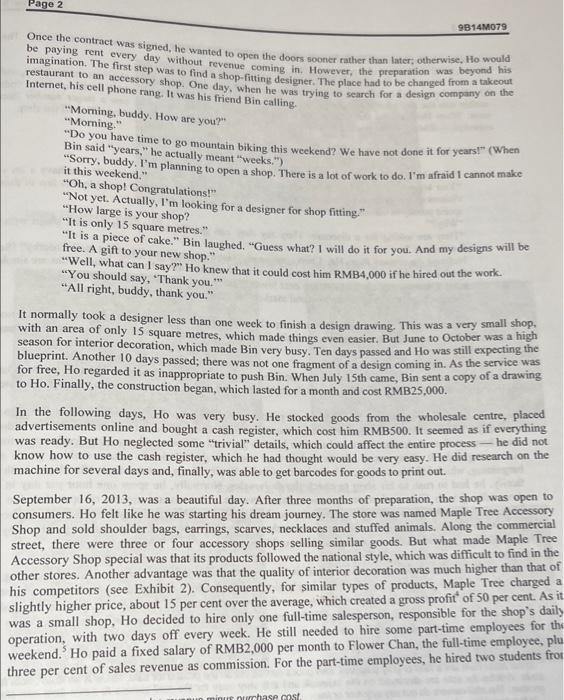
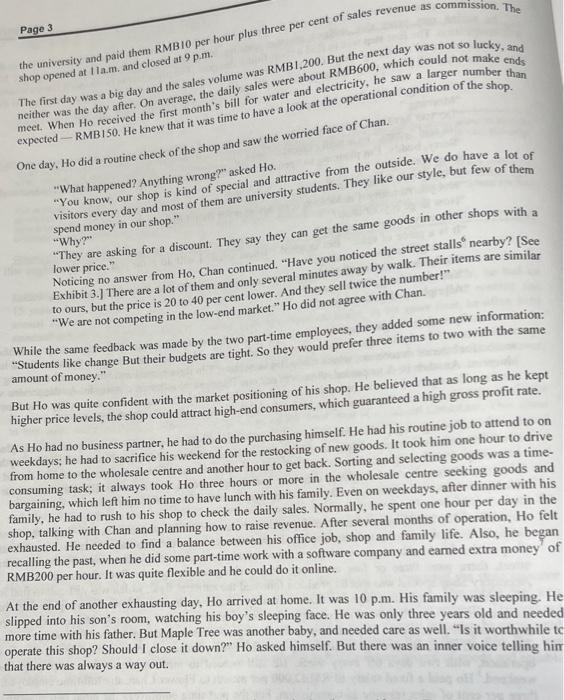
9B14M079 Ivey Publishing MAPLE TREE ACCESSORY SHOP Version 2014-09-22 Yurant Zong and wrote this caserole to provide materia for class discussion. The authors do not intend to strate her effective or infective hand of a managerial som The authors may have disguised certain names and other Antig information to protect confidential This publication may not be transmitted photocopied digired or otherwise mooduced in any form or by any means without the organization. To order copies or request permission to reproduce materials contact Ivey Publishing. Ivey Business School Westem con of the copyright holder Reproduction of this material is not covered under authorization by any reproduction nights University London Ontano Garade NEGOVT (0) 519 661 3208(e) cases@veyca www.veycases.com Copyr.2014 Richard ney School of Business Foundation In 2013, in Canton, South China, Ivon Ho had been working for a large-scale state-owned enterprise for 15 years. As a manager of the channel management office in the firm's marketing sector, he had an annual income of about RMB240,000.- Working for a state-owned enterprise was quite routine and standardized, so it did not fit with his personal style. He loved challenge. In his spare time, he often wend hiking with a group of outdoorsmen who explored mountains rarely visited by humans. However, he needed money to pay for his mortgage and his son's education. This was a full-time job, and he had to go to work at 8 a.m. and would arrive home around 7p.m. Obviously, he worked very hard. However, Starting his own business had always been Ho's dream. He had been waiting for a chance. It was a summer afternoon when Ho got back from work and went to a commercial street near his home to buy some daily necessities. He saw a shop notice on the front door of a takeout restaurant. This street was adjacent to a university with more than 12,000 students. It was nearly 200 metres long and was lined with small businesses, most of which were small shops with an area of 10 to 40 square metres, selling food, -clothing, Stationery and accessories. Among them were an economy-priced hotel and two convenience stores (see Exhibit 1).The closest large shopping mall was over 20 minutes away by car, which made the commercial street very busy, especially at mealtimes, when students were eating out. The operator of the takeout restaurant was a third-year student at the university. She had been running the store for more than a year and the profit was respectable, averaging RMB25,000 per month. However, she wanted to spend more time on her thesis writing, as she would become a senior in September. Thus, she wanted to sublet the store to someone else. Ho recognized this as a good opportunity, which could not be missed. He contacted the store operator immediately. After several rounds of discussions, they signed a sublet contract. The sublet fee was RMB58,000. On June 15, 2013, he also signed a rent contract with the owner of the property. The rent per month was RMB3,300 and the due date was June 14, 2015. As Ho was a channel manager, he considered his background to be an advantage in operating an accessory shop. He believed that the key characteristics of running a successful accessory shop were to have a decent source of goods and reliable purchasing channels. tml the market channels of the enterprise. Page 2 9B14M079 Once the contract was signed, he wanted to open the doors sooner rather than later, otherwise, Ho would restaurant to accessory shop. One day, when he was trying to search for a design company on the . Internet, his cell phone rang. It was his friend Bin calling, "Moming, buddy. How are you?" "Moming." "Do you have time to go mountain biking this weekend? We have not done it for years!" (When Bin said "years," he actually meant "weeks.") Sorry, buddy. I'm planning to open a shop. There is a lot of work to do. I'm afraid I cannot make it this . "Oh, a shop! Congratulations!" "Not yet. Actually, I'm looking for a designer for shop fitting." "How large is your shop? "It is only 15 square metres." "It is a piece of cake." Bin laughed. Guess what? I will do it for you. And my designs will be free. A gift to your new shop." "Well, what can I say?" Ho knew that it could cost him RMB4,000 if he hired out the work "You should say, "Thank you." "All right, buddy, thank you." It normally took a designer less than one week to finish a design drawing. This was a very small shop, with an area of only 15 square metres, which made things even easier. But June to October was a high season for interior decoration, which made Bin very busy. Ten days passed and Ho was still expecting the blueprint. Another 10 days passed, there was not one fragment of a design coming in. As the service was for free, Ho regarded it as inappropriate to push Bin. When July 15th came, Bin sent a copy of a drawing to Ho. Finally, the construction began, which lasted for a month and cost RMB25,000. In the following days, Ho was very busy. He stocked goods from the wholesale centre, placed advertisements online and bought a cash register, which cost him RMB500. It seemed as if everything was ready. But Ho neglected some "trivial" details, which could affect the entire process - he did not know how to use the cash register, which he had thought would be very easy. He did research on the machine for several days and, finally, was able to get barcodes for goods to print out. September 16, 2013, was a beautiful day. After three months of preparation, the shop was open to consumers. Ho felt like he was starting his dream journey. The store was named Maple Tree Accessory Shop and sold shoulder bags, earrings, scarves, necklaces and stuffed animals. Along the commercial street, there were three or four accessory shops selling similar goods. But what made Maple Tree Accessory Shop special was that its products followed the national style, which was difficult to find in the other stores. Another advantage was that the quality of interior decoration was much higher than that of his competitors (see Exhibit 2). Consequently, for similar types of products, Maple Tree charged a slightly higher price, about 15 per cent over the average, which created a gross profit of 50 per cent. As it was a small shop. Ho decided to hire only one full-time salesperson, responsible for the shop's daily operation, with two days off every week. He still needed to hire some part-time employees for the weekend.' Ho paid a fixed salary of RMB2,000 per month to Flower Chan, the full-time employee, plu three per cent of sales revenue as commission. For the part-time employees, he hired two students from minue nunhase cost Page 3 the university and paid them RMBIO per hour plus three per cent of sales revenue as commission. The shop opened at llamand closed at 9p.m. The first day was a big day and the sales volume was RMB1,200, But the next day was not so lucky, and neither was the day after. On average, the daily sales were about RMB600, which could not make ends meet. When Ho received the first month's bill for water and electricity, he saw a larger number than expected - RMB 150. He knew that it was time to have a look at the operational condition of the shop. One day. Ho did a routine check of the shop and saw the worried face of Chan. "What happened? Anything wrong?" asked Ho. "You know, our shop is kind of special and attractive from the outside. We do have a lot of visitors every day and most of them are university students. They like our style, but few of them spend money in our shop." "Why? "They are asking for a discount. They say they can get the same goods in other shops with a Exhibit 3. There are a lot of them and only several minutes away by walk. Their items are similar Noticing no answer from Ho, Chan continued. "Have you noticed the street stalls nearby? [See to ours, but the price is 20 to 40 per cent lower. And they sell twice the number!" "We are not competing in the low-end market." Ho did not agree with Chan. While the same feedback was made by the two part-time employees, they added some new information: "Students like change But their budgets are tight. So they would prefer three items to two with the same lower price." amount of money." But Ho was quite confident with the market positioning of his shop. He believed that as long as he kept higher price levels, the shop could attract high-end consumers, which guaranteed a high gross profit rate. As Ho had no business partner, he had to do the purchasing himself. He had his routine job to attend to on weekdays; he had to sacrifice his weekend for the restocking of new goods. It took him one hour to drive from home to the wholesale centre and another hour to get back. Sorting and selecting goods was a time- consuming task; it always took Ho three hours or more in the wholesale centre seeking goods and bargaining, which left him no time to have lunch with his family. Even on weekdays, after dinner with his family, he had to rush to his shop to check the daily sales. Normally, he spent one hour per day in the shop, talking with Chan and planning how to raise revenue. After several months of operation, Ho felt exhausted. He needed to find a balance between his office job, shop and family life. Also, he began recalling the past, when he did some part-time work with a software company and eamed extra money of RMB200 per hour. It was quite flexible and he could do it online. At the end of another exhausting day, Ho arrived at home. It was 10 p.m. His family was sleeping. He slipped into his son's room, watching his boy's sleeping face. He was only three years old and needed more time with his father. But Maple Tree was another baby, and needed care as well. "Is it worthwhile te operate this shop? Should I close it down?" Ho asked himself. But there was an inner voice telling him that there was always a way out. 1. Should Ho have accepted his friend's free design offer? Why or why not? 2. Should Ho accept Chan's suggestion to cut prices by 20 percent? Why or why not? 3. Would it be a wise choice for Ho to shut the shop down in the short run? Why or why not? 4. What suggestions do you have for Ho that would help him be more successful in his business at the bottom. 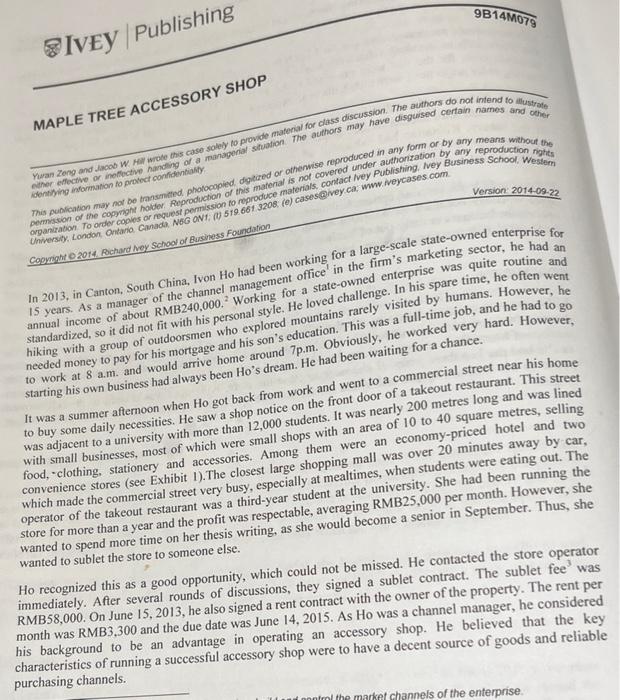
Step by Step Solution
There are 3 Steps involved in it
1 Expert Approved Answer
Step: 1 Unlock

Question Has Been Solved by an Expert!
Get step-by-step solutions from verified subject matter experts
Step: 2 Unlock
Step: 3 Unlock