







Question: Write a C program to apply interleaving mechanism on a given number of data chunks. The transmitter program must accept the original stream and display
 Write a C program to apply interleaving mechanism on a given number of data chunks. The transmitter program must accept the original stream and display the interleaved stream. The receiver program must accept the received stream with/without loss and display the reconstructed stream.
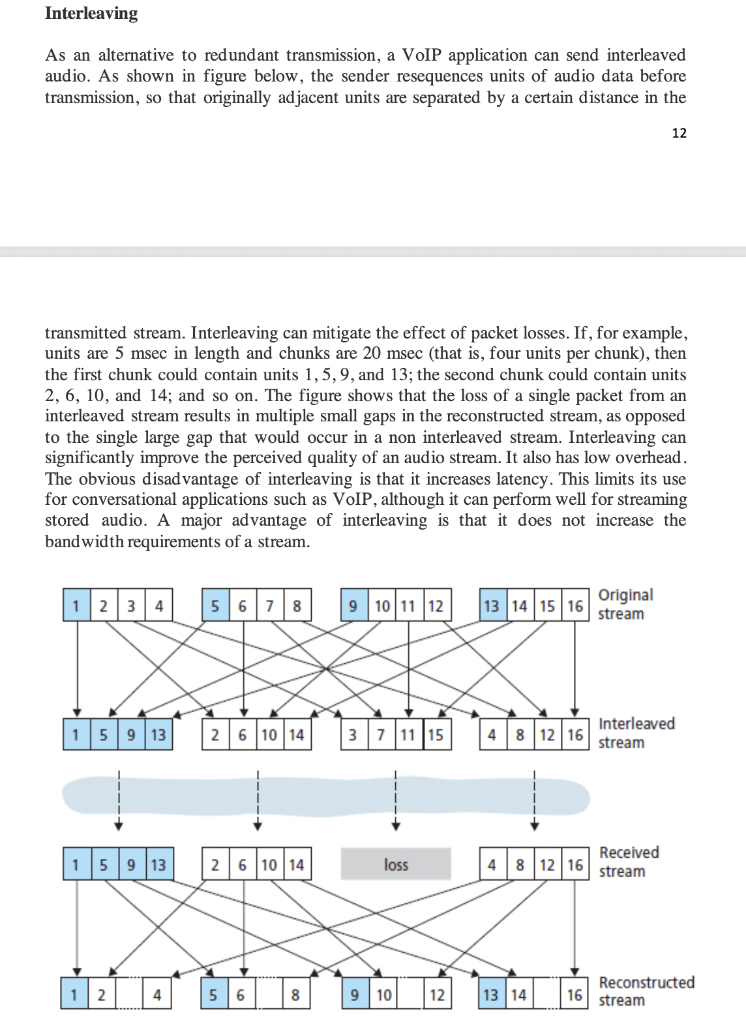
Interleaving As an alternative to redundant transmission, a VoIP application can send interleaved audio. As shown in figure below, the sender resequences units of audio data before transmission, so that originally adjacent units are separated by a certain distance in the 12 transmitted stream. Interleaving can mitigate the effect of packet losses. If, for example, units are 5 msec in length and chunks are 20 msec (that is, four units per chunk), then the first chunk could contain units 1,5,9, and 13; the second chunk could contain units 2, 6, 10, and 14; and so on. The figure shows that the loss of a single packet from an interleaved stream results in multiple small gaps in the reconstructed stream, as opposed to the single large gap that would occur in a non interleaved stream. Interleaving can significantly improve the perceived quality of an audio stream. It also has low overhead. The obvious disadvantage of interleaving is that it increases latency. This limits its use for conversational applications such as VoIP, although it can perform well for streaming stored audio. A major advantage of interleaving is that it does not increase the bandwidth requirements of a stream. 1 2 3 4 5 678 9 10 11 12 13 14 15 16 Original stream 1 5 9 13 26 10 14 37 11 15 4 8 12 16 Interleaved stream 1 5 9 13 26 10 14 loss 4 8 12 16 Received stream Reconstructed 12. 4 . 56 8 9 10 12 13 14 16 stream
Step by Step Solution
There are 3 Steps involved in it

Get step-by-step solutions from verified subject matter experts
 Study Help