







Question: Write a C++ program to simulate managing files on disk. Define the disk as a one-dimensional array disk of size numOfSectors * sizeOfSector, where sizeOfSector
Write a C++ program to simulate managing files on disk. Define the disk as a one-dimensional array disk of
size numOfSectors * sizeOfSector, where sizeOfSector indicates the number of characters stored in a
one sector. (For the sake of debugging, make it a very small number.) A pool of available sectors is kept
in a linked list sectors of three-field structures: two fields to indicate ranges of available sectors and one
next field. Files are kept in a linked list files of fours-field structures: file name, the number of characters
in the file, a pointer to a linked list of sectors where the contents of the file can be found, and the next
field.
a) In the first part, implement functions to save and delete files. Saving files requires claiming a
sufficient number of sectors from pool, if available, The sectors may not be contiguous, so the
linked list assigned to the file may contain several nodes. Then the contents of the file have to
be written to the sectors assigned to the file. Deletion of a file only requires removing the nodes
corresponding with this file (one from files and the rest from its own linked list of sectors) and
transferring the sectors assigned to this file back to pool. No changes are made in disk.
b) File fragmentation slows down file retrieval. In the ideal situation, one cluster of sectors is
assigned to one file. However, after many operations with files, it may not be possible. Extend
the program to include a function together() to transfer files to contiguous sctors, that is, to
create a situation illustrated in the attached figure. Fragmented files file1 and file2 occupy only
one cluster of sectors after together() is finished. However, particular care should be taken not
to overwrite sectors occupied by other files. For example, file1 requires eight sectors; five
sectors are free at the beginning of pool, but sectors 5 and 6 are occupied by file2. Therefore, a
file f occupying such sectors has to be located first by scanning files. The contents of these
sectors must be transferred to unoccupied positions, which requires updating the sectors
belonging to f in the linked list; only then can the released sectors be utilized. One way of
accomplishing this is by copying from the area into which one file is copied chunks of sectors of
another file into an area of the disk large enough to accommodate these chunks. In the example
in the figure, contents of file1 are first copied to sectors 0 through 4, and then copying is
temporarily suspended because sector 5 is occupied. Thus, contents of sectors 5 and t are
moved to sector 12 and 14, and the copying of file1 is resumed.
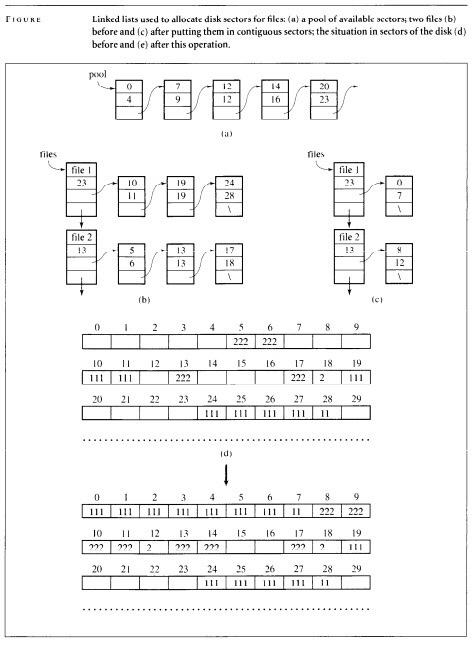
Linked lists used to allocate disk sectors for files: (a) a pool of available scctora; two files (b) before and (c) after putting them in contiguous sectors; the situation in sectors of the disk (d) before and (e) after this operation. IGURE pxol lal) files files file l file 2 file 2 icl 10 234 15 6 7 18 20 21 22 23 24 25 6 27 28 29 3 4 56789 10 2 3 4 15 6 7 819 20 21 2 23 24 25 26 27 28 9
Step by Step Solution
There are 3 Steps involved in it
1 Expert Approved Answer
Step: 1 Unlock

Question Has Been Solved by an Expert!
Get step-by-step solutions from verified subject matter experts
Step: 2 Unlock
Step: 3 Unlock
 Study Help