







Question: Write a C++ program to solve the problem Note that the elements in the subset should be output in non-decreasing order. Note that the elements
Write a C++ program to solve the problem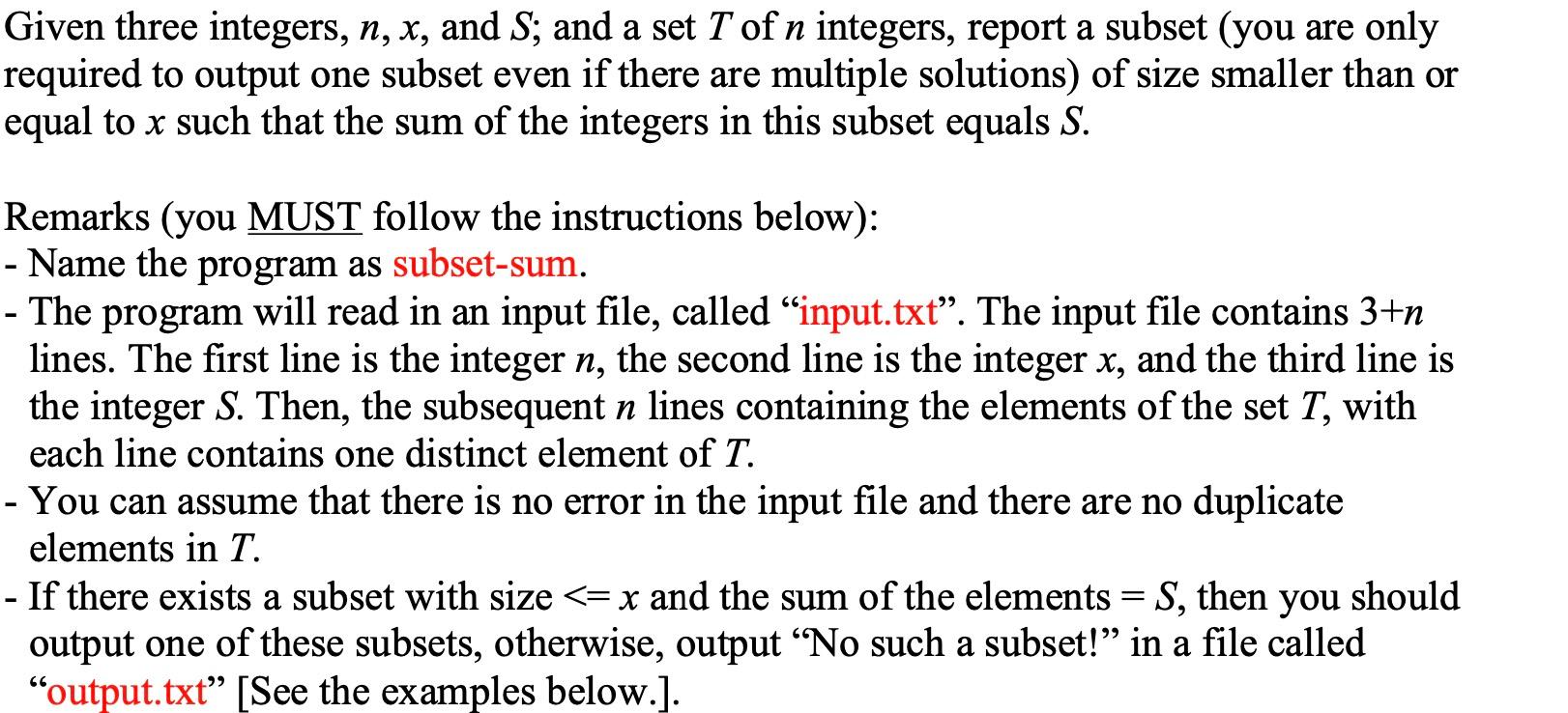
Note that the elements in the subset should be output in non-decreasing order.
Note that the elements in the subset should be output in non-decreasing order.
Note that the elements in the subset should be output in non-decreasing order.
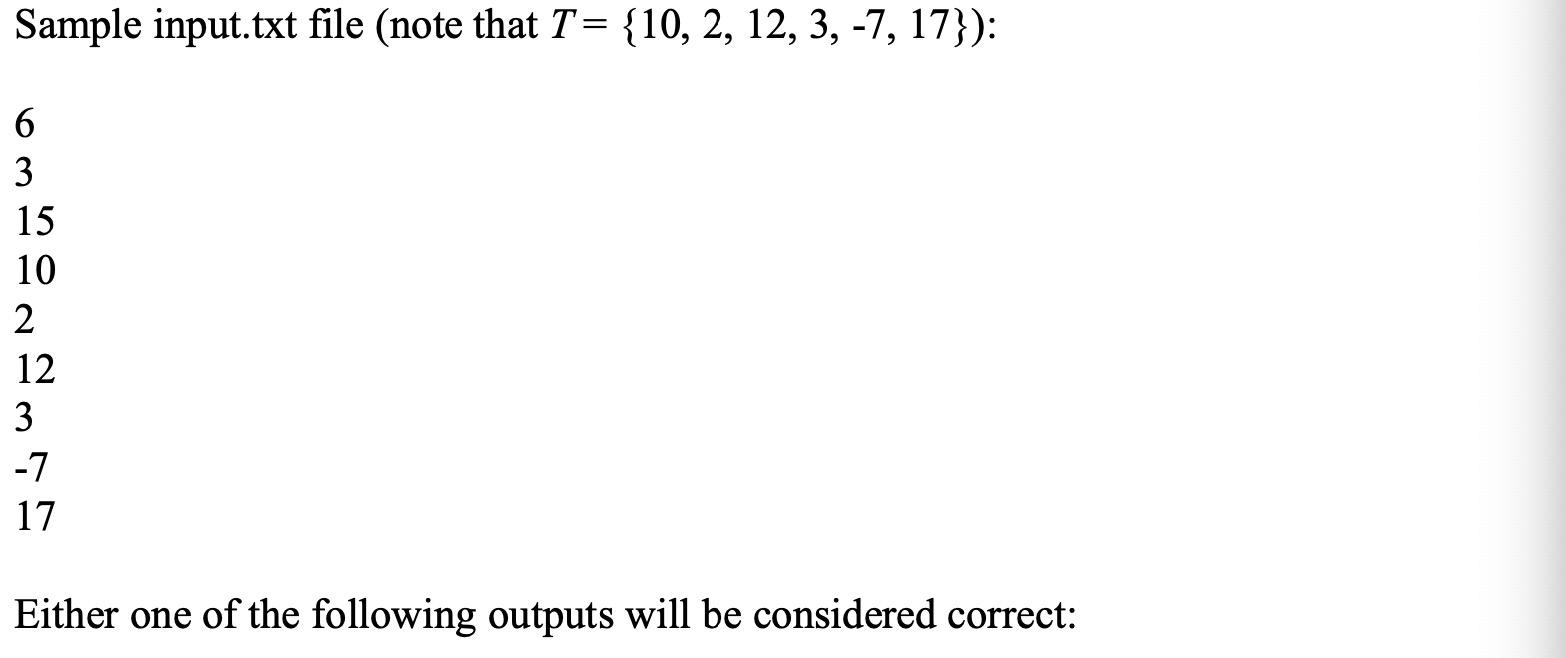
2,3,10
-7,10,12
Note also that even the sum of elements in {2, 3, -7, 17} = 15, but the number of elements exceed 3, this will not be considered as a correct output.
Sample input.txt file (note that T = {0, 4, 6, -2, 20}):
5
2
-9
0
4
6
-2
20
Only the following output will be correct.
No such a subset!
Sample input.txt file (note that T = {2, 9, 8, 1}):
4
2
10
2
9
8
1
Either one of the following outputs will be considered correct:
2, 8
1, 9
Given three integers, n, x, and S; and a set T of n integers, report a subset (you are only required to output one subset even if there are multiple solutions) of size smaller than or equal to x such that the sum of the integers in this subset equals S. Remarks (you MUST follow the instructions below): - Name the program as subset-sum. - The program will read in an input file, called input.txt. The input file contains 3+n lines. The first line is the integer n, the second line is the integer x, and the third line is the integer S. Then, the subsequent n lines containing the elements of the set T, with each line contains one distinct element of T. - You can assume that there is no error in the input file and there are no duplicate elements in T. - If there exists a subset with size
Step by Step Solution
There are 3 Steps involved in it

Get step-by-step solutions from verified subject matter experts
 Study Help