





Question: Write a code that works as a recursive descent parser for the following EBNF grammar. Use the language you have chosen for your presentation to
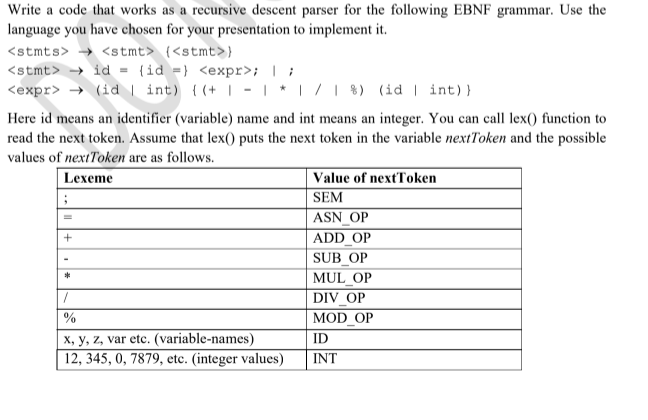
 Write a code that works as a recursive descent parser for

Write a code that works as a recursive descent parser for the following EBNF grammar. Use the language you have chosen for your presentation to implement it. ( id = {id =} ; 1; + (id | int) {(+ |-|*! | %) (id | int)} Here is means an identifier (variable) name and int means an integer. You can call lex() function to read the next token. Assume that lex() puts the next token in the variable nextToken and the possible values of nextToken are as follows. Lexeme Value of nextToken ; SEM ASN OP ADD OP SUB_OP MUL OP / DIV_OP % MOD OP x, y, z, var etc. (variable-names) ID 12, 345, 0, 7879, etc. (integer values) INT + Write a code that works as a recursive descent parser for the following EBNF grammar. Use the language you have chosen for your presentation to implement it. ( id = {id =} ; 1; + (id | int) {(+ |-|*! | %) (id | int)} Here is means an identifier (variable) name and int means an integer. You can call lex() function to read the next token. Assume that lex() puts the next token in the variable nextToken and the possible values of nextToken are as follows. Lexeme Value of nextToken ; SEM ASN OP ADD OP SUB_OP MUL OP / DIV_OP % MOD OP x, y, z, var etc. (variable-names) ID 12, 345, 0, 7879, etc. (integer values) INT +

Step by Step Solution

There are 3 Steps involved in it

1 Expert Approved Answer
Step: 1 Unlock blur-text-image
Question Has Been Solved by an Expert!

Get step-by-step solutions from verified subject matter experts

Step: 2 Unlock
Step: 3 Unlock

Students Have Also Explored These Related Databases Questions!