







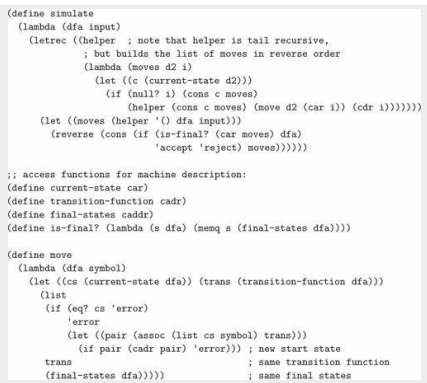
Question: Write a comparative analysis between the implementations of the DFA simulation in Scheme vs OCaml in the images below scheme: OCaml: (define sinulate (lambda (dfa
Write a comparative analysis between the implementations of the DFA simulation in Scheme vs OCaml in the images below
scheme:
OCaml:
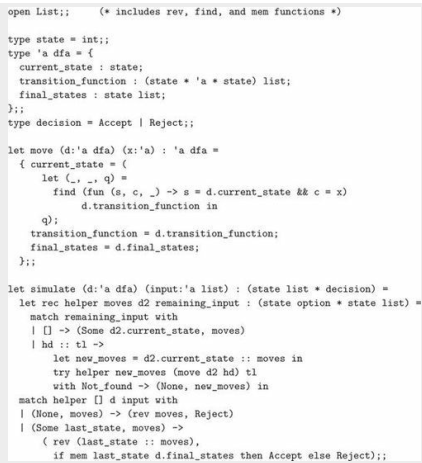
(define sinulate (lambda (dfa input) (letrec ((elper note that helper is tail recursive, ;but builds the list of moves in reverse order (lambda (moves d2 i) (let ((c (current-state d2))) if (nul1? i) (cons cmoves) (let ((moves (helperO dfa input))) (reverse (cons (if (is-final? (car moves) dfa) access functions for machine description: (define current-state car) (define transition-function cadr) (define final-states caddr) (define is-final? (lanbda (s dfa) (nemq s (final-states dfa)))) (define nove (lambda (dfa aymbol) (let ((cs (current-state dfa)) (trans (transition-function dfa))) (118t if (eq? cs 'error) error (let ((pair (assoc (list cs synbol) trans))) (if pair (cadr pair) 'error)) ne ) ; now start tate trans sane transition function ; same final states open List; includes rev, find, and mem functions) type state int;; type 'a dfa f current statestate; transition function (statea state) list; final states: state list; type decision Accept I Reject;; let move (d: 'a dfa) (x: 'a) : 'a dfa . { current-state let find (fun (s, c, d.current state kk cx) d.transition function in transition function d.transition function; final_states d.final states; let simulate (d: 'a dfa) (input: 'a 1ist)(state listdecision) let rec helper soves d2 remaining input (state option state list) match remaining input with | [] -> (Sone d2. current-state , moves) I hd : tl-> let neu_moves d2.current state oves in try helper new_moves (move d2 hd) t1 vith Not_found-> (None, nev moves) in atch helper d input vith I (None, moves) - (rev moves, Reject) I (Some last state, moves)> rev (last state moves), if mem last state d.final states then Accept else Reject) (define sinulate (lambda (dfa input) (letrec ((elper note that helper is tail recursive, ;but builds the list of moves in reverse order (lambda (moves d2 i) (let ((c (current-state d2))) if (nul1? i) (cons cmoves) (let ((moves (helperO dfa input))) (reverse (cons (if (is-final? (car moves) dfa) access functions for machine description: (define current-state car) (define transition-function cadr) (define final-states caddr) (define is-final? (lanbda (s dfa) (nemq s (final-states dfa)))) (define nove (lambda (dfa aymbol) (let ((cs (current-state dfa)) (trans (transition-function dfa))) (118t if (eq? cs 'error) error (let ((pair (assoc (list cs synbol) trans))) (if pair (cadr pair) 'error)) ne ) ; now start tate trans sane transition function ; same final states open List; includes rev, find, and mem functions) type state int;; type 'a dfa f current statestate; transition function (statea state) list; final states: state list; type decision Accept I Reject;; let move (d: 'a dfa) (x: 'a) : 'a dfa . { current-state let find (fun (s, c, d.current state kk cx) d.transition function in transition function d.transition function; final_states d.final states; let simulate (d: 'a dfa) (input: 'a 1ist)(state listdecision) let rec helper soves d2 remaining input (state option state list) match remaining input with | [] -> (Sone d2. current-state , moves) I hd : tl-> let neu_moves d2.current state oves in try helper new_moves (move d2 hd) t1 vith Not_found-> (None, nev moves) in atch helper d input vith I (None, moves) - (rev moves, Reject) I (Some last state, moves)> rev (last state moves), if mem last state d.final states then Accept else Reject)
Step by Step Solution
There are 3 Steps involved in it

Get step-by-step solutions from verified subject matter experts
 Study Help