







Question: Write a computer program that prompts the user for a number, creates an array for that number of random integers, and then uses the bubble
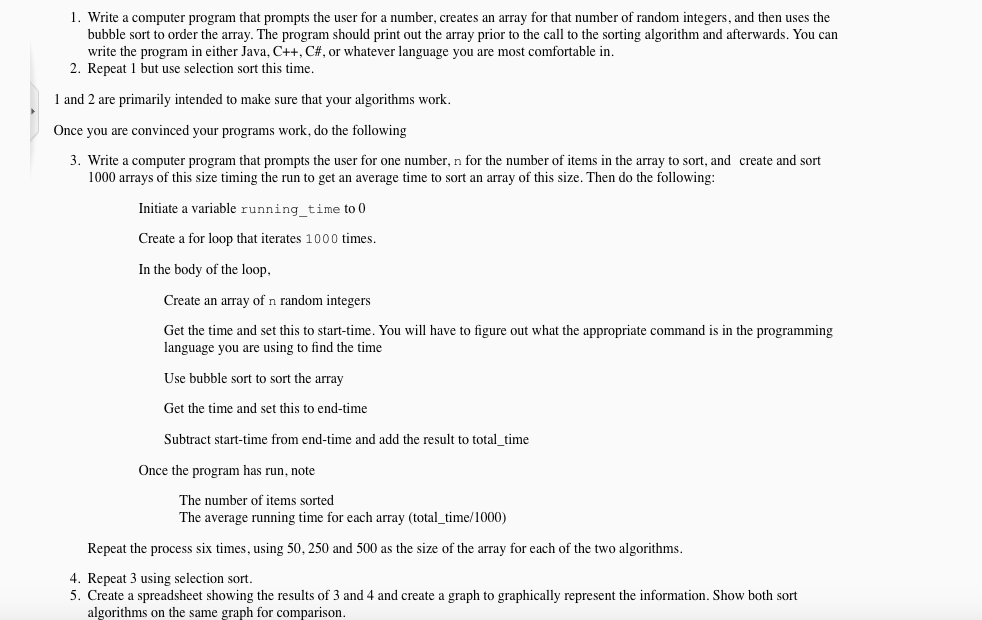
Write a computer program that prompts the user for a number, creates an array for that number of random integers, and then uses the bubble sort to order the array. The program should print out the array prior to the call to the sorting algorithm and afterwards. You can write the program in either Java, C++, C#, or whatever language you are most comfortable in. Repeat 1 but use selection sort this time. 1 and 2 are primarily intended to make sure that your algorithms work. Once you are convinced your programs work, do the following Write a computer program that prompts the user for one number, n for the number of items in the array to sort, and create and sort 1000 arrays of this size timing the run to get an average time to sort an array of this size. Then do the following: Initiate a variable running_time to 0 Create a for loop that iterates 1000 times. In the body of the loop, Create an array of n random integers Get the time and set this to start-time. You will have to figure out what the appropriate command is in the programming language you are using to find the time Use bubble sort to sort the array Get the time and set this to end-time Subtract start-time from end-time and add the result to total_time Once the program has run, note The number of items sorted The average running time for each array (total_time/1000) Repeat the process six times, using 50, 250 and 500 as the size of the array for each of the two algorithms. Repeat 3 using selection sort. Create a spreadsheet showing the results of 3 and 4 and create a graph to graphically represent the information. Show both sort algorithms on the same graph for comparison
Step by Step Solution
There are 3 Steps involved in it

Get step-by-step solutions from verified subject matter experts
 Study Help