







Question: Write a function list_diff that takes as input two lists, l1 and l2. The output is produced as follows. For every element x of l1:
Write a function list_diff that takes as input two lists, l1 and l2. The output is produced as follows.
For every element x of l1:
- if xl2, strike out x both from l1 and from l2.
- if xl2, add x to the resulting string.
Thus, list_diff(['a', 'b', 'b', 'c'], ['b', 'c', 'd']) returns
['a', 'b']
and list_diff(['a', 'a', 'b', 'b', 'b'], ['a', 'a', 'b', 'b', 'c']) returns
['b']
The implementation should leave the input lists unchanged. (Recall that lists are mutable, not immutable like tuples are!) You can achieve this by copying the input arguments before using them; you can obtain a copy of a list l with list(l).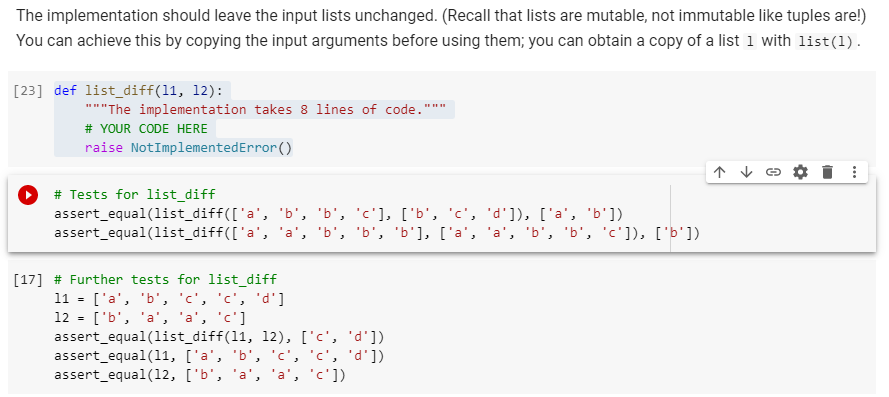
The implementation should leave the input lists unchanged. (Recall that lists are mutable, not immutable like tuples are!) You can achieve this by copying the input arguments before using them; you can obtain a copy of a list 1 with list(1). [23] def list_diff(11, 12): """The implementation takes 8 lines of code. """ # YOUR CODE HERE raise NotImplementedError() # Tests for list_diff assert_equal(list_diff(['a', 'b', 'b', 'c'], ['b', 'c','d']), ['a', 'b']) assert_equal(list_diff(['a', 'a', 'b', 'b', 'b'], ['a', 'a', 'b', 'b', 'c']), ['b']) [17] # Further tests for list_diff 11 = ['a', 'b', 'c', 'c','d'] 12 = ['b', 'a', 'a', 'c'] assert_equal(list_diff(11, 12), ['c', 'd']) assert_equal(11, ['a', 'b', 'c', 'c','d']) assert_equal(12, ['b', 'a', 'a', 'c'])
Step by Step Solution
There are 3 Steps involved in it

Get step-by-step solutions from verified subject matter experts
 Study Help