







Question: Write a function split in Scheme that takes a list L of positive integers (duplicates are possible, zero is not considered a positive integer) and
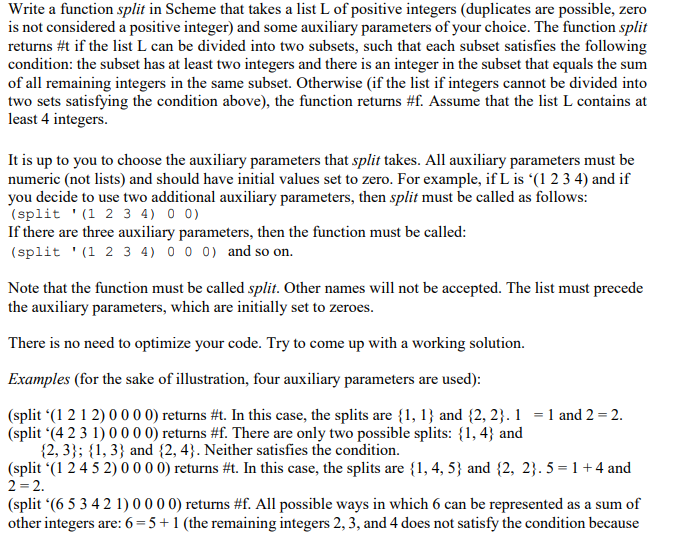
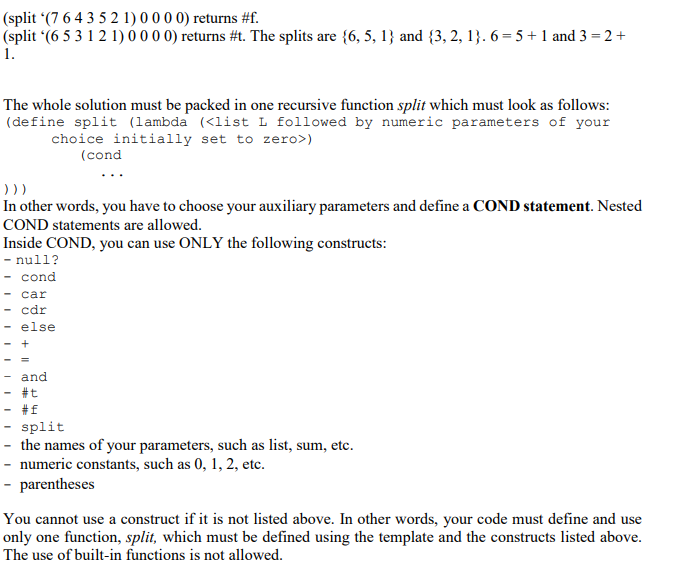
Write a function split in Scheme that takes a list L of positive integers (duplicates are possible, zero is not considered a positive integer) and some auxiliary parameters of your choice. The function split returns #t if the list L can be divided into two subsets, such that each subset satisfies the following condition: the subset has at least two integers and there is an integer in the subset that equals the sum of all remaining integers in the same subset. Otherwise (if the list if integers cannot be divided into two sets satisfying the condition above), the function returns #f. Assume that the list L contains at least 4 integers It is up to you to choose the auxiliary parameters that split takes. All auxiliary parameters must be numeric (not lists) and should have initial values set to zero. For example, if L is (1 2 3 4) and if you decide to use two additional auxiliary parameters, then split must be called as follows: (split '(1 2 3 4) 0 0) If there are (split '(12 3 4) 00 0) and so on. three auxiliary parameters, then the function must be called Note that the function must be called split. Other names will not be accepted. The list must precede the auxiliary parameters, which are initially set to zeroes There is no need to optimize your code. Try to come up with a working solution. Examples (for the sake of illustration, four auxiliary parameters are used) (split'(1 2 1 2) 0 0 0 0) returns #t. In this case, the splits are { 1, } and { 2, 2 }. 1-1 and 2-2. (split "(4 2 3 1) 0 0 0 0) returns #f. There are only two possible splits: { 1,4} and {2, 33; {1, 3} and {2, 4. Neither satisfies the condition (split .(1 2 4 5 2) 0 0 0 0) returns #t. In this case, the splits are { 1, 4, 5} and { 2, 2). 5-1 +4 and (split'(6 5 3 4 2 1) 0 0 0 0) returns #f. All possible ways in which 6 can be represented as a sum of other integers are: 6-51 (the remaining integers 2, 3, and 4 does not satisfy the condition because
Step by Step Solution
There are 3 Steps involved in it

Get step-by-step solutions from verified subject matter experts
 Study Help