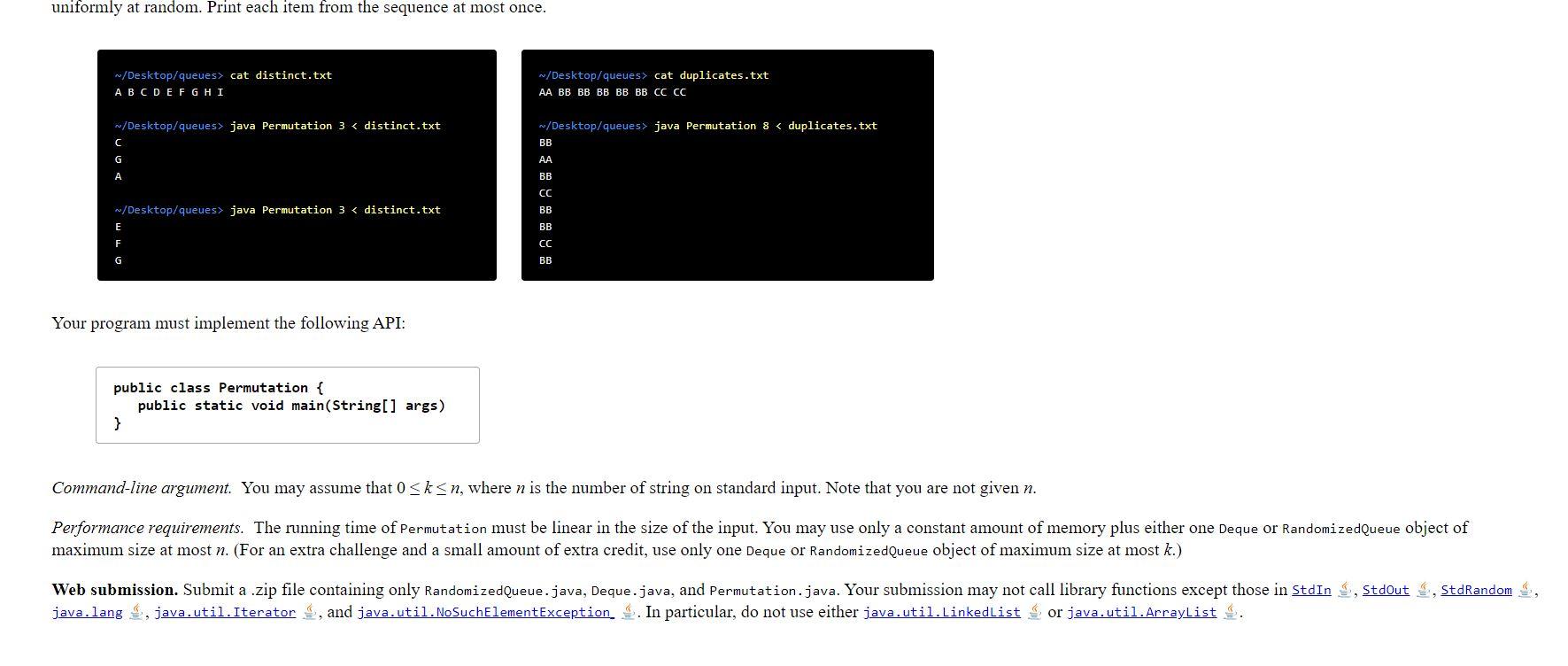
Question: Write a generic data type for a deque and a randomized queue. The goal of this assignment is to implement elementary data structures using arrays
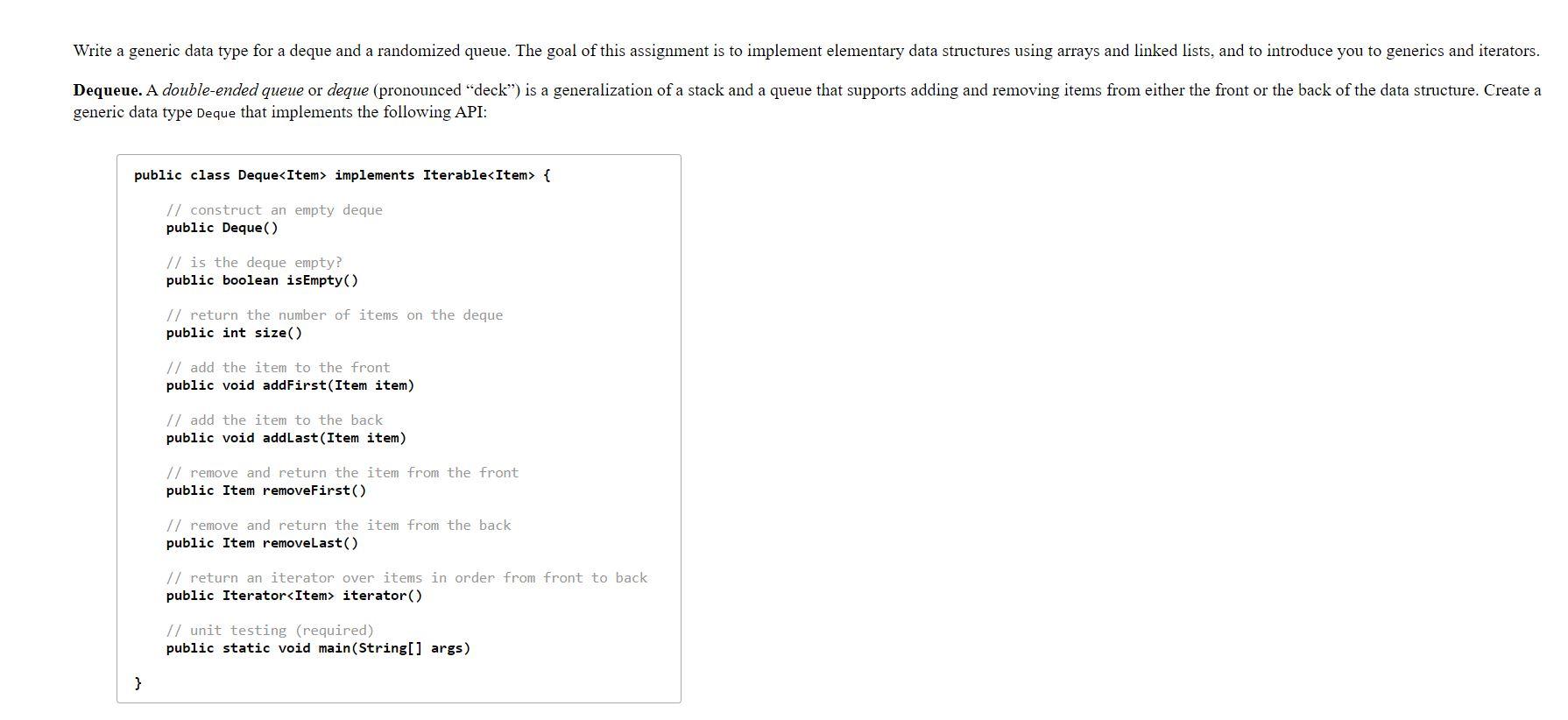
 Write a generic data type for a deque and a randomizedqueue. The goal of this assignment is to implement elementary data structuresusing arrays and linked lists, and to introduce you to generics anditerators. Dequeue. A double-ended queue or deque (pronounced "deck) is a generalization

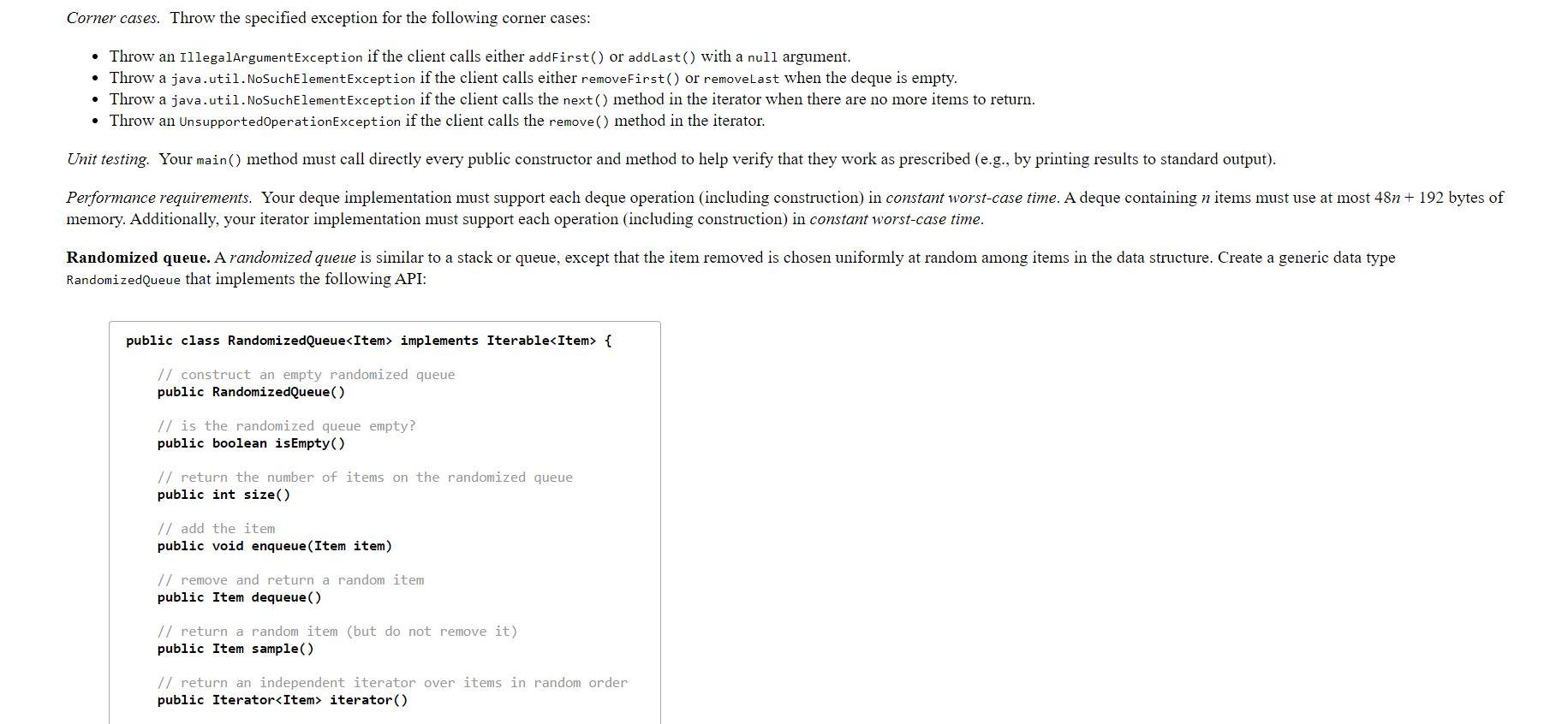
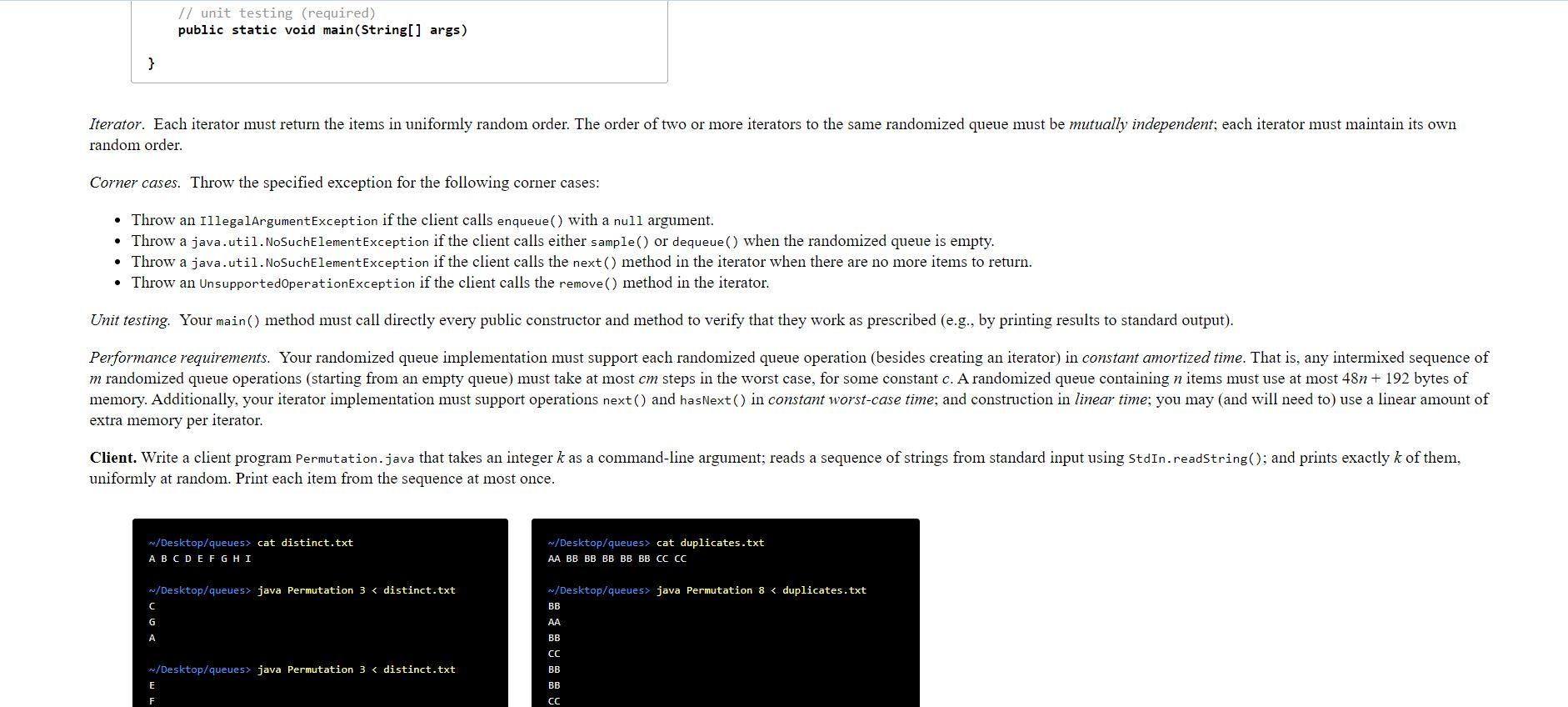
Write a generic data type for a deque and a randomized queue. The goal of this assignment is to implement elementary data structures using arrays and linked lists, and to introduce you to generics and iterators. Dequeue. A double-ended queue or deque (pronounced "deck) is a generalization of a stack and a queue that supports adding and removing items from either the front or the back of the data structure. Create a generic data type Deque that implements the following API: public class Deque implements Iterable { // construct an empty deque public Deque() // is the deque empty? public boolean isEmpty() // return the number of items on the deque public int size() // add the item to the front public void addFirst(Item item) // add the item to the back public void addLast(Item item) // remove and return the item from the front public Item removeFirst() // remove and return the item from the back public Item removeLast() // return an iterator over items in order from front to back public Iterator iterator() // unit testing (required) public static void main(String[] args) } Corner cases. Throw the specified exception for the following corner cases: Throw an IllegalArgumentException if the client calls either addFirst() or addLast() with a null argument. Throw a java.util. NoSuchElementException if the client calls either removeFirst() or removeLast when the deque is empty. Throw a java.util. NoSuchElementException if the client calls the next() method in the iterator when there are no more items to return. Throw an Unsupported OperationException if the client calls the remove() method in the iterator. Unit testing. Your main() method must call directly every public constructor and method to help verify that they work as prescribed (e.g., by printing results to standard output). Performance requirements. Your deque implementation must support each deque operation (including construction) in constant worst-case time. A deque containing n items must use at most 48n + 192 bytes of memory. Additionally, your iterator implementation must support each operation (including construction) in constant worst-case time. Randomized queue. A randomized queue is similar to a stack or queue, except that the item removed is chosen uniformly at random among items in the data structure. Create a generic data type RandomizedQueue that implements the following API: public class RandomizedQueue implements Iterable { // construct an empty randomized queue public RandomizedQueue () // is the randomized queue empty? public boolean isEmpty() // return the number of items on the randomized queue public int size() // add the item public void enqueue (Item item) // remove and return a random item public Item dequeue () // return a random item (but do not remove it) public Item sample() // return an independent iterator over items in random order public Iterator iterator() // unit testing (required) public static void main(String[] args) } Iterator. Each iterator must return the items in uniformly random order. The order of two or more iterators to the same randomized queue must be mutually independent; each iterator must maintain its own random order. Corner cases. Throw the specified exception for the following corner cases: Throw an IllegalArgumentException if the client calls enqueue () with a null argument. Throw a java.util. NoSuchElementException if the client calls either sample() or dequeue () when the randomized queue is empty. Throw a java.util.NoSuchElementException if the client calls the next() method in the iterator when there are no more items to return. Throw an Unsupported OperationException if the client calls the remove() method in the iterator. Unit testing. Your main() method must call directly every public constructor and method to verify that they work as prescribed (e.g., by printing results to standard output). Performance requirements. Your randomized queue implementation must support each randomized queue operation (besides creating an iterator) in constant amortized time. That is, any intermixed sequence of m randomized queue operations (starting from an empty queue) must take at most cm steps in the worst case, for some constant c. A randomized queue containing n items must use at most 48n + 192 bytes of memory. Additionally, your iterator implementation must support operations next() and hasNext() in constant worst-case time; and construction in linear time; you may (and will need to use a linear amount of extra memory per iterator. Client. Write a client program Permutation.java that takes an integer k as a command-line argument; reads a sequence of strings from standard input using stdin.readString(); and prints exactly k of them, uniformly at random. Print each item from the sequence at most once. >/queues> cat distinct.txt ABCDEFGHI /Desktop/queues> cat duplicates.txt AA BB BB BB BB BB CC CC /Desktop/queues> java Permutation 3 java Permutation 8 java Permutation 3 cat distinct.txt ABCDEFGHI ~/Desktop/queues> cat duplicates.txt AA BB BB BB BB BB CCCC /Desktop/queues> java Permutation 3 java Permutation 8 java Permutation 3
Step by Step Solution

There are 3 Steps involved in it

1 Expert Approved Answer
Step: 1 Unlock blur-text-image
Question Has Been Solved by an Expert!

Get step-by-step solutions from verified subject matter experts

Step: 2 Unlock
Step: 3 Unlock

Students Have Also Explored These Related Databases Questions!