







Question: Write a JavaScript function sigLoss(x, y) that estimates the number of base 10 digits of precision loss in doing the subtraction x - y, according
Write a JavaScript function sigLoss(x, y) that estimates the number of base 10 digits of precision loss in doing the subtraction x - y, according to the estimate just mentioned.. (You will need the standard library function Math.log which calculates the natural logarithm function.) Of course, sigLoss(x, y) will return fractional values even though we are estimating an integer quantity. Fill in the table:
Before modifying the routine, use it to calculate sine(a, 150) with a = 5, 10, 20, 40 and the calculate the relative errors in approximating Math.sin of the same values. The relative errors should be about 1.505e-15, 4.771e-13, , and 0.467 respectively.
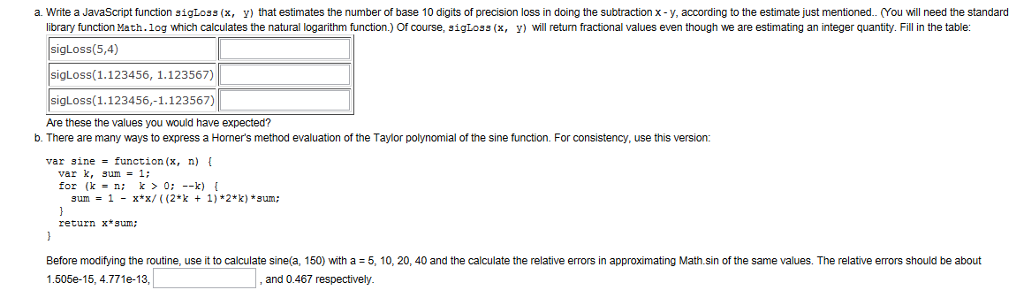
a. Write a JavaScript function sigLoss (x, y) that estimates the number of base 10 digits of precision loss in doing the subtraction x-y, according to the estimate just mentioned.- (You will need the standard library function Math.log which calculates the natural logarithm function. Of course, sigLoss (x, y) will return fractional values even though we are estimating an integer quantity. Fill in the table sigLoss (5,4) sig Loss 1.123567) (1.123456, sigLoss (1.123456,-1.123567) Are these the values you would have expected? b. There are many ways to express a Horners method evaluation of the Taylor polynomial of the sine function. For consistency, use this version: var sine- function (x, n) var k sum 1; for (k n: k 0 --k) x*x/ ((2*k 1) 2 k) sum. return x sum: Before modifying the routine, use it to calculate sine(a, 1500 with a -5, 10, 20, 40 and the calculate the relative errors in approximating Math.sin of the same values. The relative errors should be about 1.505e-15, 4.771e-13, and 0.467 respectively
Step by Step Solution
There are 3 Steps involved in it

Get step-by-step solutions from verified subject matter experts
 Study Help