Question: Write a journal. Read the article that came out in the March 2012 issue of the Harvard Business Review titled Reviving Entrepreneurship. In it, the
Write a journal. Read the article that came out in the March 2012 issue of the Harvard Business Review titled "Reviving Entrepreneurship." In it, the authors discuss how "policy decisions in 12 areas could nurture - or cripple - America's greatest asset."
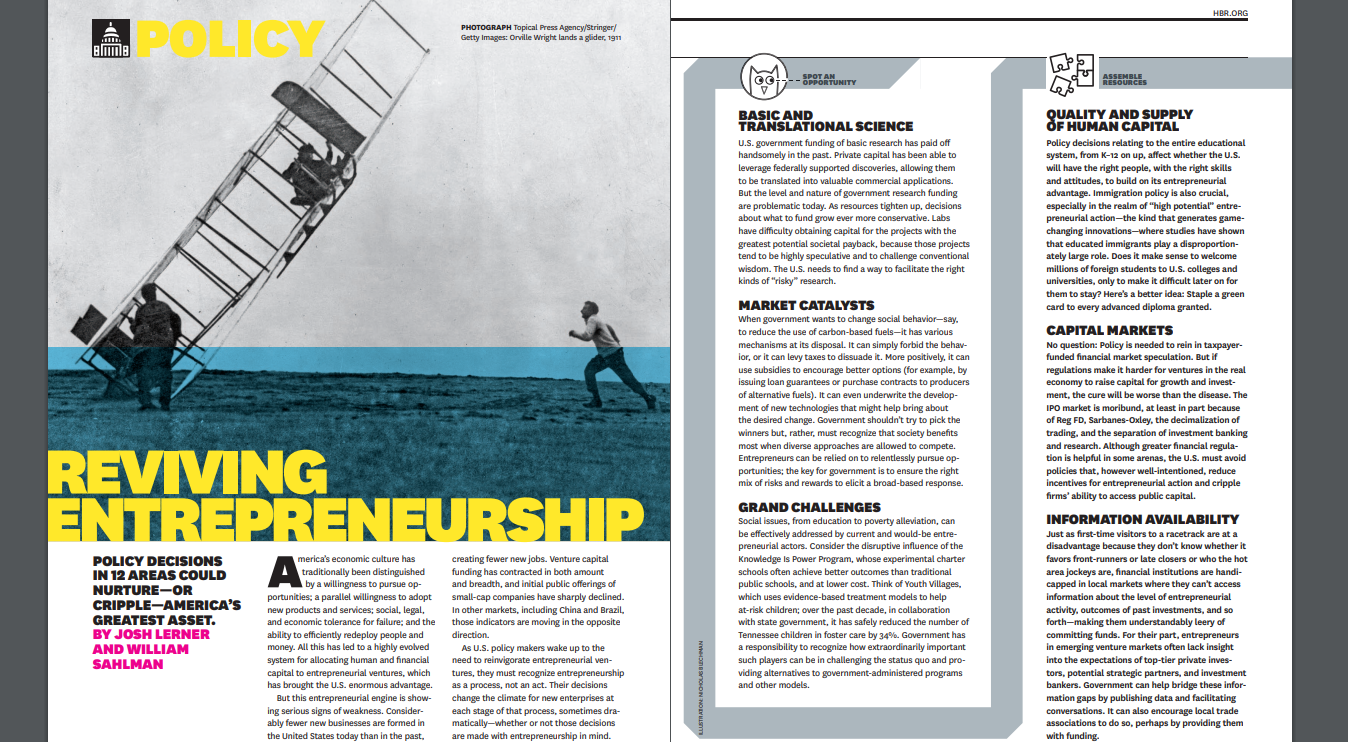
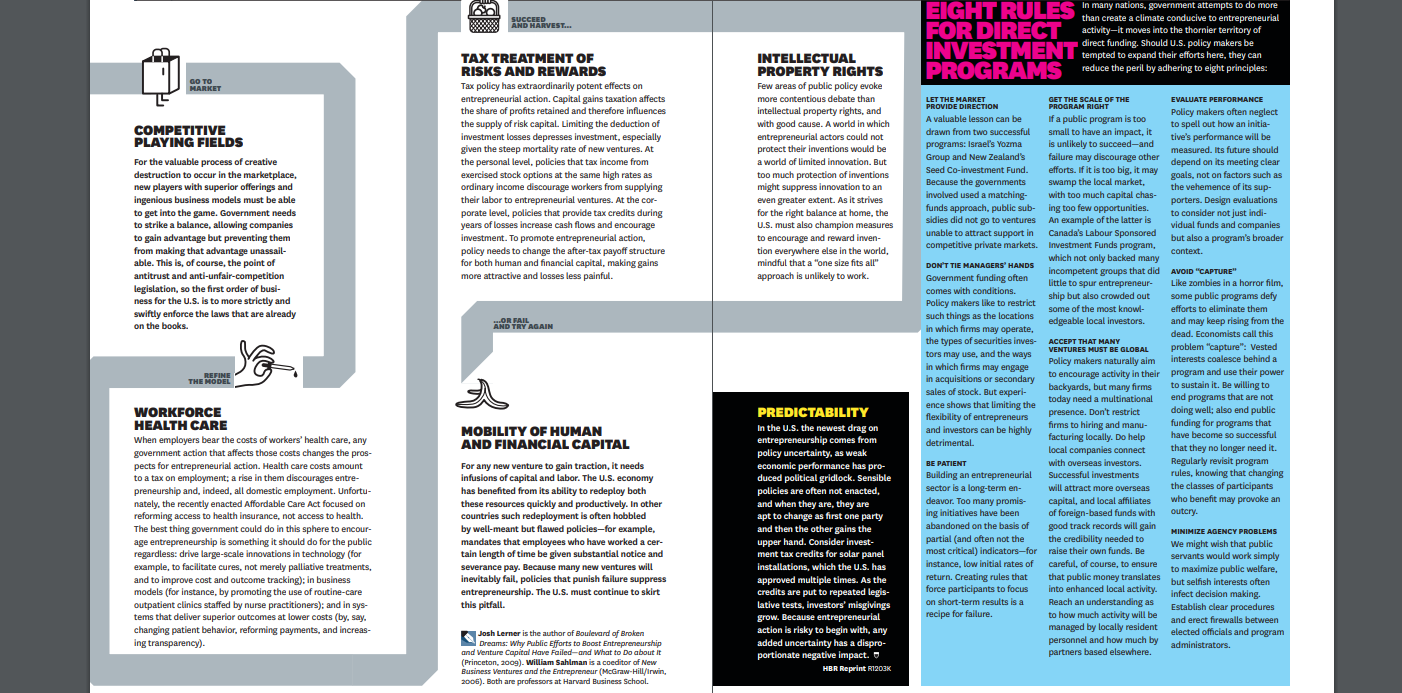
BASICAND U.S. government funding of basic research has paid off handsomely in the past. Private capital has been able to leverage federally supported discoveries, allowing them to be translated into valuable commercial applications. to be translated into valuable commercial applications. are problematic today. As resources tighten up, decisions about what to fund grow ever more conservathe. Labs greatest potentlal societal payback, because those projects tend to be highly speculative and to challenge conventional wisdom. The U.S. needs to kinds of "risky" research. MARKET CATALYSTS When government wants to change social behavior-say, to reduce the use of carbon-based fuels-it has various mechanisms at its disposal. It can simply forbid the behav- ior, or it can levy taxes to dissuade it. More positively, it can use subsidies to encourage better cptions (for example, by issuing Loan guarantees or purchase contracts to producers of alternative fuels). It can even underwrite the develop- the desired change. Government shouldn't try to pick the winners but, rather, must recognize that society benefits most when diverse approaches are allowed to compete. portunities; the key for government is to ensure the right mix of risks and rewards to elicit a broad-based response. GRAND CHALLENGES social issues, from education to poverty alleviation, can INFORMATION AVAILABILITY be effectively addressed by current and would-be entre- preneurial actors. Consider the disruptive influence of the Just as first-time visitors to a racetrack are at a Knowledge Is Power Program, whose experimental charter favors front-runners or late closers or who the hot COMPETITIVE PLAYING FIELDS For the valuable process of creative destruction to occur in the marketplace, new players with superior offerings and ingenious business models must be able to get into the game. Government needs to strike a balance, allowing companies to gain advantage but preventing them from making that advantage unassail- able. This is, of course, the point of antitrust and anti-unfair-competition legislation, so the first order of busi- ness for the U.S. is to more strictly and swiftly enforce the laws that are already on the books. WORKFORCE HEALTH CARE When employers bear the costs of workers' health care, any government action that affects those costs changes the pros- pects for entrepreneurial action. Health care costs amount to a tax on employment; a rise in them discourages entre- preneurship and, indeed, all domestic employment. Unfortu- nately, the recently enacted Affordable Care Act focused on reforming access to health insurance, not access to health. The best thing government could do in this sphere to encour- age entrepreneurship is something it should do for the public regardless: drive large-scale innovations in technology (for example, to facilitate cures, not merely palliative treatments, and to improve cost and outcome tracking): in business models (for instance, by promoting the use of routine-care outpatient clinics staffed by nurse practitioners): and in sys- tems that deliver superior outcomes at lower costs (by, say. changing patient behavior, reforming payments, and increas- ing transparency)









 Study Help