







Question: Write a one-page reflection of this article that 1) summarize how Porter's value chain was uniquely applied to Turkish tourism (what did they change to
Write a one-page reflection of this article that 1) summarize how Porter's value chain was uniquely applied to Turkish tourism (what did they change to make it work?) AND 2) add a separate personal reflection on the topic.
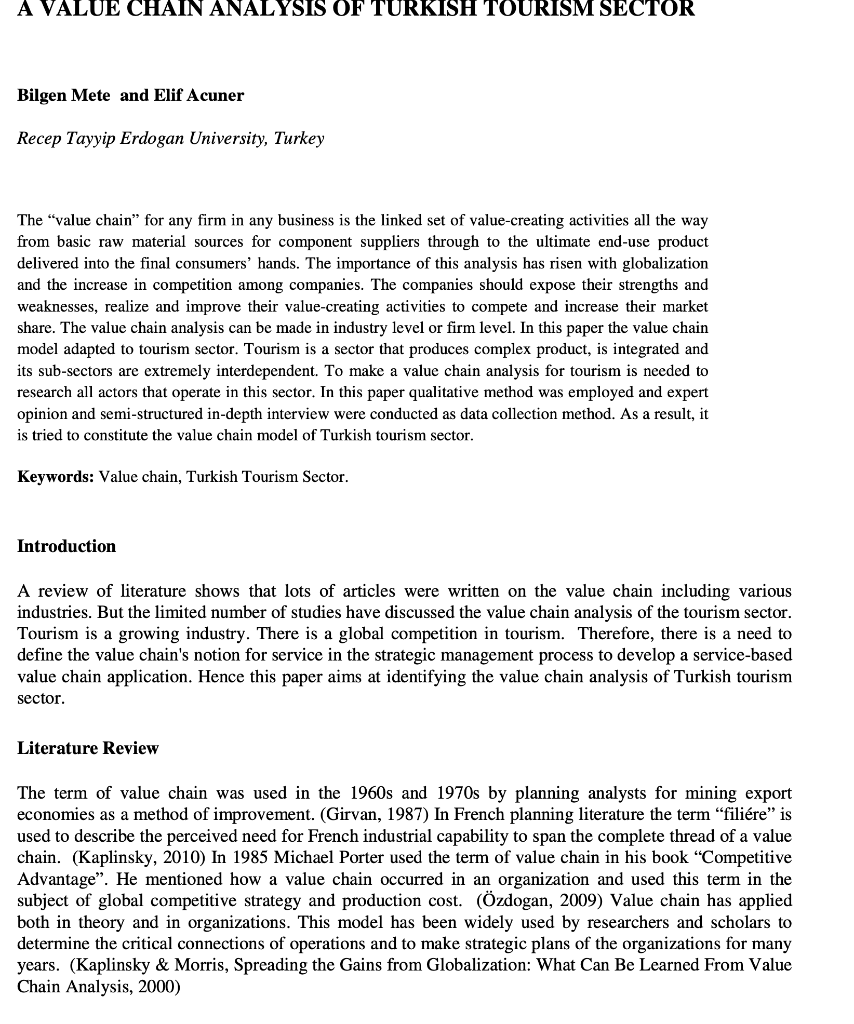
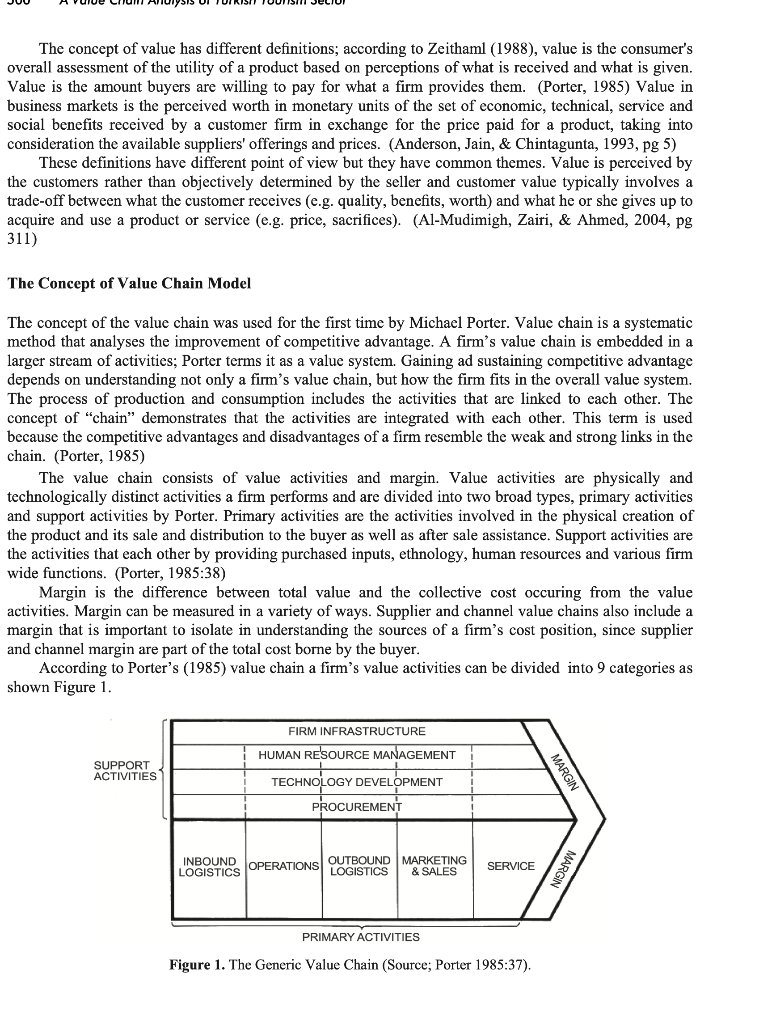
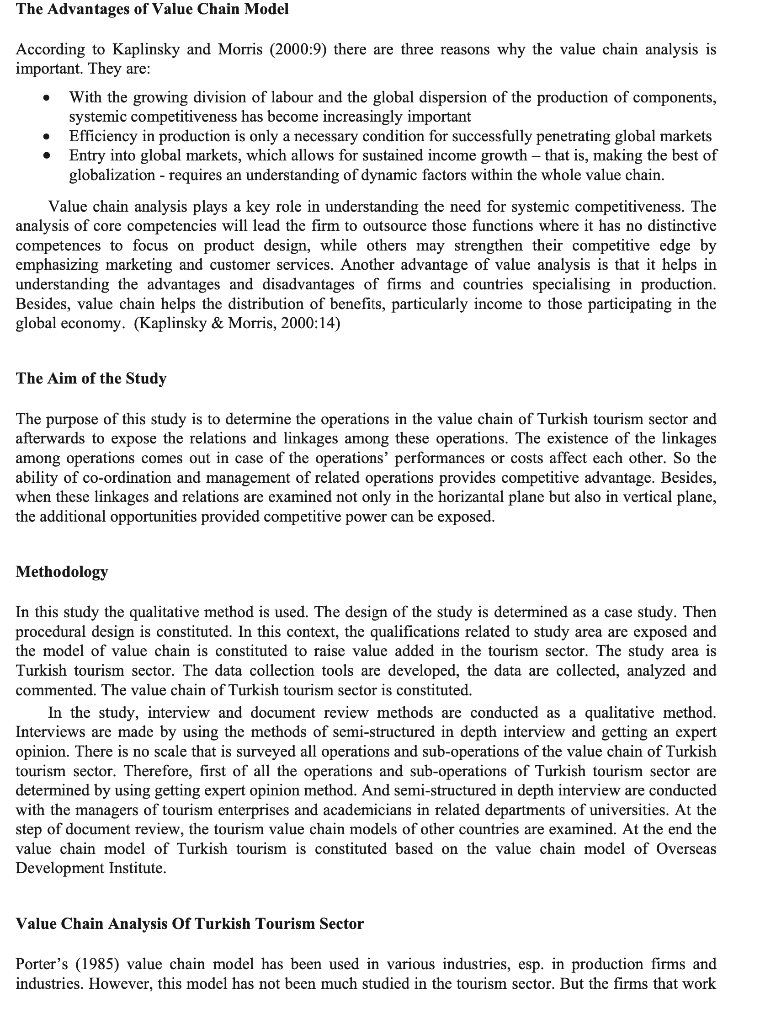
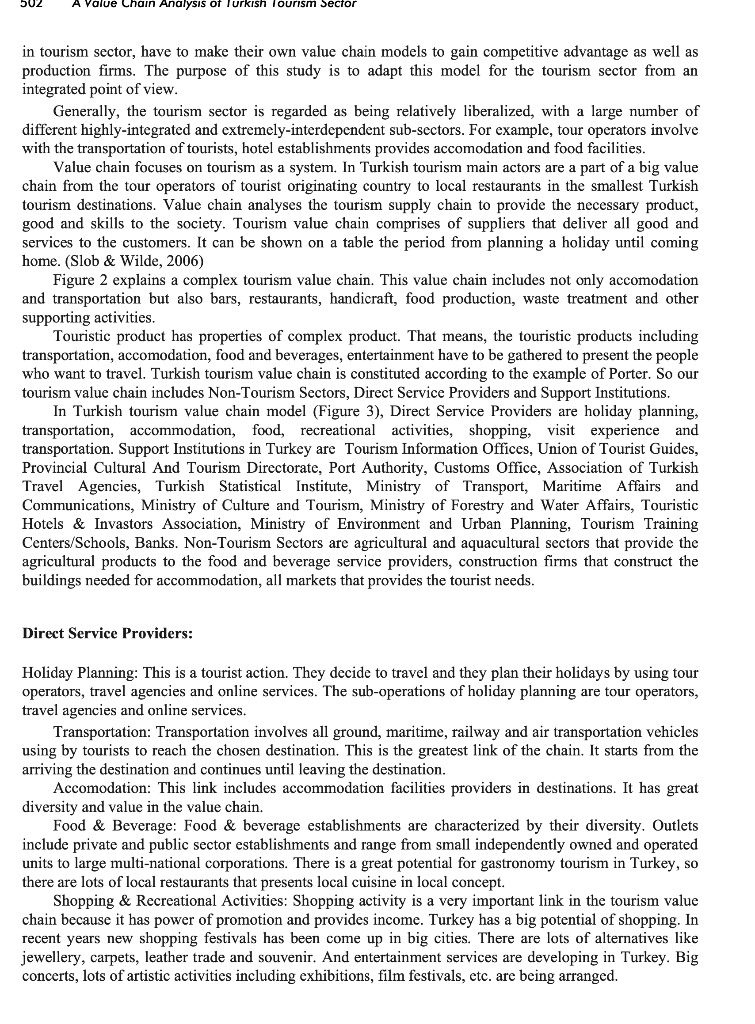
A VALUE CHAIN ANALYSIS OF TURKISH TOURISM SECTOR Bilgen Mete and Elif Acuner Recep Tayyip Erdogan University, Turkey The "value chain" for any firm in any business is the linked set of value-creating activities all the way from basic raw material sources for component suppliers through to the ultimate end-use product delivered into the final consumers' hands. The importance of this analysis has risen with globalization and the increase in competition among companies. The companies should expose their strengths and weaknesses, realize and improve their value-creating activities to compete and increase their market share. The value chain analysis can be made in industry level or firm level. In this paper the value chain model adapted to tourism sector. Tourism is a sector that produces complex product, is integrated and its sub-sectors are extremely interdependent. To make a value chain analysis for tourism is needed to research all actors that operate in this sector. In this paper qualitative method was employed and expert opinion and semi-structured in-depth interview were conducted as data collection method. As a result, it is tried to constitute the value chain model of Turkish tourism sector. Keywords: Value chain, Turkish Tourism Sector. Introduction A review of literature shows that lots of articles were written on the value chain including various industries. But the limited number of studies have discussed the value chain analysis of the tourism sector. Tourism is a growing industry. There is a global competition in tourism. Therefore, there is a need to define the value chain's notion for service in the strategic management process to develop a service-based value chain application. Hence this paper aims at identifying the value chain analysis of Turkish tourism sector. Literature Review The term of value chain was used in the 1960s and 1970s by planning analysts for mining export economies as a method of improvement. (Girvan, 1987) In French planning literature the term filire" is used to describe the perceived need for French industrial capability to span the complete thread of a value chain. (Kaplinsky, 2010) In 1985 Michael Porter used the term of value chain in his book Competitive Advantage. He mentioned how a value chain occurred in an organization and used this term in the subject of global competitive strategy and production cost. (zdogan, 2009) Value chain has applied both in theory and in organizations. This model has been widely used by researchers and scholars to determine the critical connections of operations and to make strategic plans of the organizations for many years. (Kaplinsky & Morris, Spreading the Gains from Globalization: What Can Be Learned From Value Chain Analysis, 2000) The concept of value has different definitions, according to Zeithaml (1988), value is the consumer's overall assessment of the utility of a product based on perceptions of what is received and what is given. Value is the amount buyers are willing to pay for what a firm provides them. (Porter, 1985) Value in business markets is the perceived worth in monetary units of the set of economic, technical, service and social benefits received by a customer firm in exchange for the price paid for a product, taking into consideration the available suppliers' offerings and prices. (Anderson, Jain, & Chintagunta, 1993, pg 5) These definitions have different point of view but they have common themes. Value is perceived by the customers rather than objectively determined by the seller and customer value typically involves a trade-off between what the customer receives (e.g. quality, benefits, worth) and what he or she gives up to acquire and use a product or service (e.g. price, sacrifices). (Al-Mudimigh, Zairi, & Ahmed, 2004, pg 311) The Concept of Value Chain Model The concept of the value chain was used for the first time by Michael Porter. Value chain is a systematic method that analyses the improvement of competitive advantage. A firm's value chain is embedded in a larger stream of activities; Porter terms it as a value system. Gaining ad sustaining competitive advantage depends on understanding not only a firm's value chain, but how the firm fits in the overall value system. The process of production and consumption includes the activities that are linked to each other. The concept of "chain" demonstrates that the activities are integrated with each other. This term is used because the competitive advantages and disadvantages of a firm resemble the weak and strong links in the chain. (Porter, 1985) The value chain consists of value activities and margin. Value activities are physically and technologically distinct activities a firm performs and are divided into two broad types, primary activities and support activities by Porter. Primary activities are the activities involved in the physical creation of the product and its sale and distribution to the buyer as well as after sale assistance. Support activities are the activities that each other by providing purchased inputs, ethnology, human resources and various firm wide functions. (Porter, 1985:38) Margin is the difference between total value and the collective cost occuring from the value activities. Margin can be measured in a variety of ways. Supplier and channel value chains also include a margin that is important to isolate in understanding the sources of a firm's cost position, since supplier and channel margin are part of the total cost borne by the buyer. According to Porter's (1985) value chain a firm's value activities can be divided into 9 categories as shown Figure 1. a FIRM INFRASTRUCTURE HUMAN RESOURCE MANAGEMENT SUPPORT ACTIVITIES TECHNOLOGY DEVELOPMENT MARGIN PROCUREMENT INBOUND OPERATIONS LOGISTICS OUTBOUND MARKETING LOGISTICS & SALES SERVICE MARGIN PRIMARY ACTIVITIES Figure 1. The Generic Value Chain (Source; Porter 1985:37). The Advantages of Value Chain Model . . According to Kaplinsky and Morris (2000:9) there are three reasons why the value chain analysis is important. They are: With the growing division of labour and the global dispersion of the production of components, systemic competitiveness has become increasingly important Efficiency in production is only a necessary condition for successfully penetrating global markets Entry into global markets, which allows for sustained income growth that is, making the best of globalization - requires an understanding of dynamic factors within the whole value chain. Value chain analysis plays a key role in understanding the need for systemic competitiveness. The analysis of core competencies will lead the firm to outsource those functions where it has no distinctive competences to focus on product design, while others may strengthen their competitive edge by emphasizing marketing and customer services. Another advantage of value analysis is that it helps in understanding the advantages and disadvantages of firms and countries specialising in production. Besides, value chain helps the distribution of benefits, particularly income to those participating in the global economy. (Kaplinsky & Morris, 2000:14) The Aim of the Study The purpose of this study is to determine the operations in the value chain of Turkish tourism sector and afterwards to expose the relations and linkages among these operations. The existence of the linkages among operations comes out in case of the operations' performances or costs affect each other. So the ability of co-ordination and management of related operations provides competitive advantage. Besides, when these linkages and relations are examined not only in the horizantal plane but also in vertical plane, the additional opportunities provided competitive power can be exposed. Methodology In this study the qualitative method is used. The design of the study is determined as a case study. Then procedural design is constituted. In this context, the qualifications related to study area are exposed and the model of value chain is constituted to raise value added in the tourism sector. The study area is Turkish tourism sector. The data collection tools are developed, the data are collected, analyzed and commented. The value chain of Turkish tourism sector is constituted. In the study, interview and document review methods are conducted as a qualitative method. Interviews are made by using the methods of semi-structured in depth interview and getting an expert opinion. There is no scale that is surveyed all operations and sub-operations of the value chain of Turkish tourism sector. Therefore, first of all the operations and sub-operations of Turkish tourism sector are determined by using getting expert opinion method. And semi-structured in depth interview are conducted with the managers of tourism enterprises and academicians in related departments of universities. At the step of document review, the tourism value chain models of other countries are examined. At the end the value chain model of Turkish tourism is constituted based on the value chain model of Overseas Development Institute. Value Chain Analysis Of Turkish Tourism Sector Porter's (1985) value chain model has been used in various industries, esp. in production firms and industries. However, this model has not been much studied in the tourism sector. But the firms that work A Value Chain Analysis of Turkish Tourism Sector in tourism sector, have to make their own value chain models to gain competitive advantage as well as production firms. The purpose of this study is to adapt this model for the tourism sector from an integrated point of view. Generally, the tourism sector is regarded as being relatively liberalized, with a large number of different highly-integrated and extremely-interdependent sub-sectors. For example, tour operators involve with the transportation of tourists, hotel establishments provides accomodation and food facilities. Value chain focuses on tourism as a system. In Turkish tourism main actors are a part of a big value chain from the tour operators of tourist originating country to local restaurants in the smallest Turkish tourism destinations. Value chain analyses the tourism supply chain to provide the necessary product, good and skills to the society. Tourism value chain comprises of suppliers that deliver all good and services to the customers. It can be shown on a table the period from planning a holiday until coming home. (Slob & Wilde, 2006) Figure 2 explains a complex tourism value chain. This value chain includes not only accomodation and transportation but also bars, restaurants, handicraft, food production, waste treatment and other supporting activities. Touristic product has properties of complex product. That means, the touristic products including transportation, accomodation, food and beverages, entertainment have to be gathered to present the people who want to travel. Turkish tourism value chain is constituted according to the example of Porter. So our tourism value chain includes Non-Tourism Sectors, Direct Service Providers and Support Institutions. In Turkish tourism value chain model (Figure 3), Direct Service Providers are holiday planning, transportation, accommodation, food, recreational activities, shopping, visit experience and transportation. Support Institutions in Turkey are Tourism Information Offices, Union of Tourist Guides, Provincial Cultural And Tourism Directorate, Port Authority, Customs Office, Association of Turkish Travel Agencies, Turkish Statistical Institute, Ministry of Transport, Maritime Affairs and Communications, Ministry of Culture and Tourism, Ministry of Forestry and Water Affairs, Touristic Hotels & Invastors Association, Ministry of Environment and Urban Planning, Tourism Training Centers/Schools, Banks. Non-Tourism Sectors are agricultural and aquacultural sectors that provide the agricultural products to the food and beverage service providers, construction firms that construct the buildings needed for accommodation, all markets that provides the tourist needs. Direct Service Providers: Holiday Planning: This is a tourist action. They decide to travel and they plan their holidays by using tour operators, travel agencies and online services. The sub-operations of holiday planning are tour operators, travel agencies and online services. Transportation: Transportation involves all ground, maritime, railway and air transportation vehicles using by tourists to reach the chosen destination. This is the greatest link of the chain. It starts from the arriving the destination and continues until leaving the destination. Accomodation: This link includes accommodation facilities providers in destinations. It has great diversity and value in the value chain. Food & Beverage: Food & beverage establishments are characterized by their diversity, Outlets include private and public sector establishments and range from small independently owned and operated units to large multi-national corporations. There is a great potential for gastronomy tourism in Turkey, so there are lots of local restaurants that presents local cuisine in local concept. Shopping & Recreational Activities: Shopping activity is a very important link in the tourism value chain because it has power of promotion and provides income. Turkey has a big potential of shopping. In recent years new shopping festivals has been come up in big cities. There are lots of alternatives like jewellery, carpets, leather trade and souvenir. And entertainment services are developing in Turkey. Big concerts, lots of artistic activities including exhibitions, film festivals, etc. are being arranged. occupational activities, to ensure the occupation develops and improves in line with its general interests, to ensure reliability and safety among the occupational groups and their relations with the public; To ensure that tourism industry and tourist facilities develop in accordance with the requirements, to ensure contact and coordination between the members and organizations, institutions, persons and entities that are engaged in tourism either directly or indirectly, to represent its members inside and outside the industry. (TUROB, 2014) Union of Tourist Guides: The aims of Union of Tourist Guides are to determine the common problems of tourist guides and to offer solutions, to provide co-ordination among the professional organizations, to make the legal regulations about the profession of tourist guiding. (TUREB, 2014) Turkish Statistical Institute: This institute prepares the statistical data about monthly tourism income, tourism income by type of expenditures, departing visitors by type of accomodation, number of nights spent and average night spent, departing visitors by purpose of visit, tourism expenditure by type of expenses. Ministry of Transport, Maritime Affairs and Communications, Ministry of Forestry and Water Affairs, Ministry of Environment and Urban Planning are ministries that support tourism about protecting environment, planning the structuring, protecting natural beauties and national parks, developing infrastructure for touristic destinations. Other Associations: There are lots of both local and also international associations in Turkish tourism sector. These associations carry out studies on offering solutions to present problems, developing the tourism sector. The other support institutions in tourism value chain are Undersecretariat For Treasury, Tourism Information Offices, Universities and other tourism training centers, development agencies. Result Turkish tourism industry is growing very fast. Besides in this sector, there is a global competition from now on. So the states have to make their own strategic planning and have to make analyses to determine what operations they have or not. They have to know their strengths and weaknesses and the linkages among the operations of the tourism sector. This will provide competitive advantage to the states. Value chain includes the application order and relations of operations in a system. In this point the aim is to constitute more value-added. In the base of the model it is aimed to produce valuable products and services for customers. So the operations of value chain are focused on customer needs. If the last customer is placed at the end of the value chain, each ring in the chain is customer of previous one. That means each ring in the chain has to describe the needs of own customer and produce the products that meet these needs. In tourism sector the process of purchasing and consuming for the tourist as the last customer includes the steps of holiday planning, transportation, accomodation, food and beverage, entertainment, shopping, visit experience and returning home. In this context the main product and service providers are tour operators. Besides, the primary activities of tourism value chain integrate with the support activities in the vertical plane and produce the most value-added for the sectorStep by Step Solution
There are 3 Steps involved in it
1 Expert Approved Answer
Step: 1 Unlock

Question Has Been Solved by an Expert!
Get step-by-step solutions from verified subject matter experts
Step: 2 Unlock
Step: 3 Unlock
 Study Help