







Question: Write a program in Java to simulate the processing of customers at a bank. Use a Class Queue for each of the tellers. Develop your
Write a program in Java to simulate the processing of customers at a bank.
Use a Class Queue for each of the tellers.
Develop your own priority queue member function in Class Queue for the event queue. This simulation is to be an event driven simulation using a priority queue for the events.
(The full instructions are down below)
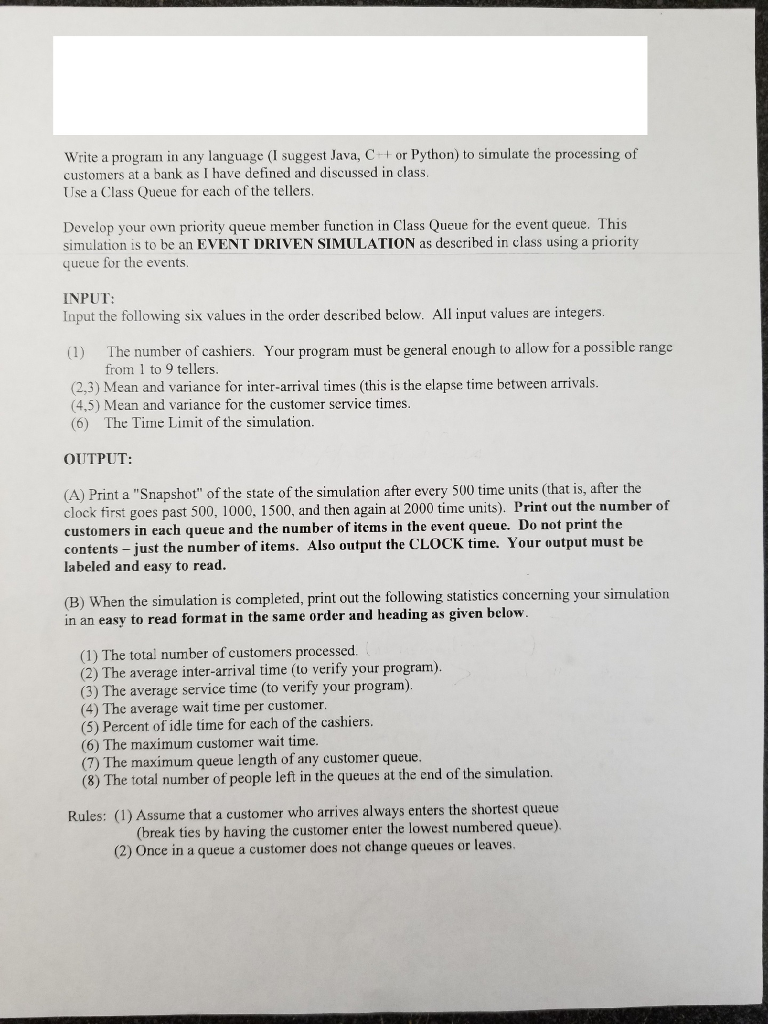
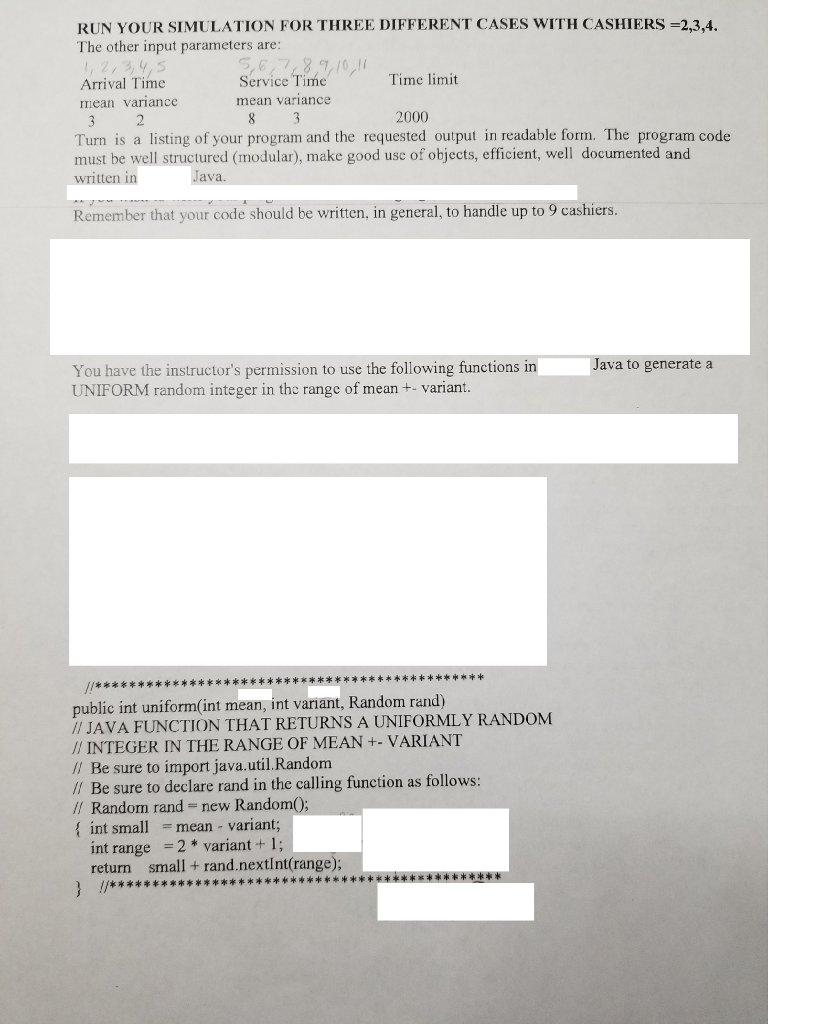 (I removed all references to writing the program in C in the image above. Please write the program in Java).
Write a program in any language (I suggest Java, C or Python) to simulate the processing of customers at a bank as I have defined and discussed in class. Use a Class Queue for each of the tellers Develop your own priority queue member function in Class Queue for the event queue. This simulation is to be an EVENT DRIVEN SIMULATION as described in class using a priority queue for the events. INPUT: Input the following six values in the order described below. All input values are integers. The number of cashiers. from 1 to 9 tellers. Your program must be general enough to allow for a possible range (1) (2,3) Mean and variance for inter-arrival times (this is the elapse time between arrivals (4,5) Mean and variance for the customer service times (6) The Time Limit of the simulation. OUTPUT (A) Print a "Snapshot" of the state of the simulation after every 500 time units (that is, after the clock first goes past 500, 1000, 1500, and then again at 2000 time units). Print out the number of customers in each queue and the number of items in the event queue. Do not print the contents - just the number of items. Also output the CLOCK time. Your output must be labeled and easy to read. (B) When the simulation is completed, print out the following statistics concerning your simulation in an easy to read format in the same order and heading as given below. (1) The total number of customers processed. (2) The average inter-arrival time (to verify your program). (3) The average service time (to verify your program) (4) The average wait time per customer. (5) Percent of idle time for each of the cashiers. (6) The maximum customer wait time. (7) The maximum queue length of any customer queue. (8) The total number of people left in the queues at the end of the simulation. Rules: (1) Assume that a customer who arrives al ways enters the shortest queue (break ties by having the customer enter the lowest numbered queue). (2) Once in a queue a customer does not change queues or leaves Write a program in any language (I suggest Java, C or Python) to simulate the processing of customers at a bank as I have defined and discussed in class. Use a Class Queue for each of the tellers Develop your own priority queue member function in Class Queue for the event queue. This simulation is to be an EVENT DRIVEN SIMULATION as described in class using a priority queue for the events. INPUT: Input the following six values in the order described below. All input values are integers. The number of cashiers. from 1 to 9 tellers. Your program must be general enough to allow for a possible range (1) (2,3) Mean and variance for inter-arrival times (this is the elapse time between arrivals (4,5) Mean and variance for the customer service times (6) The Time Limit of the simulation. OUTPUT (A) Print a "Snapshot" of the state of the simulation after every 500 time units (that is, after the clock first goes past 500, 1000, 1500, and then again at 2000 time units). Print out the number of customers in each queue and the number of items in the event queue. Do not print the contents - just the number of items. Also output the CLOCK time. Your output must be labeled and easy to read. (B) When the simulation is completed, print out the following statistics concerning your simulation in an easy to read format in the same order and heading as given below. (1) The total number of customers processed. (2) The average inter-arrival time (to verify your program). (3) The average service time (to verify your program) (4) The average wait time per customer. (5) Percent of idle time for each of the cashiers. (6) The maximum customer wait time. (7) The maximum queue length of any customer queue. (8) The total number of people left in the queues at the end of the simulation. Rules: (1) Assume that a customer who arrives al ways enters the shortest queue (break ties by having the customer enter the lowest numbered queue). (2) Once in a queue a customer does not change queues or leaves
Step by Step Solution
There are 3 Steps involved in it

Get step-by-step solutions from verified subject matter experts
 Study Help