







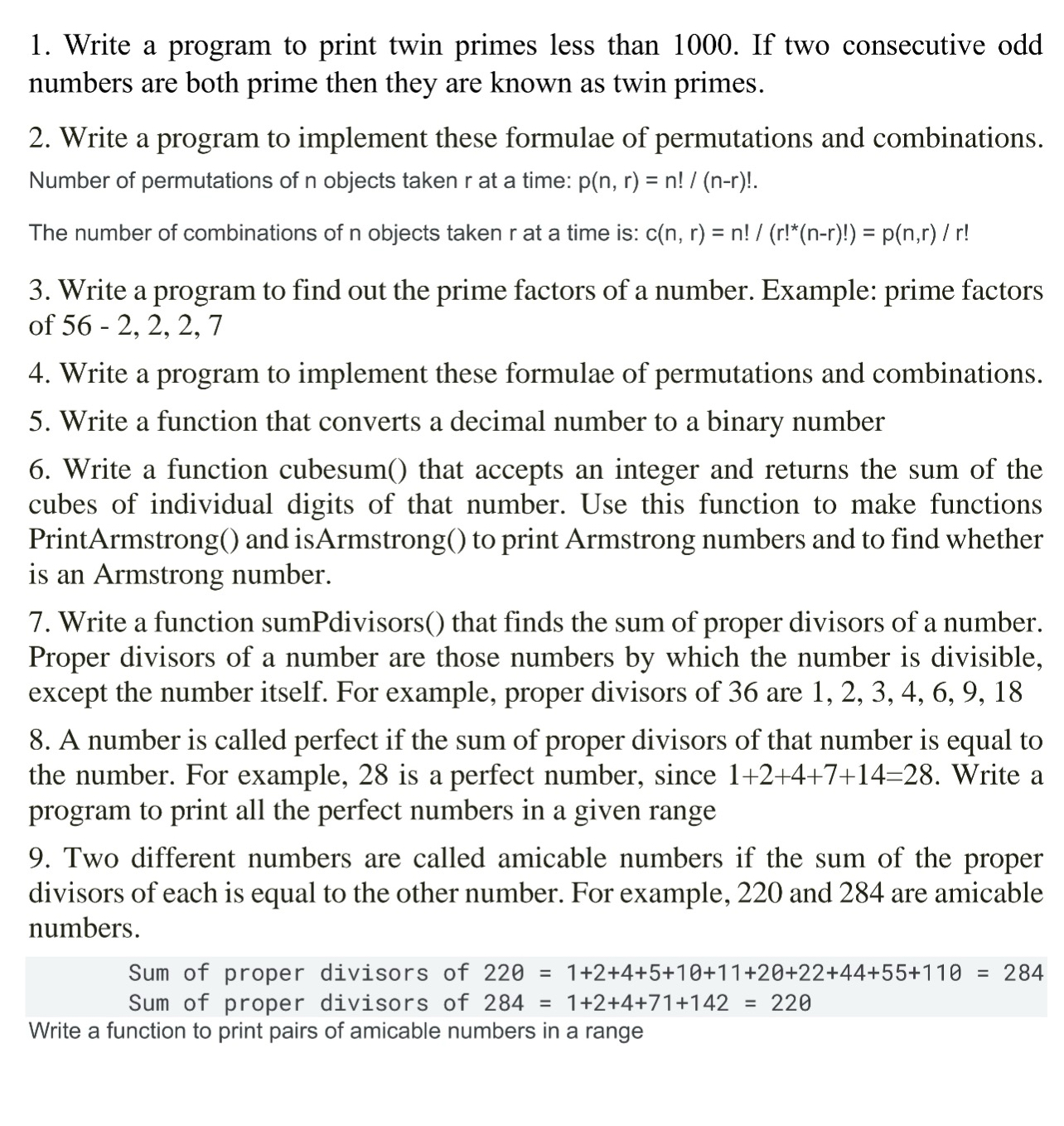
Question: Write a program to print twin primes less than 1 0 0 0 . If two consecutive odd numbers are both prime then they are
Write a program to print twin primes less than If two consecutive odd numbers are both prime then they are known as twin primes.
Write a program to implement these formulae of permutations and combinations. Number of permutations of objects taken at a time:
The number of combinations of objects taken at a time is:
Write a program to find out the prime factors of a number. Example: prime factors of
Write a program to implement these formulae of permutations and combinations.
Write a function that converts a decimal number to a binary number
Write a function cubesum that accepts an integer and returns the sum of the cubes of individual digits of that number. Use this function to make functions PrintArmstrong and isArmstrong to print Armstrong numbers and to find whether is an Armstrong number.
Write a function sumPdivisors that finds the sum of proper divisors of a number. Proper divisors of a number are those numbers by which the number is divisible, except the number itself. For example, proper divisors of are
A number is called perfect if the sum of proper divisors of that number is equal to the number. For example, is a perfect number, since Write a program to print all the perfect numbers in a given range
Two different numbers are called amicable numbers if the sum of the proper divisors of each is equal to the other number. For example, and are amicable numbers.
Sum proper divisors
Sum proper divisors
Write a function to print pairs of amicable numbers in a range
Step by Step Solution
There are 3 Steps involved in it
1 Expert Approved Answer
Step: 1 Unlock

Question Has Been Solved by an Expert!
Get step-by-step solutions from verified subject matter experts
Step: 2 Unlock
Step: 3 Unlock
 Study Help