







Question: Write a Python function that takes as input a list A and an index j and returns the maximum sum of consecutive numbers in the
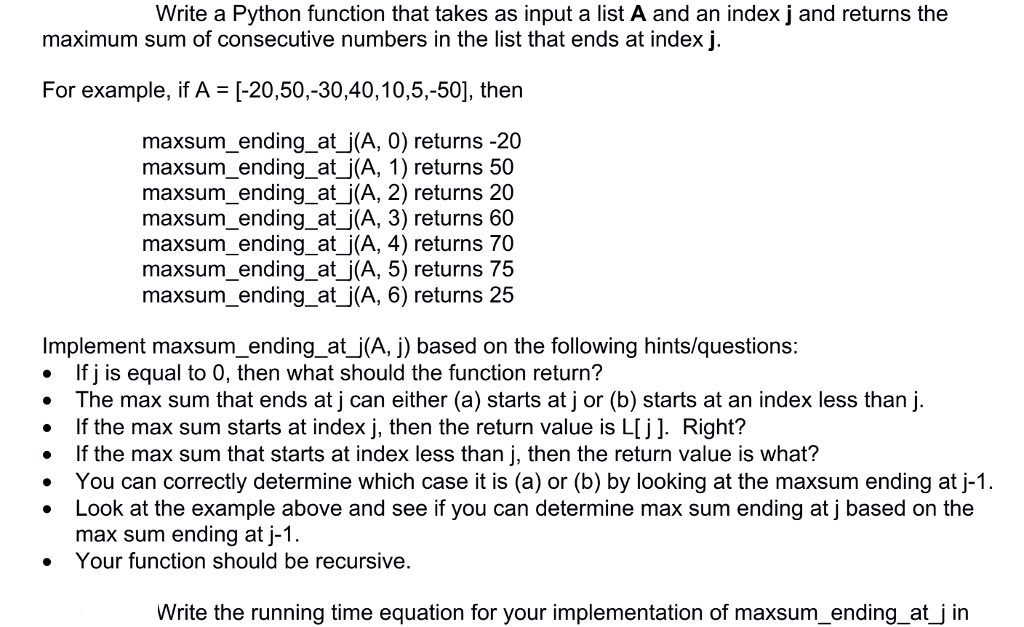
Write a Python function that takes as input a list A and an index j and returns the maximum sum of consecutive numbers in the list that ends at index j For example, if A = [-20,50,-30,40, 10.5,-50], then maxsum ending_at_j(A, 0) returns -20 maxsum_ending_at _j(A, 1) returns 50 maxsum_ending_at_j(A, 2) returns 20 maxsum_ending_at_j(A, 3) returns 60 maxsum_ending_at_j(A, 4) returns 70 maxsum_ending_at_j(A, 5) returns 75 maxsum_ending_at j(A, 6) returns 25 Implement maxsum_ending_at_j(A, j) based on the following hints/questions: If j is equal to 0, then what should the function return? . The max sum that ends at j can either (a) starts at j or (b) starts at an index less than j . If the max sum starts at index j, then the return value is LIj]. Right? . If the max sum that starts at index less than j, then the return value is what? . You can correctly determine which case it is (a) or (b) by looking at the maxsum ending at 1 Look at the example above and see if you can determine max sum ending at j based on the max sum ending at j-1. . Your function should be recursive. Write the running time equation for your implementation of maxsum_ending_at_j in
Step by Step Solution
There are 3 Steps involved in it

Get step-by-step solutions from verified subject matter experts
 Study Help