







Question: Write a response in relation to the article. Do not use prior post on the article. Cultures Clash at Ford saving profits ten years earlier,
Write a response in relation to the article. Do not use prior post on the article.
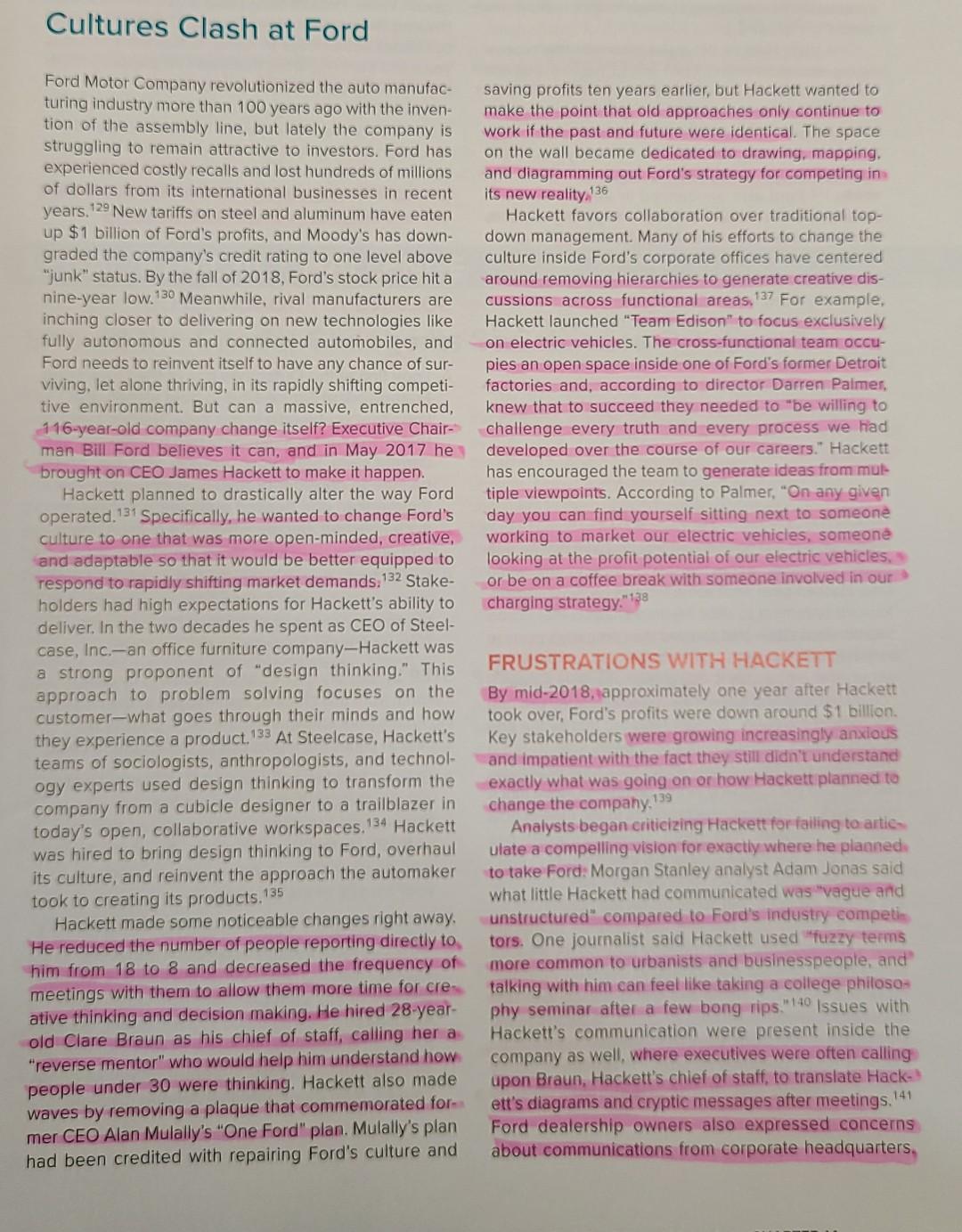
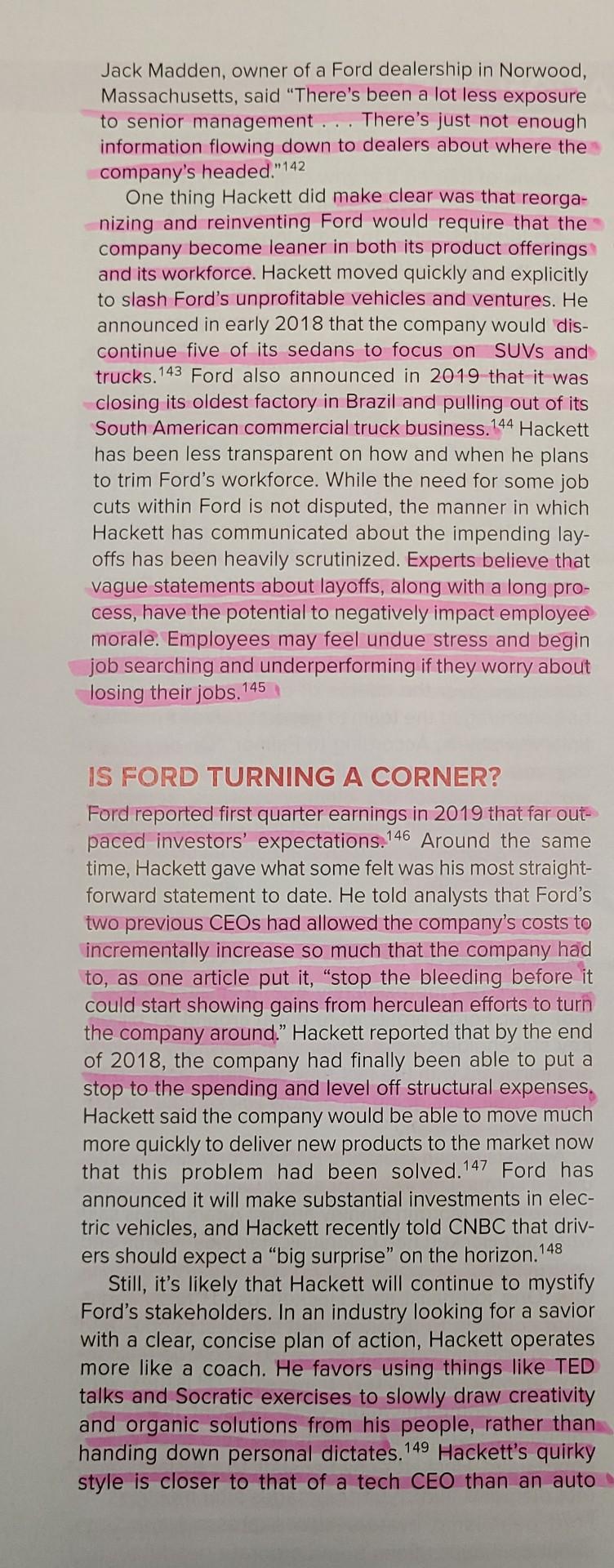
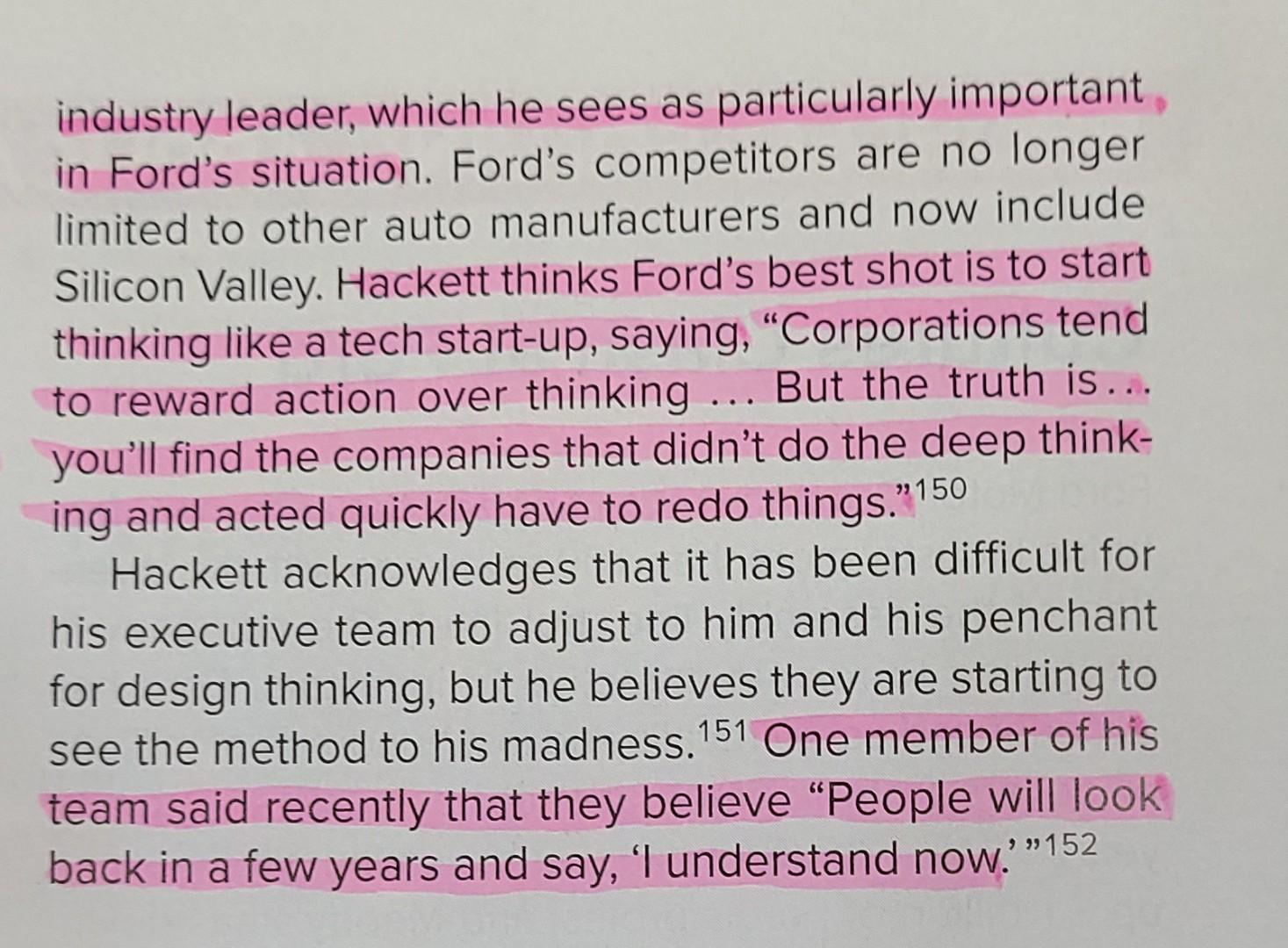
Cultures Clash at Ford saving profits ten years earlier, but Hackett wanted to make the point that old approaches only continue to work if the past and future were identical. The space on the wall became dedicated to drawing, mapping, and diagramming out Ford's strategy for competing in its new reality 136 Hackett favors collaboration over traditional top- down management. Many of his efforts to change the culture inside Ford's corporate offices have centered around removing hierarchies to generate creative dis- cussions across functional areas,137 For example, Hackett launched "Team Edison" to focus exclusively on electric vehicles. The cross-functional team occu- pies an open space inside one of Ford's former Detroit factories and, according to director Darren Palmer knew that to succeed they needed to "be willing to challenge every truth and every process we had developed over the course of our careers." Hackett has encouraged the team to generate ideas from mul- tiple viewpoints. According to Palmer, "On any given day you can find yourself sitting next to someone working to market our electric vehicles, someone looking at the profit potential of our electric vehicles, or be on a coffee break with someone involved in our charging strategy."138 Ford Motor Company revolutionized the auto manufac- turing industry more than 100 years ago with the inven- tion of the assembly line, but lately the company is struggling to remain attractive to investors. Ford has experienced costly recalls and lost hundreds of millions of dollars from its international businesses in recent years. 129 New tariffs on steel and aluminum have eaten up $1 billion of Ford's profits, and Moody's has down- graded the company's credit rating to one level above "junk" status. By the fall of 2018, Ford's stock price hit a nine-year low. 130 Meanwhile, rival manufacturers are inching closer to delivering on new technologies like fully autonomous and connected automobiles, and Ford needs to reinvent itself to have any chance of sur- viving, let alone thriving, in its rapidly shifting competi- tive environment. But can a massive, entrenched, 116-year-old company change itself? Executive Chair- man Bill Ford believes it can, and in May 2017 he brought on CEO James Hackett to make it happen. Hackett planned to drastically alter the way Ford operated, 131 Specifically, he wanted to change Ford's culture to one that was more open-minded, creative, and adaptable so that it would be better equipped to respond to rapidly shifting market demands, 132 Stake- holders had high expectations for Hackett's ability to deliver. In the two decades he spent as CEO of Steel- case, Inc.-an office furniture company--Hackett was a strong proponent of "design thinking." This approach to problem solving focuses on the customer-what goes through their minds and how they experience a product.133 At Steelcase, Hackett's teams of sociologists, anthropologists, and technol- ogy experts used design thinking to transform the company from a cubicle designer to a trailblazer in today's open, collaborative workspaces. 134 Hackett was hired to bring design thinking to Ford, overhaul its culture, and reinvent the approach the automaker took to creating its products. 135 Hackett made some noticeable changes right away. He reduced the number of people reporting directly to him from 18 to 8 and decreased the frequency of meetings with them to allow them more time for cre ative thinking and decision making. He hired 28-year- old Clare Braun as his chief of staff, calling her a "reverse mentor" who would help him understand how people under 30 were thinking. Hackett also made waves by removing a plaque that commemorated for mer CEO Alan Mulally's "One Ford" plan. Mulally's plan had been credited with repairing Ford's culture and FRUSTRATIONS WITH HACKETT By mid-2018, approximately one year after Hackett took over, Ford's profits were down around $1 billion. Key stakeholders were growing increasingly anxious and impatient with the fact they still didn't understand exactly what was going on or how Hackett planned to change the company. 139 Analysts began criticizing Hackett for failing to artic ulate a compelling vision for exactly where he planned to take Ford: Morgan Stanley analyst Adam Jonas said what little Hackett had communicated was "vague and unstructured" compared to Ford's industry competis tors. One journalist said Hackett used "fuzzy terms more common to urbanists and businesspeople, and talking with him can feel like taking a college philosos phy seminar after a few bong rips." *140 Issues with Hackett's communication were present inside the company as well, where executives were often calling upon Braun, Hackett's chief of staff, to translate Hack) ett's diagrams and cryptic messages after meetings. 141 Ford dealership owners also expressed concerns about communications from corporate headquarters, Jack Madden, owner of a Ford dealership in Norwood, Massachusetts, said "There's been a lot less exposure to senior management ... There's just not enough information flowing down to dealers about where the company's headed."142 One thing Hackett did make clear was that reorga- nizing and reinventing Ford would require that the company become leaner in both its product offerings and its workforce. Hackett moved quickly and explicitly to slash Ford's unprofitable vehicles and ventures. He announced in early 2018 that the company would dis- continue five of its sedans to focus on SUVs and trucks.143 Ford also announced in 2019 that it was closing its oldest factory in Brazil and pulling out of its South American commercial truck business. 144 Hackett has been less transparent on how and when he plans to trim Ford's workforce. While the need for some job cuts within Ford is not disputed, the manner in which Hackett has communicated about the impending lay- offs has been heavily scrutinized. Experts believe that vague statements about layoffs, along with a long pro- cess, have the potential to negatively impact employee morale. Employees may feel undue stress and begin job searching and underperforming if they worry about losing their jobs. 145 IS FORD TURNING A CORNER? Ford reported first quarter earnings in 2019 that far out- paced investors' expectations. 146 Around the same time, Hackett gave what some felt was his most straight- forward statement to date. He told analysts that Ford's two previous CEOs had allowed the company's costs to incrementally increase so much that the company had to, as one article put it, "stop the bleeding before it could start showing gains from herculean efforts to turn the company around." Hackett reported that by the end of 2018, the company had finally been able to put a stop to the spending and level off structural expenses. Hackett said the company would be able to move much more quickly to deliver new products to the market now that this problem had been solved.147 Ford has announced it will make substantial investments in elec- tric vehicles, and Hackett recently told CNBC that driv- ers should expect a "big surprise" on the horizon.148 Still, it's likely that Hackett will continue to mystify Ford's stakeholders. In an industry looking for a savior with a clear, concise plan of action, Hackett operates more like a coach. He favors using things like TED talks and Socratic exercises to slowly draw creativity and organic solutions from his people, rather than handing down personal dictates.149 Hackett's quirky style is closer to that of a tech CEO than an auto . . . industry leader, which he sees as particularly important, in Ford's situation. Ford's competitors are no longer limited to other auto manufacturers and now include Silicon Valley. Hackett thinks Ford's best shot is to start thinking like a tech start-up, saying, Corporations tend to reward action over thinking But the truth is... you'll find the companies that didn't do the deep think- ing and acted quickly have to redo things."150 Hackett acknowledges that it has been difficult for his executive team to adjust to him and his penchant for design thinking, but he believes they are starting to see the method to his madness. 151 One member of his team said recently that they believe People will look back in a few years and say, 'I understand now.'"152 > Cultures Clash at Ford saving profits ten years earlier, but Hackett wanted to make the point that old approaches only continue to work if the past and future were identical. The space on the wall became dedicated to drawing, mapping, and diagramming out Ford's strategy for competing in its new reality 136 Hackett favors collaboration over traditional top- down management. Many of his efforts to change the culture inside Ford's corporate offices have centered around removing hierarchies to generate creative dis- cussions across functional areas,137 For example, Hackett launched "Team Edison" to focus exclusively on electric vehicles. The cross-functional team occu- pies an open space inside one of Ford's former Detroit factories and, according to director Darren Palmer knew that to succeed they needed to "be willing to challenge every truth and every process we had developed over the course of our careers." Hackett has encouraged the team to generate ideas from mul- tiple viewpoints. According to Palmer, "On any given day you can find yourself sitting next to someone working to market our electric vehicles, someone looking at the profit potential of our electric vehicles, or be on a coffee break with someone involved in our charging strategy."138 Ford Motor Company revolutionized the auto manufac- turing industry more than 100 years ago with the inven- tion of the assembly line, but lately the company is struggling to remain attractive to investors. Ford has experienced costly recalls and lost hundreds of millions of dollars from its international businesses in recent years. 129 New tariffs on steel and aluminum have eaten up $1 billion of Ford's profits, and Moody's has down- graded the company's credit rating to one level above "junk" status. By the fall of 2018, Ford's stock price hit a nine-year low. 130 Meanwhile, rival manufacturers are inching closer to delivering on new technologies like fully autonomous and connected automobiles, and Ford needs to reinvent itself to have any chance of sur- viving, let alone thriving, in its rapidly shifting competi- tive environment. But can a massive, entrenched, 116-year-old company change itself? Executive Chair- man Bill Ford believes it can, and in May 2017 he brought on CEO James Hackett to make it happen. Hackett planned to drastically alter the way Ford operated, 131 Specifically, he wanted to change Ford's culture to one that was more open-minded, creative, and adaptable so that it would be better equipped to respond to rapidly shifting market demands, 132 Stake- holders had high expectations for Hackett's ability to deliver. In the two decades he spent as CEO of Steel- case, Inc.-an office furniture company--Hackett was a strong proponent of "design thinking." This approach to problem solving focuses on the customer-what goes through their minds and how they experience a product.133 At Steelcase, Hackett's teams of sociologists, anthropologists, and technol- ogy experts used design thinking to transform the company from a cubicle designer to a trailblazer in today's open, collaborative workspaces. 134 Hackett was hired to bring design thinking to Ford, overhaul its culture, and reinvent the approach the automaker took to creating its products. 135 Hackett made some noticeable changes right away. He reduced the number of people reporting directly to him from 18 to 8 and decreased the frequency of meetings with them to allow them more time for cre ative thinking and decision making. He hired 28-year- old Clare Braun as his chief of staff, calling her a "reverse mentor" who would help him understand how people under 30 were thinking. Hackett also made waves by removing a plaque that commemorated for mer CEO Alan Mulally's "One Ford" plan. Mulally's plan had been credited with repairing Ford's culture and FRUSTRATIONS WITH HACKETT By mid-2018, approximately one year after Hackett took over, Ford's profits were down around $1 billion. Key stakeholders were growing increasingly anxious and impatient with the fact they still didn't understand exactly what was going on or how Hackett planned to change the company. 139 Analysts began criticizing Hackett for failing to artic ulate a compelling vision for exactly where he planned to take Ford: Morgan Stanley analyst Adam Jonas said what little Hackett had communicated was "vague and unstructured" compared to Ford's industry competis tors. One journalist said Hackett used "fuzzy terms more common to urbanists and businesspeople, and talking with him can feel like taking a college philosos phy seminar after a few bong rips." *140 Issues with Hackett's communication were present inside the company as well, where executives were often calling upon Braun, Hackett's chief of staff, to translate Hack) ett's diagrams and cryptic messages after meetings. 141 Ford dealership owners also expressed concerns about communications from corporate headquarters, Jack Madden, owner of a Ford dealership in Norwood, Massachusetts, said "There's been a lot less exposure to senior management ... There's just not enough information flowing down to dealers about where the company's headed."142 One thing Hackett did make clear was that reorga- nizing and reinventing Ford would require that the company become leaner in both its product offerings and its workforce. Hackett moved quickly and explicitly to slash Ford's unprofitable vehicles and ventures. He announced in early 2018 that the company would dis- continue five of its sedans to focus on SUVs and trucks.143 Ford also announced in 2019 that it was closing its oldest factory in Brazil and pulling out of its South American commercial truck business. 144 Hackett has been less transparent on how and when he plans to trim Ford's workforce. While the need for some job cuts within Ford is not disputed, the manner in which Hackett has communicated about the impending lay- offs has been heavily scrutinized. Experts believe that vague statements about layoffs, along with a long pro- cess, have the potential to negatively impact employee morale. Employees may feel undue stress and begin job searching and underperforming if they worry about losing their jobs. 145 IS FORD TURNING A CORNER? Ford reported first quarter earnings in 2019 that far out- paced investors' expectations. 146 Around the same time, Hackett gave what some felt was his most straight- forward statement to date. He told analysts that Ford's two previous CEOs had allowed the company's costs to incrementally increase so much that the company had to, as one article put it, "stop the bleeding before it could start showing gains from herculean efforts to turn the company around." Hackett reported that by the end of 2018, the company had finally been able to put a stop to the spending and level off structural expenses. Hackett said the company would be able to move much more quickly to deliver new products to the market now that this problem had been solved.147 Ford has announced it will make substantial investments in elec- tric vehicles, and Hackett recently told CNBC that driv- ers should expect a "big surprise" on the horizon.148 Still, it's likely that Hackett will continue to mystify Ford's stakeholders. In an industry looking for a savior with a clear, concise plan of action, Hackett operates more like a coach. He favors using things like TED talks and Socratic exercises to slowly draw creativity and organic solutions from his people, rather than handing down personal dictates.149 Hackett's quirky style is closer to that of a tech CEO than an auto . . . industry leader, which he sees as particularly important, in Ford's situation. Ford's competitors are no longer limited to other auto manufacturers and now include Silicon Valley. Hackett thinks Ford's best shot is to start thinking like a tech start-up, saying, Corporations tend to reward action over thinking But the truth is... you'll find the companies that didn't do the deep think- ing and acted quickly have to redo things."150 Hackett acknowledges that it has been difficult for his executive team to adjust to him and his penchant for design thinking, but he believes they are starting to see the method to his madness. 151 One member of his team said recently that they believe People will look back in a few years and say, 'I understand now.'"152 >
Step by Step Solution
There are 3 Steps involved in it
1 Expert Approved Answer
Step: 1 Unlock

Question Has Been Solved by an Expert!
Get step-by-step solutions from verified subject matter experts
Step: 2 Unlock
Step: 3 Unlock
 Study Help