







Question: Write a set of big step transition rules for this new expression language . To combine Boolean and arithmetic expressions, the semantics should interpret the
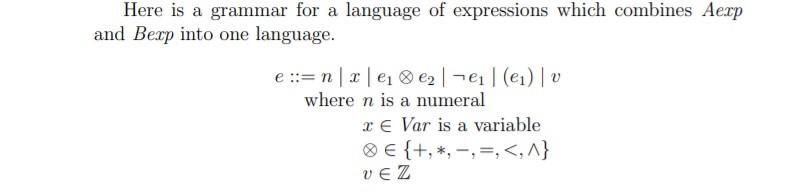
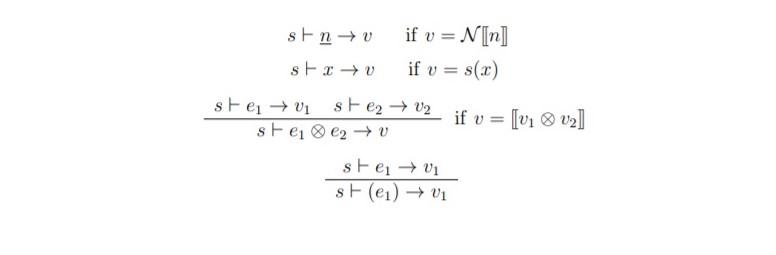
Write a set of big step transition rules for this new expression language. To combine Boolean and arithmetic expressions, the semantics should interpret the (integer) constant 0 as the (Boolean) constant ff (false). Any nonzero integer value should interpreted as tt (true). One default integer value for tt could be 1, but could also be any other non-zero number. The generalizations of the Aexp rules in the image below. You're needed to extend the meaning of an expressions of the form [[v1 v2]] when {=, . You also need to write rules for the expression e1.
Here is a grammar for a language of expressions which combines Aexp and Bexp into one language. e::=n | 2 | 2 |-|(ei) | v where n is a numeral 2 Var is a variable E {+, *,-- =,
Step by Step Solution
There are 3 Steps involved in it

Get step-by-step solutions from verified subject matter experts
 Study Help