







Question: Write a short summary about this case. CASE CASE 2.1 TO INVEST OR NOT TO INVEST? THAT IS THE QUESTION Dean Pallotta was president and
Write a short summary about this case.
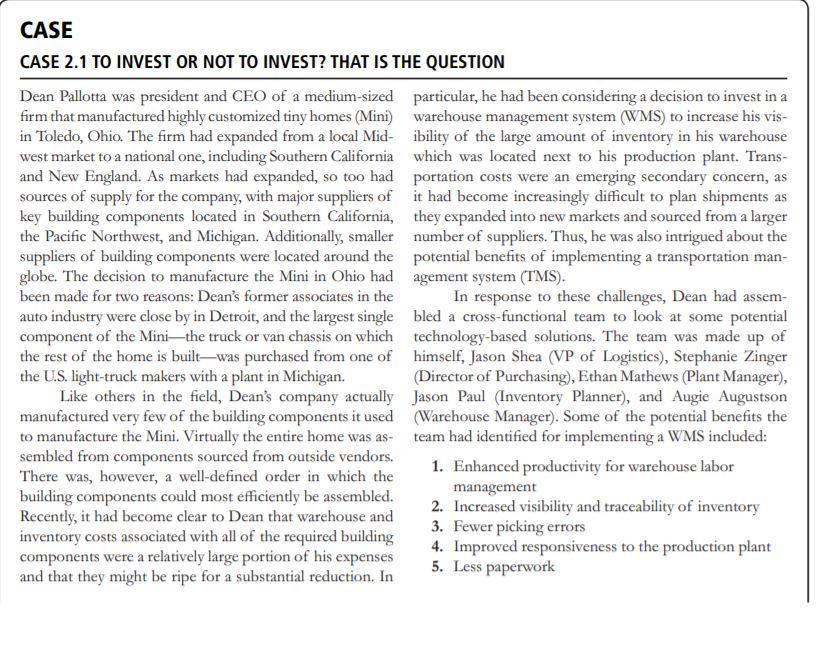
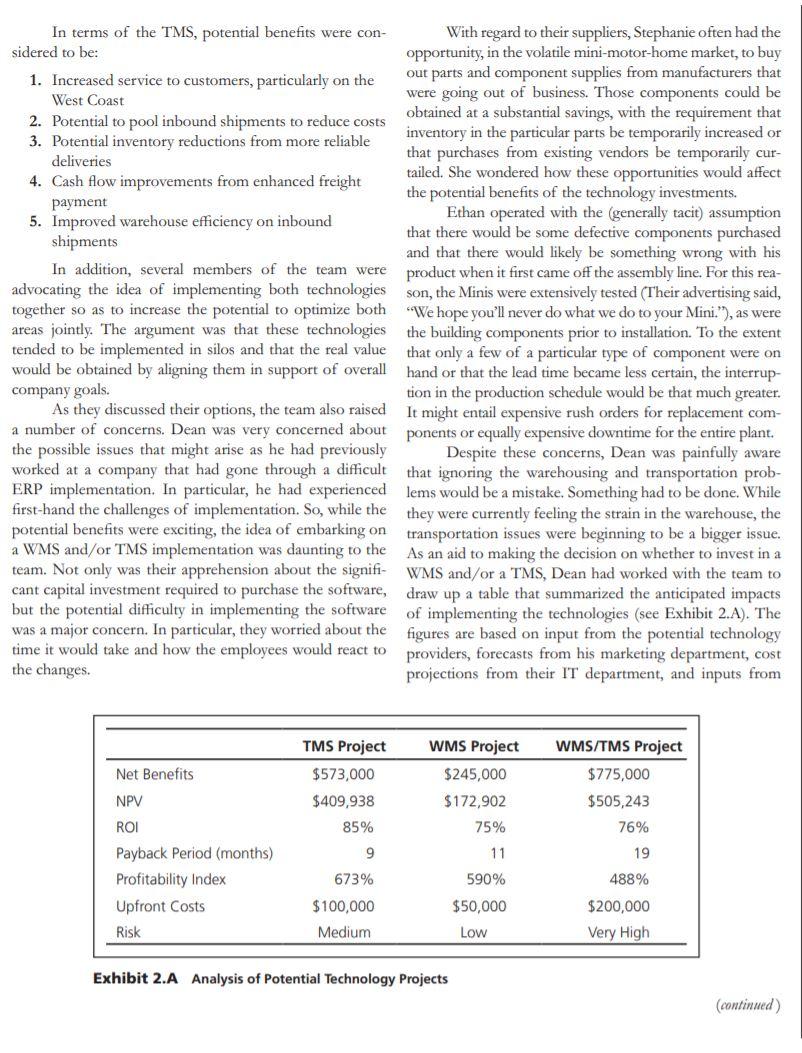
CASE CASE 2.1 TO INVEST OR NOT TO INVEST? THAT IS THE QUESTION Dean Pallotta was president and CEO of a medium-sized particular, he had been considering a decision to invest in a firm that manufactured highly customized tiny homes (Mini) warehouse management system (WMS) to increase his vis- in Toledo, Ohio. The firm had expanded from a local Mid- ibility of the large amount of inventory in his warehouse west market to a national one, including Southern California which was located next to his production plant. Trans- and New England. As markets had expanded, so too had portation costs were an emerging secondary concern, as sources of supply for the company, with major suppliers of it had become increasingly difficult to plan shipments as key building components located in Southern California, they expanded into new markets and sourced from a larger the Pacific Northwest, and Michigan. Additionally, smaller number of suppliers. Thus, he was also intrigued about the suppliers of building components were located around the potential benefits of implementing a transportation man- globe. The decision to manufacture the Mini in Ohio had agement system (TMS). been made for two reasons: Dean's former associates in the In response to these challenges, Dean had assem- auto industry were close by in Detroit, and the largest single bled a cross-functional team to look at some potential component of the Minithe truck or van chassis on which technology-based solutions. The team was made up of the rest of the home is builtwas purchased from one of himself, Jason Shea (VP of Logistics), Stephanie Zinger the U.S. light-truck makers with a plant in Michigan. (Director of Purchasing), Ethan Mathews (Plant Manager), Like others in the field, Dean's company actually Jason Paul Inventory Planner), and Augie Augustson manufactured very few of the building components it used (Warehouse Manager). Some of the potential benefits the to manufacture the Mini. Virtually the entire home was as- team had identified for implementing a WMS included: sembled from components sourced from outside vendors. There was, however, a well-defined order in which the 1. Enhanced productivity for warehouse labor building components could most efficiently be assembled. management Recently, it had become clear to Dean that warehouse and 2. Increased visibility and traceability of inventory inventory costs associated with all of the required building 3. Fewer picking errors components were a relatively large portion of his expenses 4. Improved responsiveness to the production plant and that they might be ripe for a substantial reduction. In 5. Less paperwork In terms of the TMS, potential benefits were con- With regard to their suppliers, Stephanie often had the sidered to be: opportunity, in the volatile mini-motor-home market, to buy 1. Increased service to customers, particularly on the out parts and component supplies from manufacturers that West Coast were going out of business. Those components could be 2. Potential to pool inbound shipments to reduce costs obtained at a substantial savings, with the requirement that 3. Potential inventory reductions from more reliable inventory in the particular parts be temporarily increased or deliveries that purchases from existing vendors be temporarily cur- 4. Cash flow improvements from enhanced freight tailed. She wondered how these opportunities would affect the potential benefits of the technology investments. payment 5. Improved warehouse efficiency on inbound Ethan operated with the (generally tacit) assumption that there would be some defective components purchased shipments and that there would likely be something wrong with his In addition, several members of the team were product when it first came off the assembly line. For this rea- advocating the idea of implementing both technologies son, the Minis were extensively tested (Their advertising said, together so as to increase the potential to optimize both"We hope you'll never do what we do to your Mini."), as were areas jointly. The argument was that these technologies the building components prior to installation. To the extent tended to be implemented in silos and that the real value that only a few of a particular type of component were on would be obtained by aligning them in support of overall hand or that the lead time became less certain, the interrup- company goals. tion in the production schedule would be that much greater. As they discussed their options, the team also raised It might entail expensive rush orders for replacement com- a number of concerns. Dean was very concerned about ponents or equally expensive downtime for the entire plant. the possible issues that might arise as he had previously Despite these concerns, Dean was painfully aware worked at a company that had gone through a difficult that ignoring the warehousing and transportation prob- ERP implementation. In particular, he had experienced lems would be a mistake, Something had to be done. While first-hand the challenges of implementation. So, while the they were currently feeling the strain in the warehouse, the potential benefits were exciting, the idea of embarking on transportation issues were beginning to be a bigger issue. a WMS and/or TMS implementation was daunting to the As an aid to making the decision on whether to invest in a team. Not only was their apprehension about the signifi- WMS and/or a TMS, Dean had worked with the team to cant capital investment required to purchase the software, draw up a table that summarized the anticipated impacts but the potential difficulty in implementing the software of implementing the technologies (see Exhibit 2.A). The was a major concern. In particular, they worried about the figures are based on input from the potential technology time it would take and how the employees would react to providers, forecasts from his marketing department, cost the changes. projections from their IT department, and inputs from Net Benefits TMS Project $573,000 $409,938 85% 9 NPV WMS Project $245,000 $172,902 75% 11 590% WMS/TMS Project $775,000 $505,243 76% ROI 19 673% 488% Payback period (months) Profitability Index Upfront Costs Risk $50,000 $100,000 Medium $200,000 Very High Low Exhibit 2.A Analysis of Potential Technology Projects continued)Step by Step Solution
There are 3 Steps involved in it
1 Expert Approved Answer
Step: 1 Unlock

Question Has Been Solved by an Expert!
Get step-by-step solutions from verified subject matter experts
Step: 2 Unlock
Step: 3 Unlock
 Study Help