







Question: Write a simplified version of the model into MATLAB The two different conventions are labeled as new and old, and their number is N and
Write a simplified version of the model into MATLAB
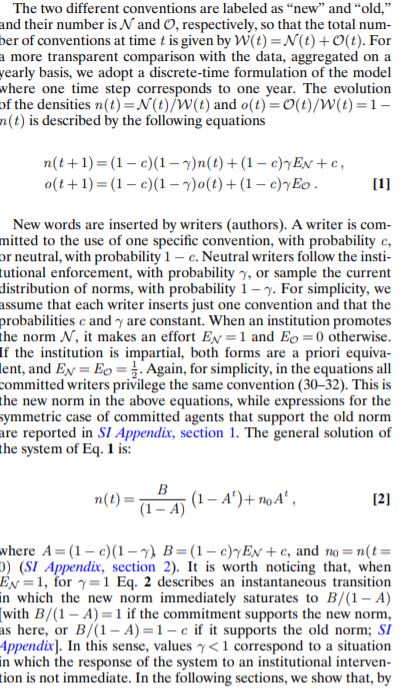
The two different conventions are labeled as "new" and "old," and their number is N and O, respectively, so that the total num- ber of conventions at time t is given by W(t)=N(t) + (t). For a more transparent comparison with the data, aggregated on a yearly basis, we adopt a discrete-time formulation of the model where one time step corresponds to one year. The evolution of the densities n(t) = N()/wt) and o(t) = 0(t)/W()=1 - (1) is described by the following equations n(t+1)= (1 - c)(1 - 1)n(t) + (1 - c) EN +e, o(t +1)= (1 - c)(1 - 7)o(t) + (1 - c) Eo. New words are inserted by writers (authors). A writer is com- mitted to the use of one specific convention, with probability C, or neutral, with probability 1 - c. Neutral writers follow the insti- tutional enforcement, with probability, or sample the current distribution of norms, with probability 1-7. For simplicity, we assume that each writer inserts just one convention and that the probabilities c and are constant. When an institution promotes the norm N, it makes an effort En = 1 and Eo =0 otherwise. If the institution is impartial, both forms are a priori equiva- lent, and En = Eo = Again, for simplicity, in the equations all committed writers privilege the same convention (30-32). This is the new norm in the above equations, while expressions for the symmetric case of committed agents that support the old norm are reported in SI Appendix, section 1. The general solution of the system of Eq. 1 is: B (1 - A )+ no A', (1 - A) [2] where A=(1-c)(1-1) B=(1-c) EN +c, and no = n(t= ) (SI Appendix, section 2). It is worth noticing that, when EN=1, for y=1 Eq. 2 describes an instantaneous transition in which the new norm immediately saturates to B/(1-A) with B/(1-A) = 1 if the commitment supports the new norm, as here, or B/(1 - A)=1 - c if it supports the old norm; SI Appendix). In this sense, values 7
Step by Step Solution
There are 3 Steps involved in it

Get step-by-step solutions from verified subject matter experts
 Study Help