





Question: Write a summary about the speedy trial act make it at least 100 words no bulletins W Follow the author's tweets about the latest crime

Write a summary about the speedy trial act make it at least 100 words no bulletins
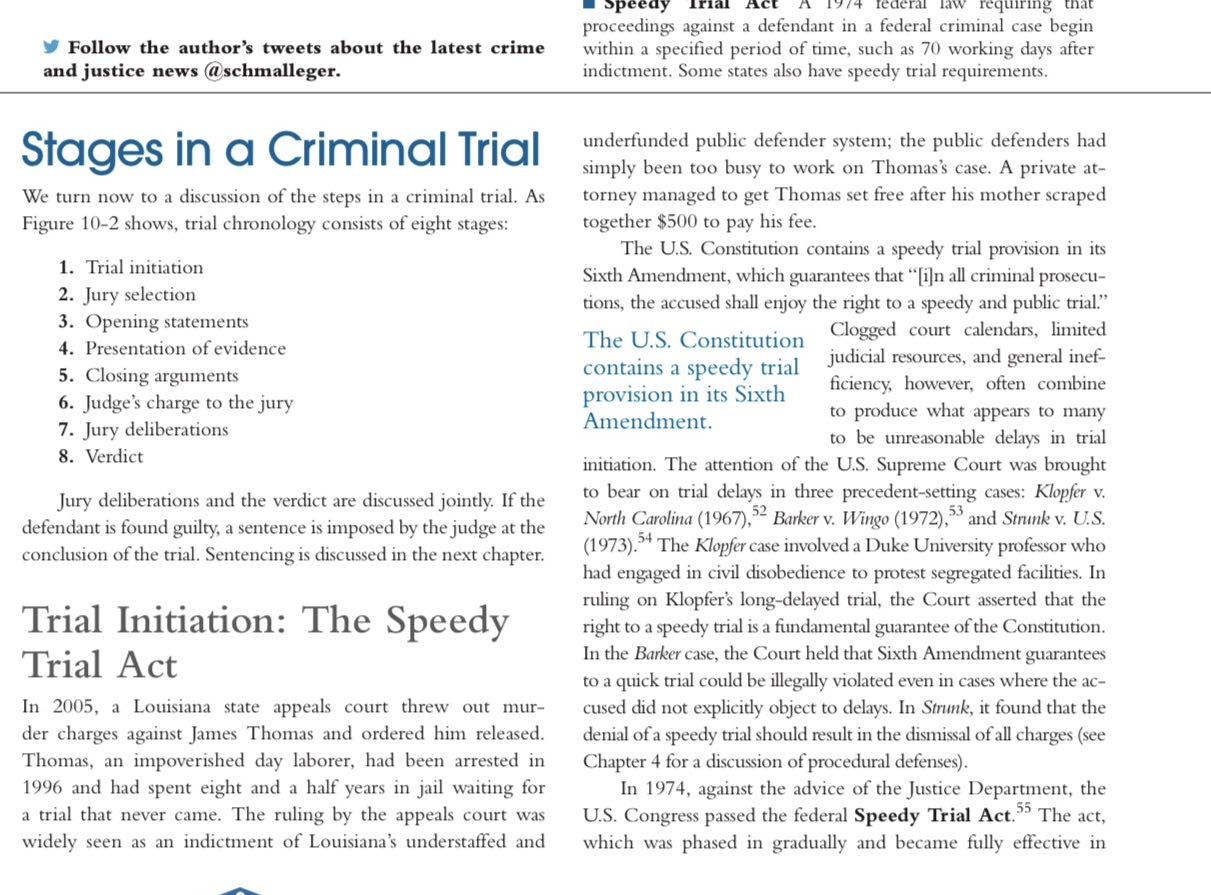
Write a summary about the speedy trial act make W Follow the author's tweets about the latest crime and justice news (@schmalleger. Stages in a Criminal Trial We turn now to a discussion of the steps in a criminal trial. As Figure 10-2 shows, trial chronology consists of eight stages: . Trial initiation . Jury selection . Opening statements . Presentation of evidence . Closing arguments . Judge's charge to the jury . Jury deliberations . Verdict aon awe Ne Jury deliberations and the verdict are discussed jointly. If the defendant is found guilty, a sentence is imposed by the judge at the conclusion of the trial. Sentencing is discussed in the next chapter. Trial Initiation: The Speedy Trial Act In 2005, a Louisiana state appeals court threw out mur- der charges against James Thomas and ordered him released. Thomas, an impoverished day laborer, had been arrested in 1996 and had spent eight and a half years in jail waiting for a trial that never came. The ruling by the appeals court was widely seen as an indictment of Louisiana's understaffed and m peeay irial Act A 1Y/4 rTeaeral law requiring tat proceedings against a defendant in a federal criminal case begin within a specified period of time, such as 70 working days after indictment. Some states also have speedy trial requirements. underfunded public defender system; the public defenders had simply been too busy to work on Thomas' case. A private at- torney managed to get Thomas set free after his mother scraped together $500 to pay his fee. The US. Constitution contains a speedy trial provision in its Sixth Amendment, which guarantees that \"[i]n all criminal prosecu- tions, the accused shall enjoy the right to a speedy and public trial.\" Clogged court calendars, limited The U.S, Constitution ; Judicial resources, and general inef- contains a speedy trial provision in its Sixth Amendment. ciency, however, often combine to produce what appears to many to be unreasonable delays in trial initiation. The attention of the U.S. Supreme Court was brought to bear on trial delays in three precedent-setting cases: Klopfer v. North Carolina (1967),7 Barker v. Wingo (1972), and Stnink v. U.S. (1973).4 The Klopfer case involved a Duke University professor who had engaged in civil disobedience to protest segregated facilities, In ruling on Klopfer's long-delayed trial, the Court asserted that the right to a speedy trial is a fundamental guarantee of the Constitution. In the Barker case, the Court held that Sixth Amendment guarantees to a quick trial could be illegally violated even in cases where the ac- cused did not explicitly object to delays. In Strunk, it found that the denial of a speedy trial should result in the dismissal of all charges (see Chapter 4 for a discussion of procedural defenses). In 1974, against the advice of the Justice Department, the USS. Congress passed the federal Speedy Trial Act.\" The act, which was phased in gradually and became fully effective in

Step by Step Solution

There are 3 Steps involved in it

1 Expert Approved Answer
Step: 1 Unlock blur-text-image

Question Has Been Solved by an Expert!

Get step-by-step solutions from verified subject matter experts

Step: 2 Unlock
Step: 3 Unlock

Students Have Also Explored These Related Law Questions!