Question: Write a summary of the article below, with a particular focus on the explanations why there are more women vegans than men. Your summary should

 Write a summary of the article below, with a particular focus on the explanations why there are more women vegans than men. Your summary should be between 200 words and 250 words. Read Assignment Two Guidelines (revised) carefully before you start writing.
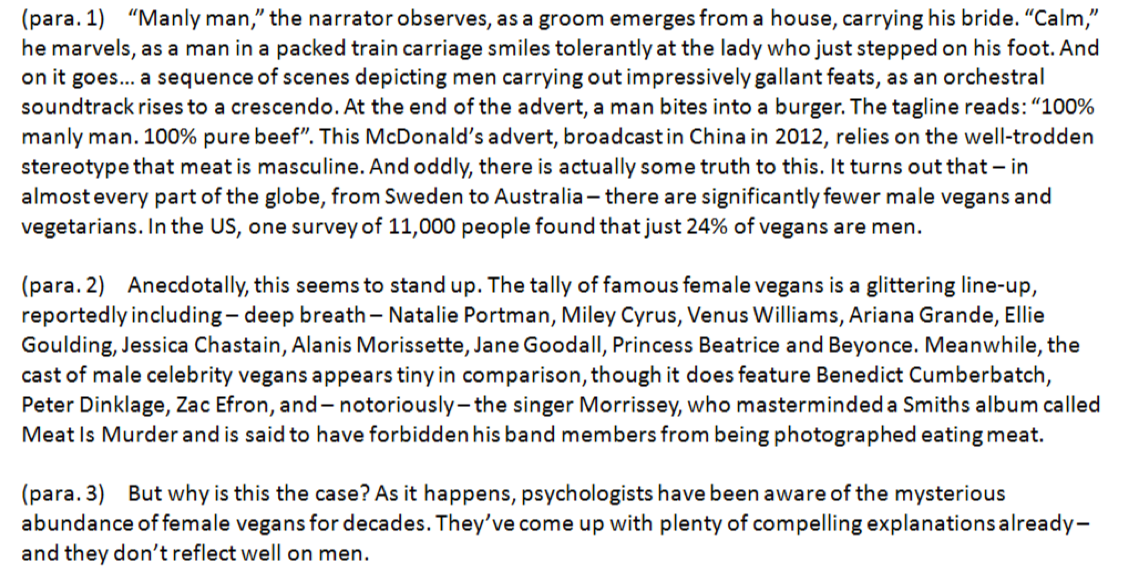
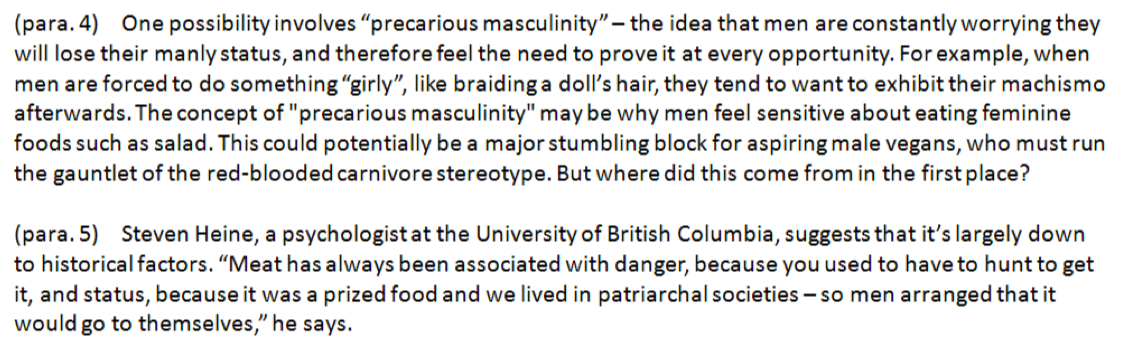
Assignment Two Guidelines (revised) Purpose The main purpose of this assignment is to test your ability to identify and condense main ideas and major details within a text. You need to demonstrate your ability to pick out the main message of a text and then reproduce them in your own words. Assignment Details On 13th March 2020, you will receive a SOUL message with the Assignment 2 question paper which contains a text of 1500-2000 words. From the reading, you need to produce a summary of between 200 and 250 words in complete paragraphs for a given purpose. You will be expected to use your own words and phrases as much as possible. This is to encourage you to demonstrate your knowledge and control of language. If you just copy out parts of the source text, it is difficult to know your level of language skills. Special Reminders Write in complete sentences. Bullet-point layout should not be used. > Identify the focus of the summary by reading the instruction carefully. Do not simply summarise the whole article without reading the instruction. Do not use any direct quotation" in this assignment as you need to demonstrate your paraphrasing skills in your work. Any words quoted directly will NOT be marked, even if they contain key points. In other words, you will not get the relevant key point marks if you do not use your own words. No marks will be given for complete sentences or other sizeable chunks lifted directly No marks will be given for complete sentences or other sizeable chunks lifted directly from the source text. This is called plagiarism. If your summary is over the word limit (250 words), any material written after the word limit will NOT be marked. Key assessment items from the Assessment Criteria Lexical accuracy and range Grammatical accuracy and range Effective organisation A range B range C range Writing shows highly effective use Writing shows very good range An extremely coherent piece of of vocabulary to meet the and control of grammatical writing, successfully organised requirements of the task. structures which are used with confident and appropriate Vocabulary is used appropriately appropriately and effectively to use of cohesive devices where and effectively to communicate address requirements of the task. necessary. Requires no effort on and is accurate in all respects. There are very few errors. the part of the reader. Writing shows good use of Writing shows a sufficiently good A coherent piece of writing with vocabulary used effectively and range and control of grammar. occasional lapses which do not appropriately with occasional Structures are generally used affect the reader. Generally well lapses. Spelling is generally appropriately. Despite occasional organised with appropriate use accurate. Occasional errors do errors, communication is not of cohesive devices. not affect the reader. hindered. Writing makes a largely effective A limited range of structures is A generally coherent piece of use of the vocabulary though at present. There are several errors writing though there are several times this does not meet the which occasionally hinder the errors in the use of cohesive requirements of the task. There reader who has to think at times devices, which may affect the are a few spelling mistakes that about what the candidate wants reader's ability to follow the line occasionally hinder the reader. to say. of communication. Insufficient range of vocabulary Writing is lacking in range and A poor piece of writing, used to meet the requirements of control of structures. There are generally lacking in the task. Vocabulary is sometimes frequent errors which hinder organisation, with misuse of used inaccurately and there are communication and confuse the cohesive devices. Requires several spelling mistakes that reader at times. effort from the reader. slow the reader down. Candidate shows poor use of Writing shows poor range and Generally incoherent and poorly vocabulary. Vocabulary is used control of grammatical structures. organised, lacking in use of inaccurately, spelling is generally The writing is generally inaccurate cohesive devices. inaccurate and causes the reader and grammatical errors cause some difficulty. confusion. D-Frange (para. 1) "Manly man," the narrator observes, as a groom emerges from a house, carrying his bride. "Calm," he marvels, as a man in a packed train carriage smiles tolerantly at the lady who just stepped on his foot. And on it goes... a sequence of scenes depicting men carrying out impressively gallant feats, as an orchestral soundtrack rises to a crescendo. At the end of the advert, a man bites into a burger. The tagline reads: "100% manly man. 100% pure beef. This McDonald's advert, broadcast in China in 2012, relies on the well-trodden stereotype that meat is masculine. And oddly, there is actually some truth to this. It turns out that - in almost every part of the globe, from Sweden to Australia - there are significantly fewer male vegans and vegetarians. In the US, one survey of 11,000 people found that just 24% of vegans are men. (para. 2) Anecdotally, this seems to stand up. The tally of famous female vegans is a glittering line-up, reportedly including-deep breath - Natalie Portman, Miley Cyrus, Venus Williams, Ariana Grande, Ellie Goulding, Jessica Chastain, Alanis Morissette, Jane Goodall, Princess Beatrice and Beyonce. Meanwhile, the cast of male celebrity vegans appears tiny in comparison, though it does feature Benedict Cumberbatch, Peter Dinklage, Zac Efron, and- notoriously-the singer Morrissey, who masterminded a Smiths album called Meat Is Murder and is said to have forbidden his band members from being photographed eating meat. (para. 3) But why is this the case? As it happens, psychologists have been aware of the mysterious abundance of female vegans for decades. They've come up with plenty of compelling explanations already- and they don't reflect well on men. (para.4) One possibility involves precarious masculinity the idea that men are constantly worrying they will lose their manly status, and therefore feel the need to prove it at every opportunity. For example, when men are forced to do something "girly", like braiding a doll's hair, they tend to want to exhibit their machismo afterwards. The concept of "precarious masculinity" may be why men feel sensitive about eating feminine foods such as salad. This could potentially be a major stumbling block for aspiring male vegans, who must run the gauntlet of the red-blooded carnivore stereotype. But where did this come from in the first place? (para. 5) Steven Heine, a psychologist at the University of British Columbia, suggests that it's largely down to historical factors. Meat has always been associated with danger, because you used to have to hunt to get it, and status, because it was a prized food and we lived in patriarchal societies - so men arranged that it would go to themselves," he says. (para. 6) The male preference for meat is also thought to have been perpetuated by marketing. Starting in the 19th Century, when it became more socially acceptable for parties of women to dine alone, restaurants and advertising executives scrambled to decide which foods were suitably feminine. Their verdict? Fussy desserts and dainty salads were for women, while steak was for men. Fast-forward to today, and we're still passing these views on to the next generation. Take "soy boys. The Urban Dictionary defines the slang term as applying to "males who completely and utterly lack all necessary masculine qualities," and claims it originates from the (scientifically dubious) link between the over-consumption of soya products and harm to the male physique and libido. (para. 7) In his research, Heine has found that merely listing the vegetarian foods a person enjoys, below a detailed description of their personality and habits, can be enough to make them seem less masculine. Knowing that, perhaps some men are concerned about what will happen if they order a salad at a restaurant, he says. Margaret Thomas, a psychologist at Earlham College, Indiana, agrees. I don't think people necessarily recognise the extent to which the food they choose to eat affects their identity," she says. Thomas has also found that vegans are seen as less masculine-but only if it's a choice. When her study participants were told that a person had been forced into the diet because of mysterious "digestive issues, they weren't judged so harshly. (para. 8) Of course, the story of why there are more women vegans isn't all about men. Women are more compassionate in general, and particularly when it comes to animals. Women are more likely to have a problem with animal use in general and experimentation in particular, more likely to keep pets, and less likely to abuse them. Likewise, women make up 75% of the members of animal rights groups. In fact, feminists and animal activists have been working together for more than a century. Two prominent campaigners for women's suffrage, Alice Wright and Edith Good, lobbied the United Nations to give animals formal rights back in the 1940s - a proposition which is only just beginning to be considered today. (para. 9) In 2018, the psychologist Carolyn Semmler set out to uncover if women are better at resolving the so-called "meat paradox, which is the idea that people claim to love animals but are also fine with eating them. "There's a lot of literature about this," she says. Together with colleagues from the University of Adelaide, Semmler recruited 460 people for the study, and split them into two groups. Both were asked to select a lamb dish that they would like to eat, and then provided with some information. But while one half was merely asked to read about the nutritional content of their meal, the other was given a breakdown of exactly how lambs are reared and slaughtered, then shown a video of a precocious individual who had learnt to open a farm gate, all by him or herself. Each participant was surveyed at the beginning and the end of the study, to see how they felt and if their attitudes to meat had changed. (para. 10) "We saw some really interesting things happen," says Semmler. First of all, most women felt worse after reading about the connection between animals and meat, while the men were more or less unaffected. Second, while the women were generally less attached to meat by the end of the study, the men were more carnivorous than ever. There was a group of male participants who had a really strong reaction to the study, saying that they were going to eat more meat, because they thought we wanted them to eat less." One explained:...Based on the line of questioning in this survey, I am concerned that some lunatics might try to ban meat; I had better enjoy as much as possible while I am able." Though not all the men felt this way, a significant proportion did. The team didn't get the same response from a single woman. (para. 11) One possible reason for this is the discrepancy in the ways men and women deal with the meat paradox. A 2013 study, led by Hank Rothgerber from Bellarmine University, Kentucky, found that women are more likely to use "avoidance" strategies to cope, such as avoiding connecting meat with animals. This is surprisingly easy to implement in everyday life. The meat found in supermarkets rarely resembles the animals it comes from, making it difficult to form its connection to living things. Most supermarkets, restaurants and food brands tend to helpfully remove the more gruesome clues, such as eyeballs, feet and fur. If animals are depicted in their marketing, they're usually happy cartoons. Even the language we use helps to keep up the ruse, since we usually to refer to pork instead of pig, mutton instead of sheep, beef instead of cow, etc. (para. 12) In contrast to the dissociation strategy favoured by women, Semmler's study found that men generally tackle the troubling reality that they like animals and also eat them more directly, by denying that they can feel pain, suggesting that meat is essential if you want to be healthy, and invoking the hierarchy of the natural world, to justify the idea that humans can do what they like with other creatures. With this in mind, it makes sense that the female participants would be more affected - since the information they were asked to read snatched their usual coping mechanism away from them. The men, meanwhile, simply pressed on with their usual justifications and dug themselves in. (para. 13) Finally, there is "social dominance theory", which suggests that men might find meat more appealing when they're reminded it's made from animals, because it reinforces their sense of dominance and superiority-by viewing animals as unworthy of respect, they are asserting their power over them. There is some evidence to support this idea. A survey of the attitudes of American college students, conducted in 2015, found a link between a preference for a more hierarchically stratified society and the use - and endorsement of the use of - animals. (para. 14) The link between meat and dominance isn't just about animals - it also seems to extend to our own species. One early study, conducted in the 1980s by the anthropologist Peggy Sanday, involved comparing the power structures of a hundred hunter-gatherer cultures, some of which relied more on meat for food, and some of which relied more on gathered fruits and vegetables. She found that the meat-based societies tended to be more patriarchal, while the plant-based ones were generally more egalitarian. This is thought to be because men are more likely to be hunters, so where meat is important they automatically have more power if they want it - which the study findings suggest they do. Meanwhile, where gathered foods dominate, women might use the status this affords them to carve out more equal societies. (para. 15) Semmler thinks we need a lot more research before we can truly unravel the enigma of the women vegans, but it looks like it's down to a combination of different factors mentioned above. One thing is clear: as the global popularity of veganism gathers pace - the number of US vegans increased by 600% between 2014 and 2017 women are way ahead




