







Question: write a summary on this short article discusinng ethics in business As a university professor, I like to think that higher education can serve as
write a summary on this short article discusinng ethics in business 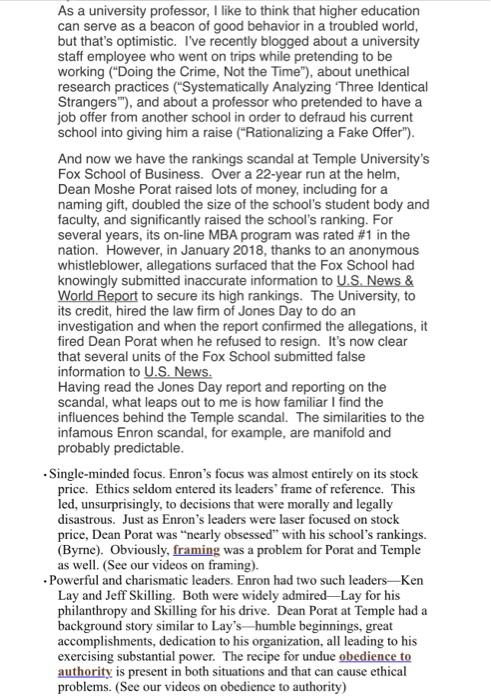
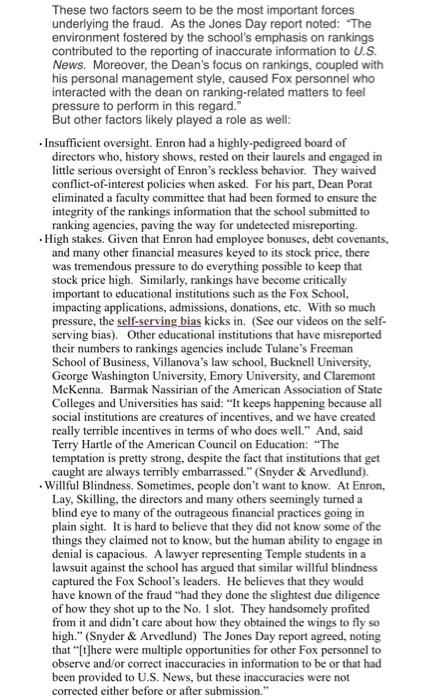
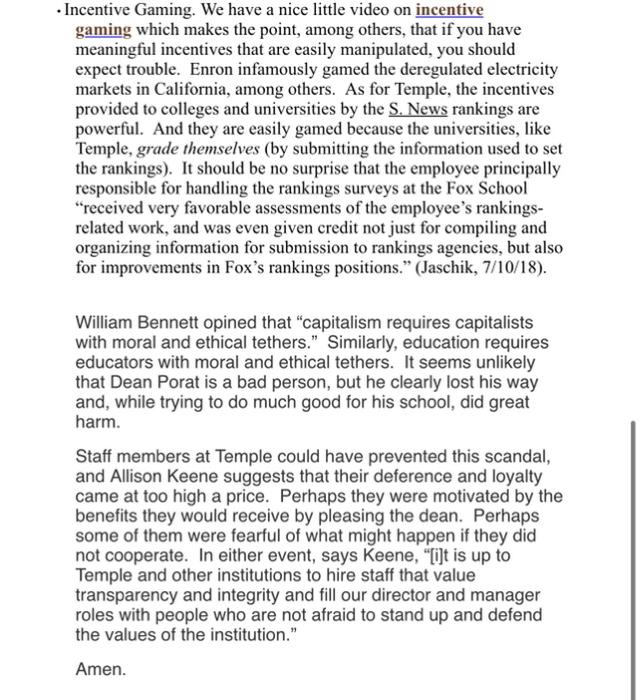
As a university professor, I like to think that higher education can serve as a beacon of good behavior in a troubled world, but that's optimistic. I've recently blogged about a university staff employee who went on trips while pretending to be working ("Doing the Crime, Not the Time"), about unethical research practices ("Systematically Analyzing Three Identical Strangers"), and about a professor who pretended to have a job offer from another school in order to defraud his current school into giving him a raise ("Rationalizing a Fake Offer"). And now we have the rankings scandal at Temple University's Fox School of Business. Over a 22-year run at the helm, Dean Moshe Porat raised lots of money, including for a naming gift, doubled the size of the school's student body and faculty, and significantly raised the school's ranking. For several years, its on-line MBA program was rated #1 in the nation. However, in January 2018, thanks to an anonymous whistleblower, allegations surfaced that the Fox School had knowingly submitted inaccurate information to U.S. News & World Report to secure its high rankings. The University, to its credit, hired the law firm of Jones Day to do an investigation and when the report confirmed the allegations, it fired Dean Porat when he refused to resign. It's now clear that several units of the Fox School submitted false information to U.S. News. Having read the Jones Day report and reporting on the scandal, what leaps out to me is how familiar I find the influences behind the Temple scandal. The similarities to the infamous Enron scandal, for example, are manifold and probably predictable. Single-minded focus. Enron's focus was almost entirely on its stock price. Ethics seldom entered its leaders' frame of reference. This led, unsurprisingly, to decisions that were morally and legally disastrous. Just as Enron's leaders were laser focused on stock price, Dean Porat was "nearly obsessed with his school's rankings. (Byrne). Obviously, framing was a problem for Porat and Temple as well. (See our videos on framing). Powerful and charismatic leaders. Enron had two such leaders-Ken Lay and Jeff Skilling. Both were widely admired-Lay for his philanthropy and Skilling for his drive. Dean Porat at Temple had a background story similar to Lay's-humble beginnings, great accomplishments, dedication to his organization, all leading to his exercising substantial power. The recipe for undue obedience to authority is present in both situations and that can cause ethical problems. (See our videos on obedience to authority) These two factors seem to be the most important forces underlying the fraud. As the Jones Day report noted: "The environment fostered by the school's emphasis on rankings contributed to the reporting of inaccurate information to U.S. News. Moreover, the Dean's focus on rankings, coupled with his personal management style, caused Fox personnel who interacted with the dean on ranking-related matters to feel pressure to perform in this regard." But other factors likely played a role as well: Insufficient oversight. Enron had a highly-pedigreed board of directors who, history shows, rested on their laurels and engaged in little serious oversight of Enron's reckless behavior. They waived conflict-of-interest policies when asked for his part, Dean Porat eliminated a faculty committee that had been formed to ensure the integrity of the rankings information that the school submitted to ranking agencies, paving the way for undetected misreporting. High stakes. Given that Enron had employee bonuses, debt covenants, and many other financial measures keyed to its stock price, there was tremendous pressure to do everything possible to keep that stock price high. Similarly, rankings have become critically important to educational institutions such as the Fox School, impacting applications, admissions, donations, etc. With so much pressure, the self-serving bias kicks in. (See our videos on the self- serving bias). Other educational institutions that have misreported their numbers to rankings agencies include Tulane's Freeman School of Business, Villanova's law school, Bucknell University, George Washington University, Emory University, and Claremont McKenna. Barmak Nassirian of the American Association of State Colleges and Universities has said: "It keeps happening because all social institutions are creatures of incentives, and we have created really terrible incentives in terms of who does well." And, said Terry Hartle of the American Council on Education: "The temptation is pretty strong, despite the fact that institutions that get caught are always terribly embarrassed." (Snyder & Arvedlund). Willful Blindness. Sometimes, people don't want to know. At Enron, Lay, Skilling, the directors and many others seemingly turned a blind eye to many of the outrageous financial practices going in plain sight. It is hard to believe that they did not know some of the things they claimed not to know, but the human ability to engage in denial is capacious. A lawyer representing Temple students in a lawsuit against the school has argued that similar willful blindness captured the Fox School's leaders. He believes that they would have known of the fraud "had they done the slightest due diligence of how they shot up to the No. 1 slot. They handsomely profited from it and didn't care about how they obtained the wings to fly so high." (Snyder & Arvedlund) The Jones Day report agreed, noting that "[t]here were multiple opportunities for other Fox personnel to observe and/or correct inaccuracies in information to be or that had been provided to U.S. News, but these inaccuracies were not corrected either before or after submission." Incentive Gaming. We have a nice little video on incentive gaming which makes the point, among others, that if you have meaningful incentives that are easily manipulated, you should expect trouble. Enron infamously gamed the deregulated electricity markets in California, among others. As for Temple, the incentives provided to colleges and universities by the S. News rankings are powerful. And they are easily gamed because the universities, like Temple, grade themselves (by submitting the information used to set the rankings). It should be no surprise that the employee principally responsible for handling the rankings surveys at the Fox School "received very favorable assessments of the employee's rankings- related work, and was even given credit not just for compiling and organizing information for submission to rankings agencies, but also for improvements in Fox's rankings positions." (Jaschik, 7/10/18). William Bennett opined that "capitalism requires capitalists with moral and ethical tethers. Similarly, education requires educators with moral and ethical tethers. It seems unlikely that Dean Porat is a bad person, but he clearly lost his way and, while trying to do much good for his school, did great harm. Staff members at Temple could have prevented this scandal, and Allison Keene suggests that their deference and loyalty came at too high a price. Perhaps they were motivated by the benefits they would receive by pleasing the dean. Perhaps some of them were fearful of what might happen if they did not cooperate. In either event, says Keene, "lijt is up to Temple and other institutions to hire staff that value transparency and integrity and fill our director and manager roles with people who are not afraid to stand up and defend the values of the institution." Amen
Step by Step Solution
There are 3 Steps involved in it
1 Expert Approved Answer
Step: 1 Unlock

Question Has Been Solved by an Expert!
Get step-by-step solutions from verified subject matter experts
Step: 2 Unlock
Step: 3 Unlock
 Study Help