Question: write a thoughtful discussion post about what you learned in this chapter 8 Page of 204 ZOOM + + 8/Changed Circumstances: Petitioning the U.S. Government
write a thoughtful discussion post about what you learned in this chapter 8
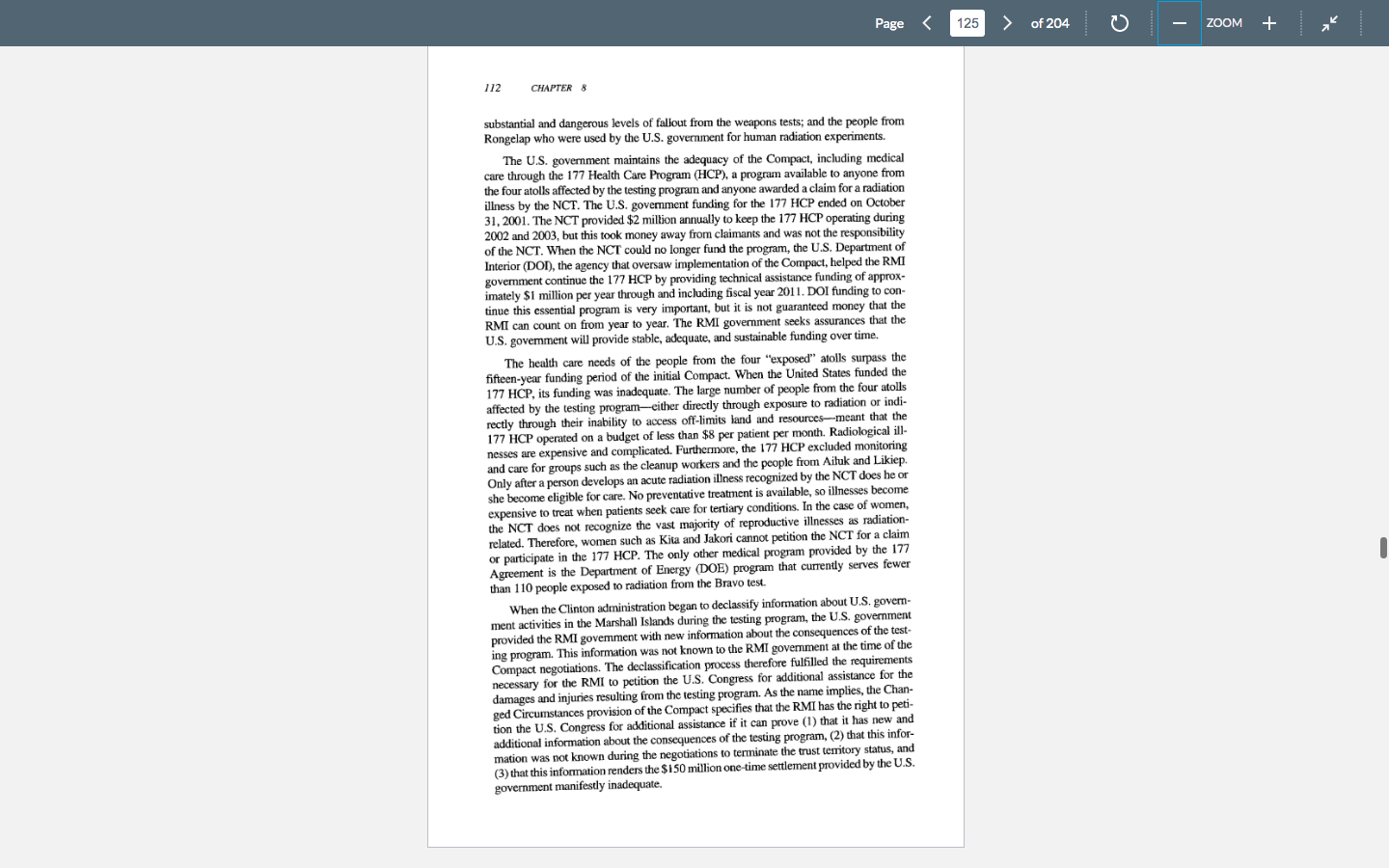
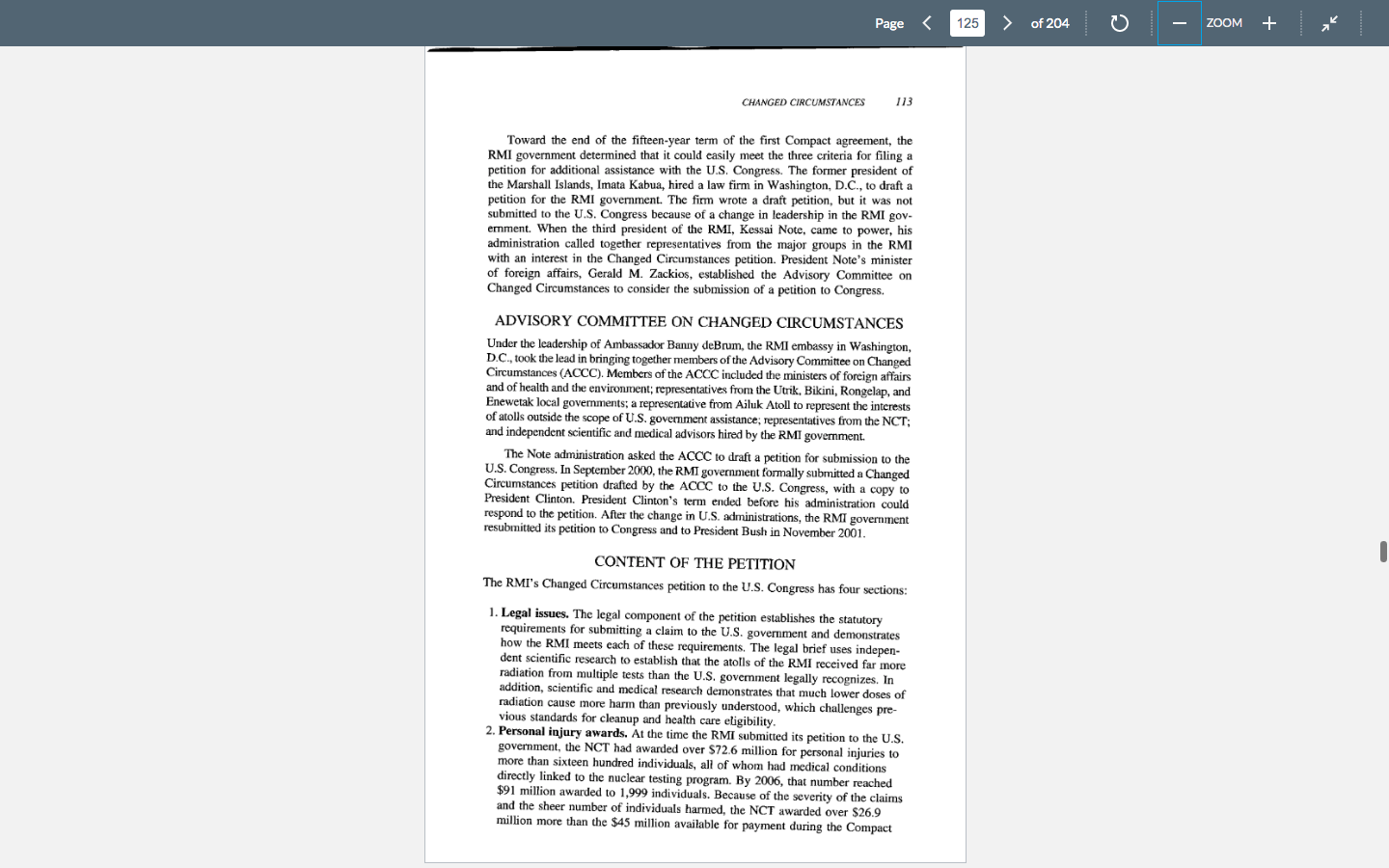
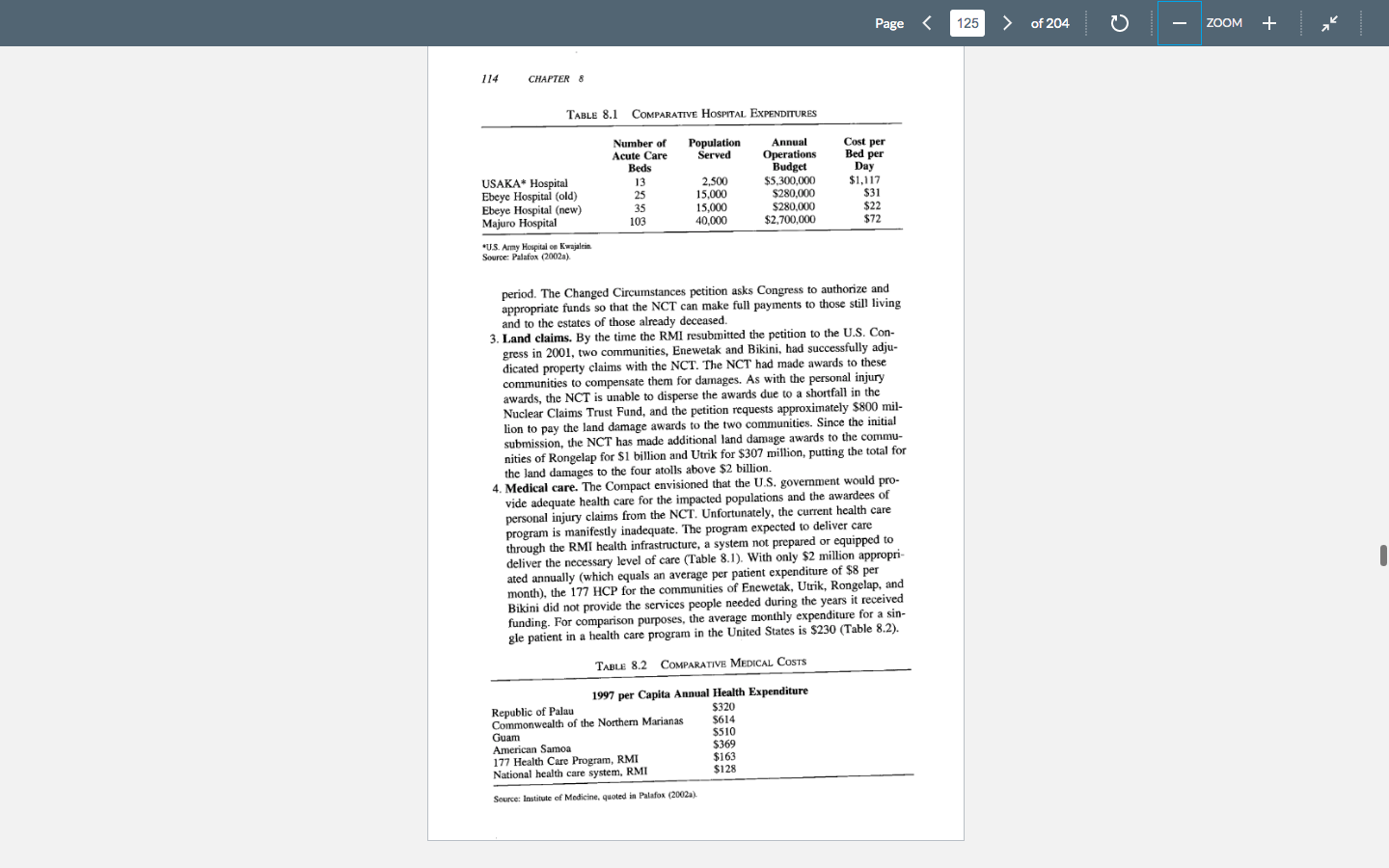
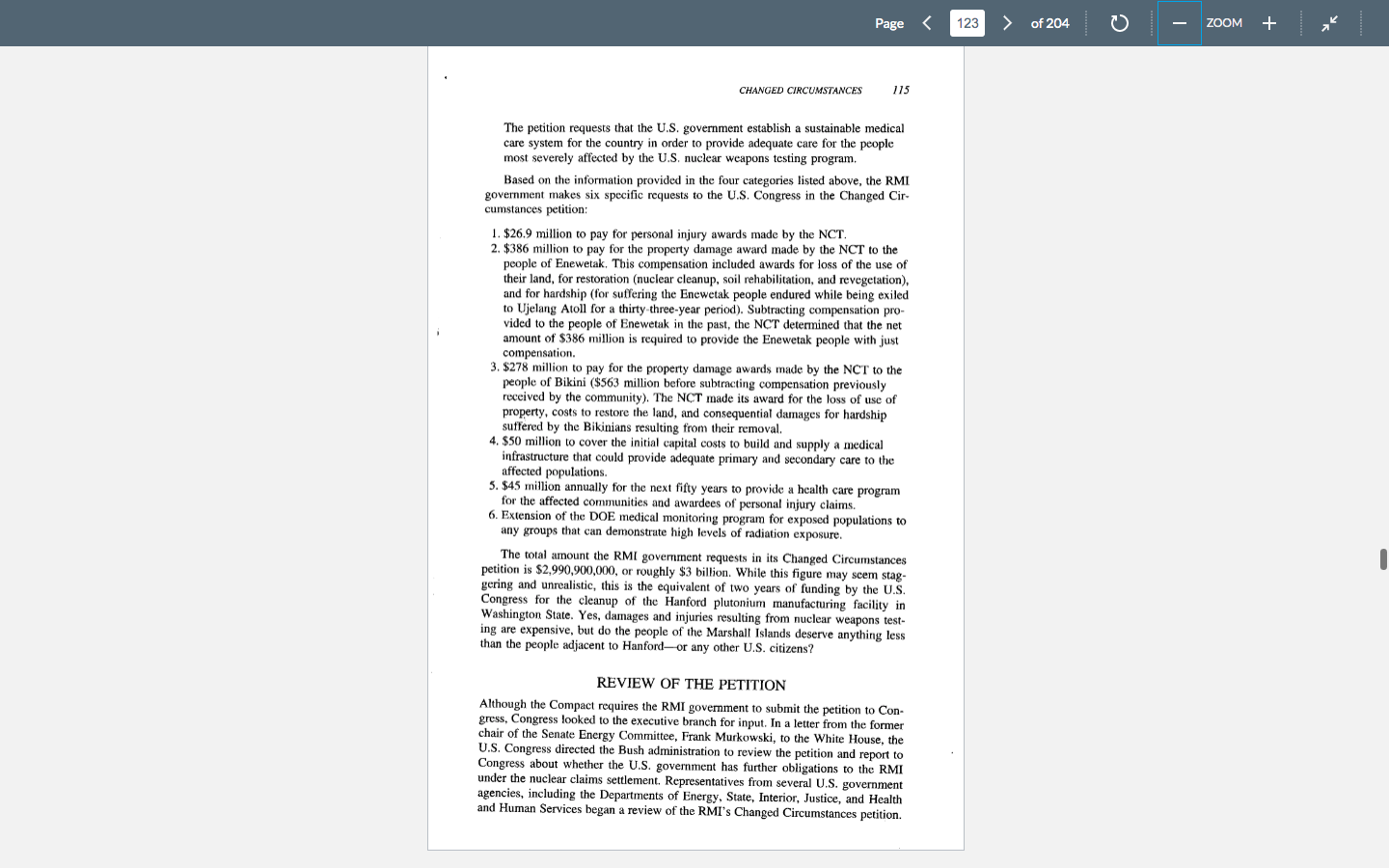
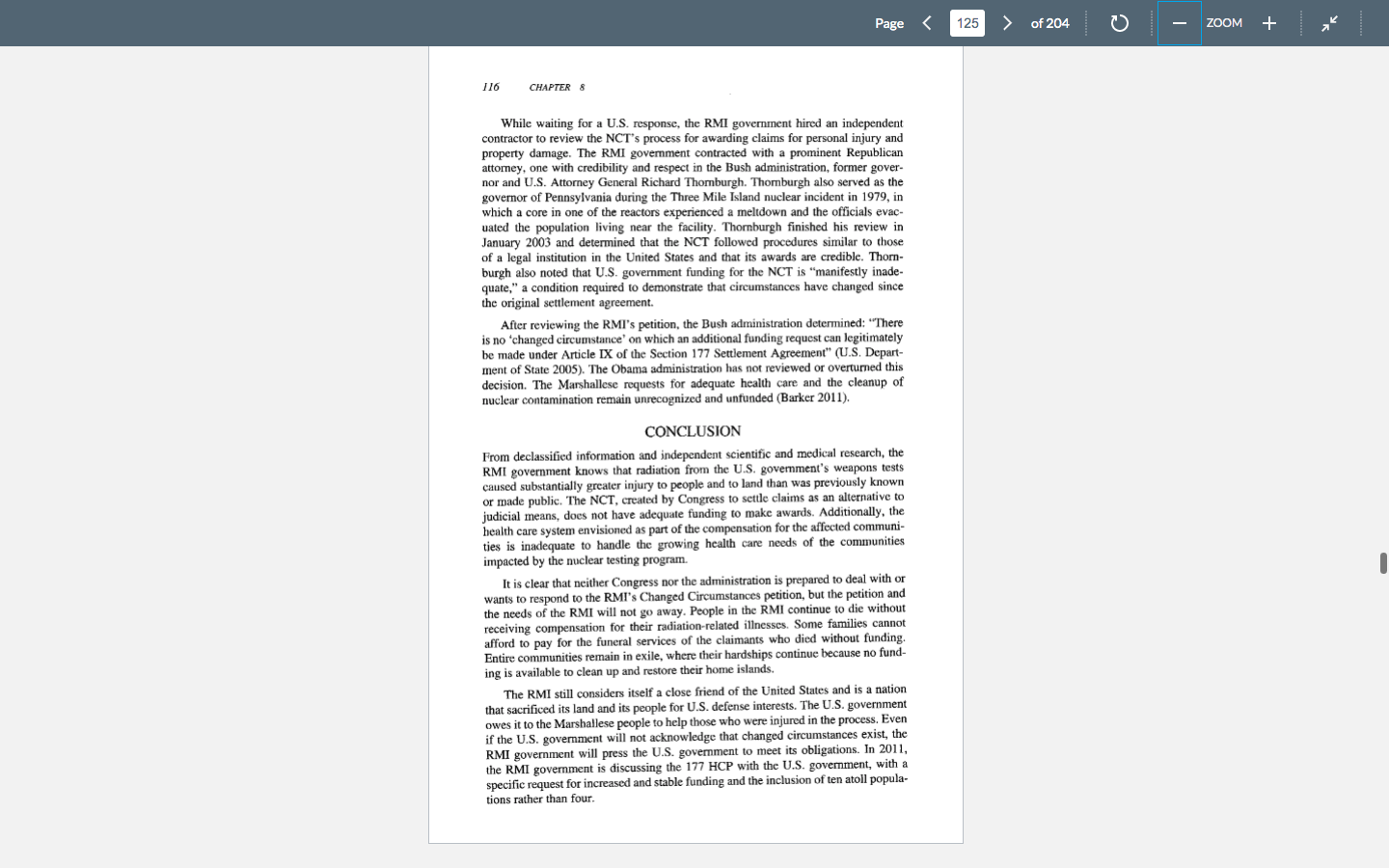
Page of 204 ZOOM + + 8/Changed Circumstances: Petitioning the U.S. Government During the original negotiations to terminate the Marshall Islands' trust territory relationship with the United States, the Reagan administration reached an agree- ment with the Republic of the Marshall Islands (RMI) on a full and final settlement of claims arising from the U.S. nuclear weapons testing program. The Compact of Free Association and the nuclear claims settlement (177 Agreement) state that the purpose of the settlement is to "create and maintain, in perpetuity, a means to address past, present, and future consequences of the nuclear testing program. The settlement agreement submitted to Congress by President Reagan included a Changed Circumstances provision authorizing the national government of the RMI to petition Congress if it believes developments since approval of the settle- ment render the assistance and compensation provided by the U.S. government "manifestly inadequate." At the termination of the trusteeship, in order to receive a settlement package from the U.S. goverment for damages and injuries, the RMI had to terminate pending claims in U.S. and RMI courts, including a major claim for damage and loss of land by the people of Bikini Atoll. The settlement also established the Nuclear Claims Tribunal (NCT) in the Marshall Islands as an alternative adjudicative forum to provide finality regarding claims. Congress approved the RMI nuclear claims settlement in 1985. The RMI made its settlement based on information about the testing and its consequences provided by the U.S. government prior to and during negotiations. At the time, the RMI had no independent scientists or medical practitioners to provide alternative conclu- sions; thus, the RMI government had no choice but to accept the U.S. govern- ment's findings about the extent of damages and injuries that became the basis for the 177 Agreement of the Compact (Chapter 3). In the years following the termination of the trust territory relationship when the Compact of Free Association came into effect, it became clear to the citizens and govem- ment of the RMI that the assistance provided by the U.S. government was "manifestly inadequate." The agreement in effect provided that entire segments of the RMI popula- tion would not receive assistance for their suffering, loss, and illness as a result of the nuclear weapons testing program. These segments of the population include many dis- cussed in the previous chapters: the Marshallese workers who helped clean up and pre- pare highly radioactive islands for resettlement; populations who were prematurely resettled on highly contaminated islands by the U.S. government; the people of Ailuk, Likiep, and other atolls who were close enough to Bikini and Enewetak to receive 111 Page of 204 ZOOM + a 112 CHAPTER 8 substantial and dangerous levels of fallout from the weapons tests; and the people from Rongelap who were used by the U.S. government for human radiation experiments. The U.S. government maintains the adequacy of the Compact, including medical care through the 177 Health Care Program (HCP), a program available to anyone from the four atolls affected by the testing program and anyone awarded a claim for a radiation illness by the NCT. The U.S. government funding for the 177 HCP ended on October 31, 2001. The NCT provided $2 million annually to keep the 177 HCP operating during LP 2002 and 2003, but this took money away from claimants and was not the responsibility of the NCT. When the NCT could no longer fund the program, the U.S. Department of Interior (DOT), the agency that oversaw implementation of the Compact, helped the RMI government continue the 177 HCP by providing technical assistance funding of approx- imately $1 million per year through and including fiscal year 2011. DOI funding to con- tinue this essential program is very important, but it is not guaranteed money that the RMI can count on from year to year. The RMI government seeks assurances that the U.S. govemment will provide stable, adequate, and sustainable funding over time. The health care needs of the people from the four "exposed" atolls surpass the fifteen-year funding period of the initial Compact. When the United States funded the 177 HCP, its funding was inadequate. The large number of people from the four atolls affected by the testing program--either directly through exposure to radiation or indi- rectly through their inability to access off-limits land and resources--meant that the 177 HCP operated on a budget of less than $8 per patient per month. Radiological ill- nesses are expensive and complicated. Furthermore, the 177 HCP excluded monitoring and care for groups such as the cleanup workers and the people from Ailuk and Likiep. Only after a person develops an acute radiation illness recognized by the NCT does he or she become eligible for care. No preventative treatment is available, so illnesses become expensive to treat when patients seek care for tertiary conditions. In the case of women, the NCT does not recognize the vast majority of reproductive illnesses as radiation- related. Therefore, women such as Kita and Jakori cannot petition the NCT for a claim or participate in the 177 HCP. The only other medical program provided by the 177 Agreement is the Department of Energy (DOE) program that currently serves fewer than 110 people exposed to radiation from the Bravo test. When the Clinton administration began to declassify information about U.S. govern- ment activities in the Marshall Islands during the testing program, the U.S. government provided the RMI goverment with new information about the consequences of the test- ing program. This information was not known to the RMI government at the time of the Compact negotiations. The declassification process therefore fulfilled the requirements necessary for the RMI to petition the U.S. Congress for additional assistance for the damages and injuries resulting from the testing program. As the name implies, the Chan- ged Circumstances provision of the Compact specifies that the RMI has the right to peti- tion the U.S. Congress for additional assistance if it can prove (1) that it has new and additional information about the consequences of the testing program, (2) that this infor- mation was not known during the negotiations to terminate the trust territory status, and (3) that this information renders the $150 million one-time settlement provided by the U.S. government manifestly inadequate. Page of 204 ZOOM + a CHANGED CIRCUMSTANCES 113 Toward the end of the fifteen-year term of the first Compact agreement, the RMI government determined that it could easily meet the three criteria for filing a petition for additional assistance with the U.S. Congress. The former president of the Marshall Islands, Imata Kabua, hired a law firm in Washington, D.C., to draft a petition for the RMI government. The firm wrote a draft petition, but it was not submitted to the U.S. Congress because of a change in leadership in the RMI gov- emment. When the third president of the RMI, Kessai Note, came to power, his administration called together representatives from the major groups in the RMI with an interest in the Changed Circumstances petition. President Note's minister of foreign affairs, Gerald M. Zackios, established the Advisory Committee on Changed Circumstances to consider the submission of a petition to Congress ADVISORY COMMITTEE ON CHANGED CIRCUMSTANCES Under the leadership of Ambassador Banny deBrum, the RMI embassy in Washington, D.C., took the lead in bringing together members of the Advisory Committee on Changed Circumstances (ACCC). Members of the ACCC included the ministers of foreign affairs and of health and the environment; representatives from the Utrik, Bikini, Rongelap, and Enewetak local governments: a representative from Ailuk Atoll to represent the interests of atolls outside the scope of U.S. government assistance, representatives from the NCT, and independent scientific and medical advisors hired by the RMI government. The Note administration asked the ACCC to draft a petition for submission to the U.S. Congress. In September 2000, the RMI government formally submitted a Changed Circumstances petition drafted by the ACCC to the U.S. Congress, with a copy to President Clinton. President Clinton's term ended before his administration could respond to the petition. After the change in U.S. administrations, the RMI government resubmitted its petition to Congress and to President Bush in November 2001. CONTENT OF THE PETITION The RMI's Changed Circumstances petition to the U.S. Congress has four sections: 1. Legal issues. The legal component of the petition establishes the statutory requirements for submitting a claim to the U.S. government and demonstrates how the RMI meets each of these requirements. The legal brief uses indepen- dent scientific research to establish that the atolls of the RMI received far more radiation from multiple tests than the U.S. government legally recognizes. In addition, scientific and medical research demonstrates that much lower doses of sen radiation cause more harm than previously understood, which challenges pre- vious standards for cleanup and health care eligibility. 2. Personal injury awards. At the time the RMI submitted its petition to the U.S. government, the NCT had awarded over $72.6 million for personal injuries to more than sixteen hundred individuals, all of whom had medical conditions directly linked to the nuclear testing program. By 2006, that number reached $91 million awarded to 1,999 individuals. Because of the severity of the claims and the sheer number of individuals harmed, the NCT awarded over $26.9 million more than the $45 million available for payment during the Compact Page of 204 ZOOM + a 114 CHAPTER 8 TABLE 8.1 COMPARATIVE HOSPITAL EXPENDITURES Population Served USAKA* Hospital Ebeye Hospital (old) Ebeye Hospital (new) Majuro Hospital Number of Acute Care Beds 13 25 35 103 2.500 15,000 15,000 40,000 Annual Operations Budget $5.300.000 $280,000 $280.000 $2,700,000 Cost per Bed per Day $1,117 $31 $22 $72 *U.S. Army Hospital on Kwajalean Source: Palafox (2002a) period. The Changed Circumstances petition asks Congress to authorize and appropriate funds so that the NCT can make full payments to those still living and to the estates of those already deceased. 3. Land claims. By the time the RMI resubmitted the petition to the U.S. Con- gress in 2001, two communities, Enewetak and Bikini, had successfully adju- dicated property claims with the NCT. The NCT had made awards to these communities to compensate them for damages. As with the personal injury awards, the NCT is unable to disperse the awards due to a shortfall in the Nuclear Claims Trust Fund, and the petition requests approximately $800 mil- lion to pay the land damage awards to the two communities. Since the initial submission, the NCT has made additional land damage awards to the commu- nities of Rongelap for $1 billion and Utrik for $307 million, putting the total for the land damages to the four atolls above $2 billion. 4. Medical care. The Compact envisioned that the U.S. government would pro- vide adequate health care for the impacted populations and the awardees of personal injury claims from the NCT. Unfortunately, the current health care program is manifestly inadequate. The program expected to deliver care through the RMI health infrastructure, a system not prepared or equipped to deliver the necessary level of care (Table 8.1). With only $2 million appropri ated annually (which equals an average per patient expenditure of $8 per month), the 177 HCP for the communities of Enewetak, Utrik, Rongelap, and Bikini did not provide the services people needed during the years it received funding. For comparison purposes, the average monthly expenditure for a sin- gle patient in a health care program in the United States is $230 (Table 8.2). 1 TABLE 8.2 COMPARATIVE MEDICAL COSTS 1997 per Capita Annual Health Expenditure Republic of Palau $320 Commonwealth of the Northern Marianas $614 Guam $510 American Samoa $369 177 Health Care Program, RMI $163 National health care system, RMI $128 Source: Institute of Medicine, quoted in Palafox (2002) Page of 204 ZOOM + a CHANGED CIRCUMSTANCES 115 The petition requests that the U.S. government establish a sustainable medical care system for the country in order to provide adequate care for the people most severely affected by the U.S. nuclear weapons testing program, Based on the information provided in the four categories listed above, the RMI government makes six specific requests to the U.S. Congress in the Changed Cir- cumstances petition: 1. $26.9 million to pay for personal injury awards made by the NCT. 2. $386 million to pay for the property damage award made by the NCT to the people of Enewetak. This compensation included awards for loss of the use of their land, for restoration (nuclear cleanup, soil rehabilitation, and revegetation), and for hardship (for suffering the Enewetak people endured while being exiled to Ujelang Atoll for a thirty-three-year period). Subtracting compensation pro- vided to the people of Enewetak in the past, the NCT determined that the net amount of $386 million is required to provide the Enewetak people with just compensation. 3. $278 million to pay for the property damage awards made by the NCT to the people of Bikini ($563 million before subtracting compensation previously received by the community). The NCT made its award for the loss of use of property, costs to restore the land, and consequential damages for hardship suffered by the Bikinians resulting from their removal. 4. $50 million to cover the initial capital costs to build and supply a medical infrastructure that could provide adequate primary and secondary care to the affected populations. 5. $45 million annually for the next fifty years to provide a health care program for the affected communities and awardees of personal injury claims. 6. Extension of the DOE medical monitoring program for exposed populations to any groups that can demonstrate high levels of radiation exposure. The total amount the RMI government requests in its Changed Circumstances petition is $2,990,900,000, or roughly $3 billion. While this figure may seem stag- gering and unrealistic, this is the equivalent of two years of funding by the U.S. Congress for the cleanup of the Hanford plutonium manufacturing facility in Washington State. Yes, damages and injuries resulting from nuclear weapons test- ing are expensive, but do the people of the Marshall Islands deserve anything less than the people adjacent to Hanford-or any other U.S. citizens? REVIEW OF THE PETITION Although the Compact requires the RMI government to submit the petition to Con- gress, Congress looked to the executive branch for input. In a letter from the former chair of the Senate Energy Committee, Frank Murkowski, to the White House, the U.S. Congress directed the Bush administration to review the petition and report to Congress about whether the U.S. government has further obligations to the RMI under the nuclear claims settlement. Representatives from several U.S. government agencies, including the Departments of Energy, State, Interior, Justice, and Health and Human Services began a review of the RMI's Changed Circumstances petition. Page of 204 ZOOM + a 116 CHAPTER 8 While waiting for a U.S. response, the RMI government hired an independent contractor to review the NCT's process for awarding claims for personal injury and property damage. The RMI goverment contracted with a prominent Republican attorney, one with credibility and respect in the Bush administration, former gover- nor and U.S. Attorney General Richard Thomburgh. Thomburgh also served as the governor of Pennsylvania during the Three Mile Island nuclear incident in 1979, in which a core in one of the reactors experienced a meltdown and the officials evac- uated the population living near the facility. Thornburgh finished his review in January 2003 and determined that the NCT followed procedures similar to those of a legal institution in the United States and that its awards are credible. Thorn- burgh also noted that U.S. government funding for the NCT is "manifestly inade- quate," a condition required to demonstrate that circumstances have changed since the original settlement agreement. After reviewing the RMI's petition, the Bush administration determined: "There is no changed circumstance' on which an additional funding request can legitimately be made under Article IX of the Section 177 Settlement Agreement" (U.S. Depart- ment of State 2005). The Obama administration has not reviewed or overturned this decision. The Marshallese requests for adequate health care and the cleanup of nuclear contamination remain unrecognized and unfunded (Barker 2011). CONCLUSION From declassified information and independent scientific and medical research, the RMI government knows that radiation from the U.S. government's weapons tests caused substantially greater injury to people and to land than was previously known or made public. The NCT, created by Congress to settle claims as an alternative to judicial means, does not have adequate funding to make awards. Additionally, the health care system envisioned as part of the compensation for the affected communi- ties is inadequate to handle the growing health care needs of the communities impacted by the nuclear testing program. It is clear that neither Congress nor the administration is prepared to deal with or wants to respond to the RMI's Changed Circumstances petition, but the petition and needs of the RMI will not go away. People in the RMI continue to die without receiving compensation for their radiation-related illnesses. Some families cannot afford to pay for the funeral services of the claimants who died without funding. Entire communities remain in exile, where their hardships continue because no fund- ing is available to clean up and restore their home islands. The RMI still considers itself a close friend of the United States and is a nation that sacrificed its land and its people for U.S. defense interests. The U.S. government owes it to the Marshallese people to help those who were injured in the process. Even if the U.S. government will not acknowledge that changed circumstances exist, the RMI government will press the U.S. government to meet its obligations. In 2011, the RMI government is discussing the 177 HCP with the U.S. government, with a specific request for increased and stable funding and the inclusion of ten atoll popula- tions rather than four









 Study Help