







Question: Write an abstract for this paper with a word limit of 150 words. A scientist is studying ants, and has written the following conclusion to

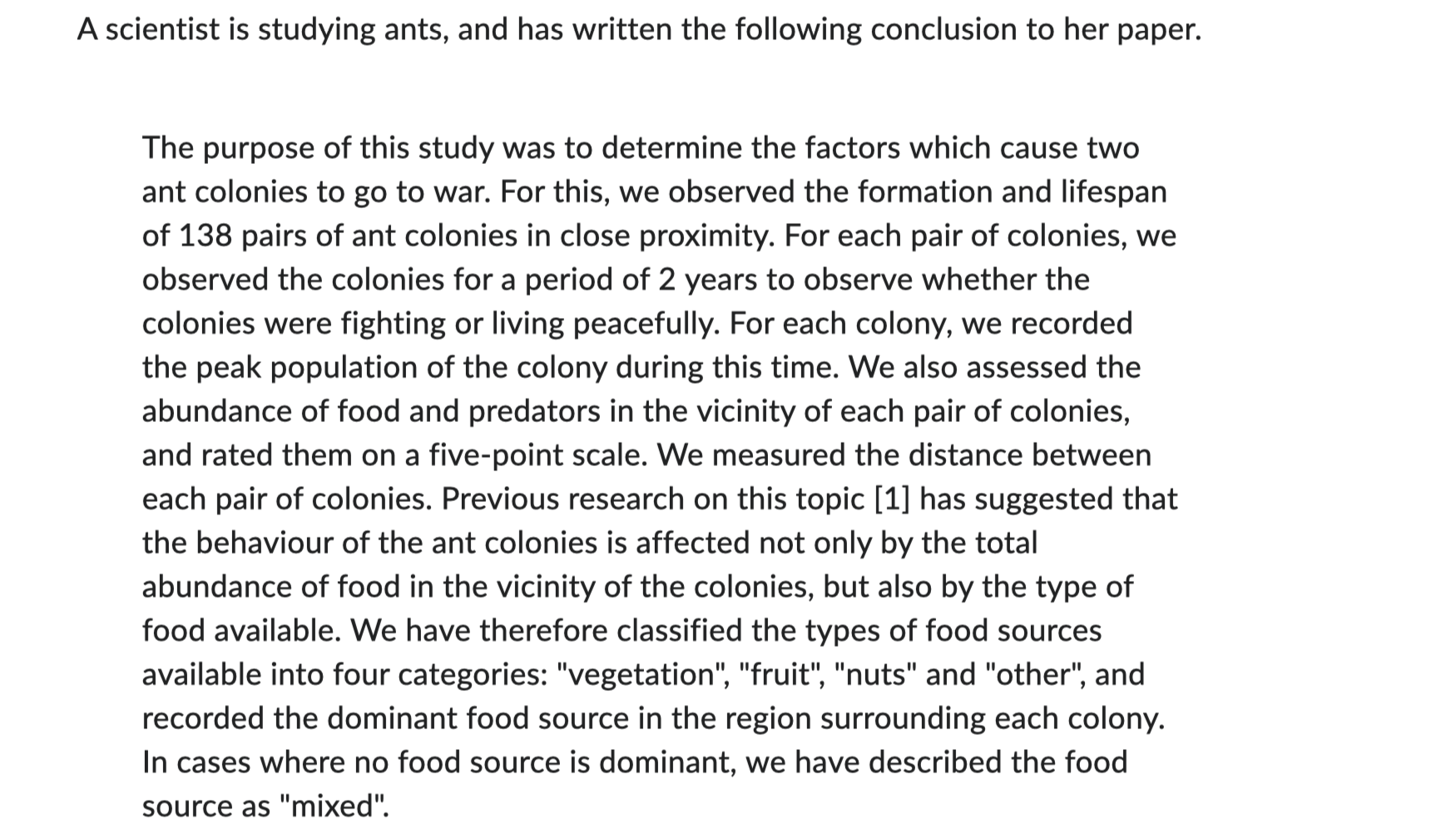
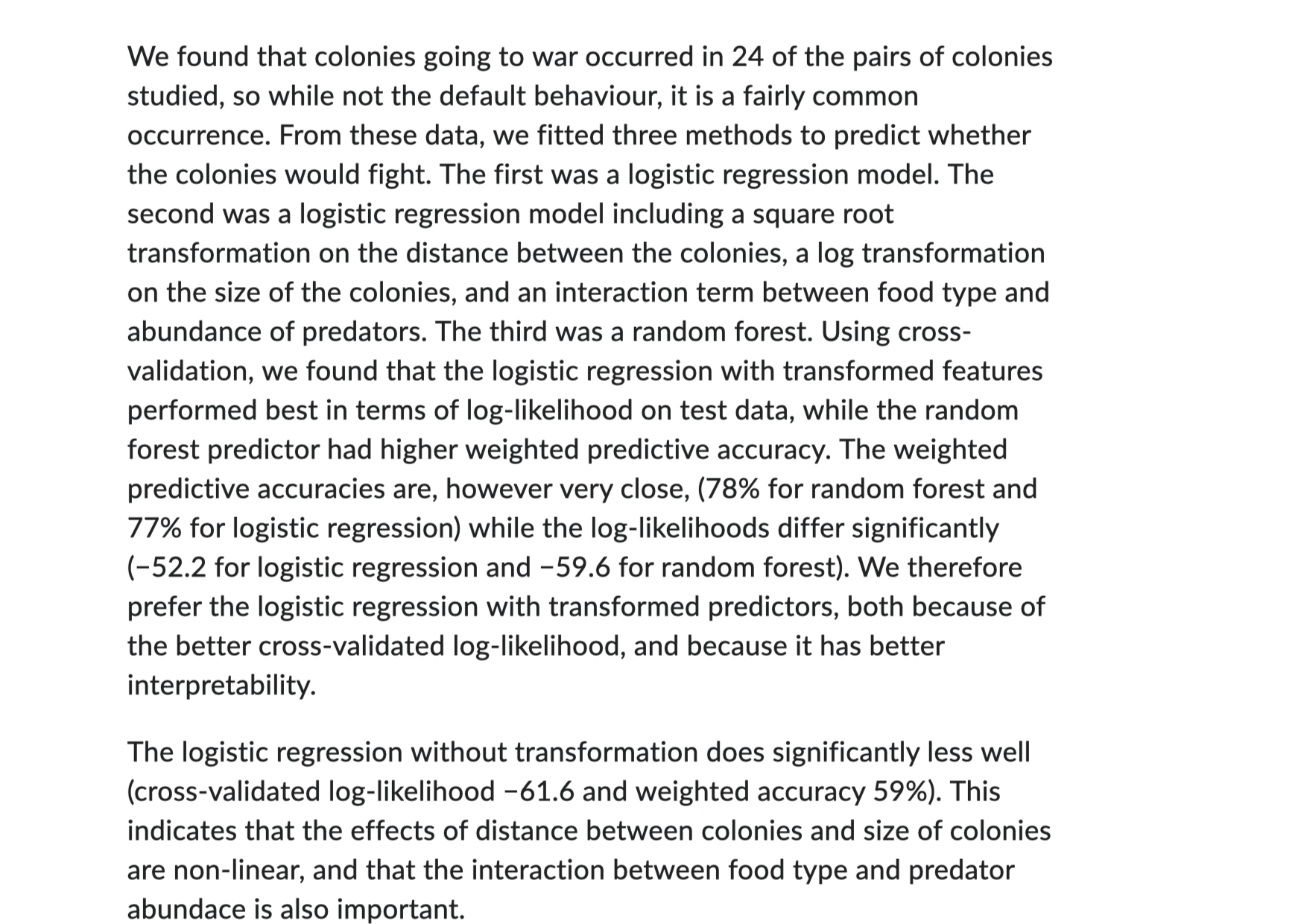
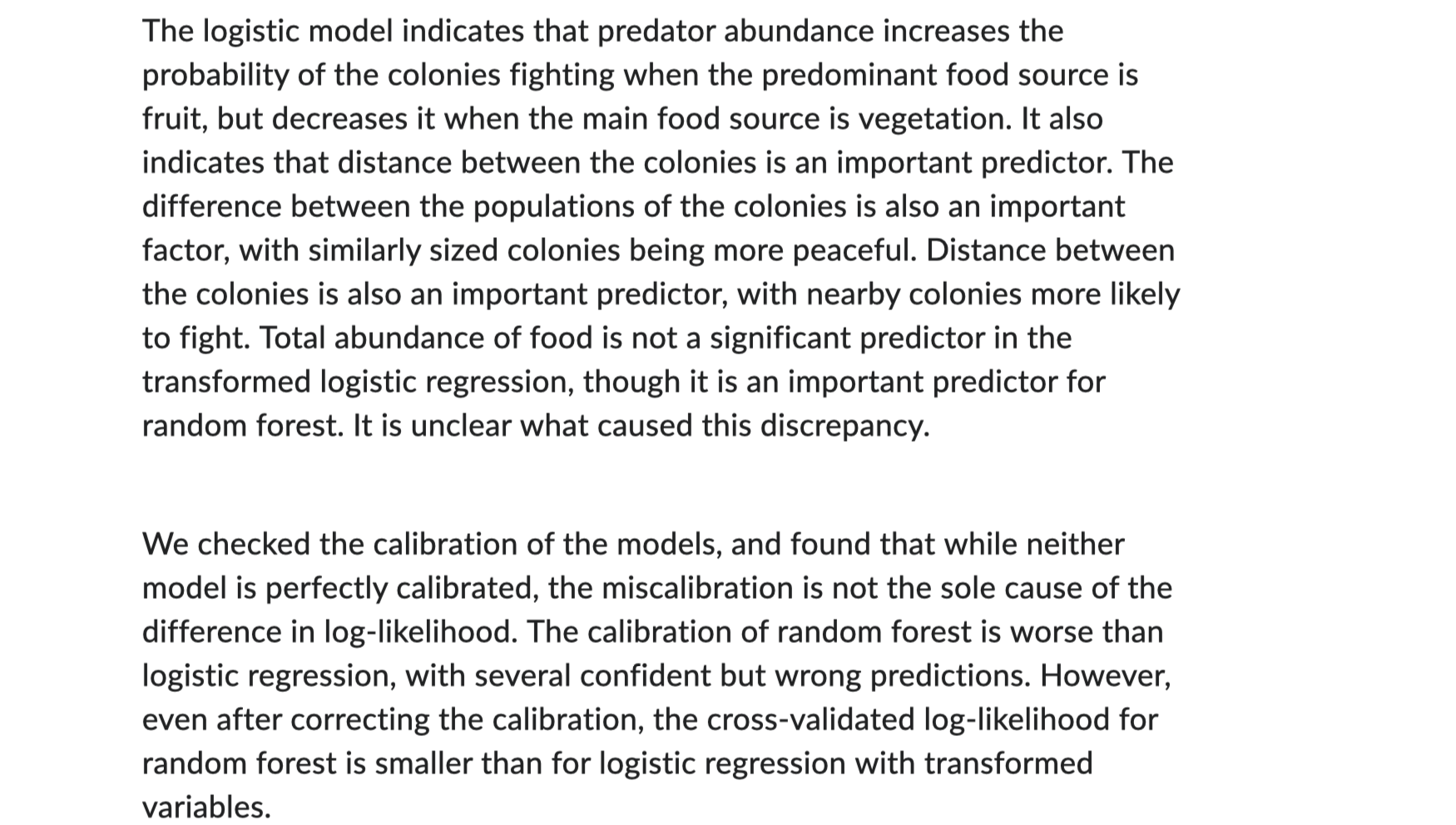
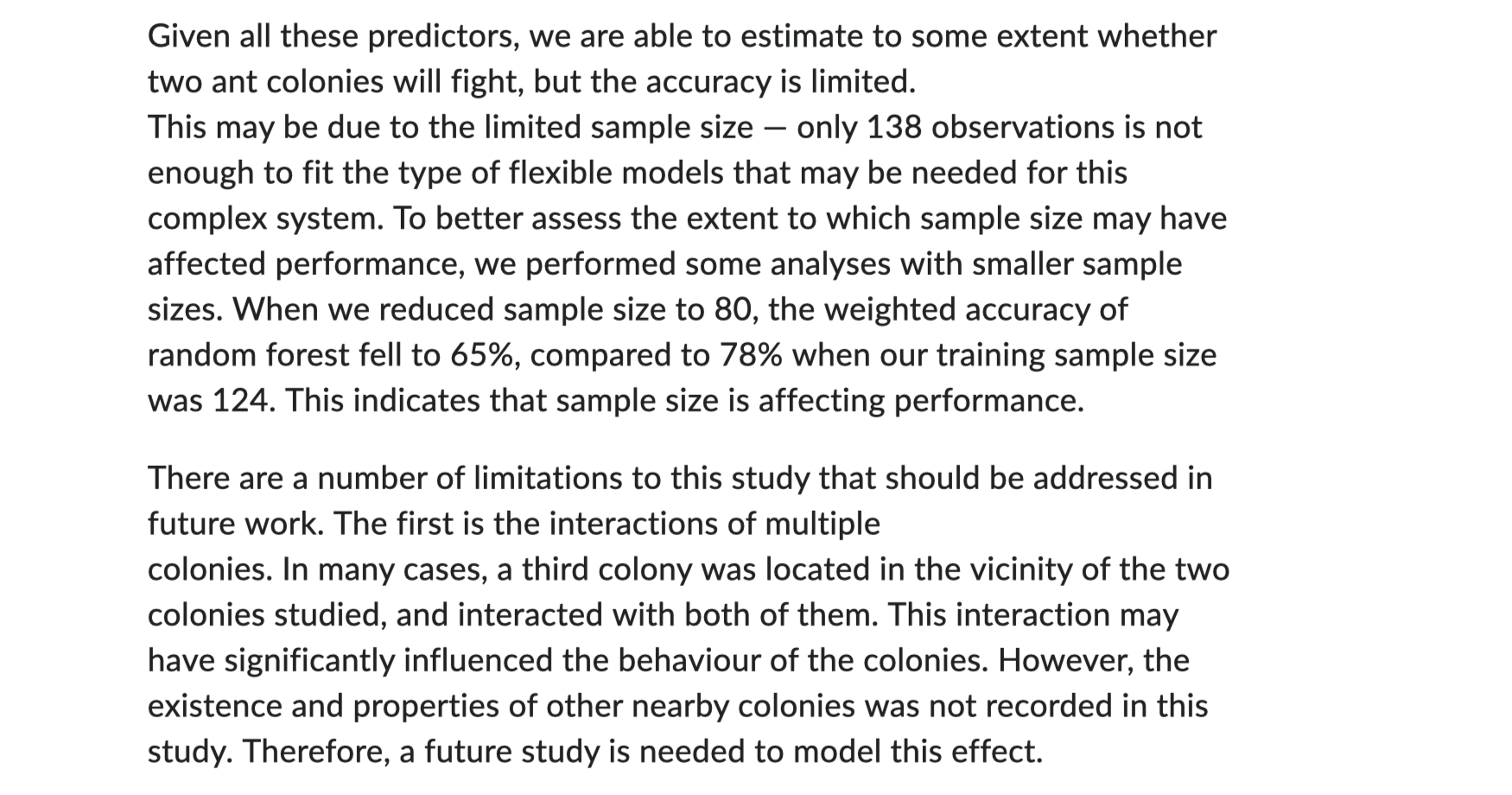
Write an abstract for this paper with a word limit of 150 words. A scientist is studying ants, and has written the following conclusion to her paper. The purpose of this study was to determine the factors which cause two ant colonies to go to war. For this, we observed the formation and lifespan of 138 pairs of ant colonies in close proximity. For each pair of colonies, we observed the colonies for a period of 2 years to observe whether the colonies were fighting or living peacefully. For each colony, we recorded the peak population of the colony during this time. We also assessed the abundance of food and predators in the vicinity of each pair of colonies, and rated them on a five-point scale. We measured the distance between each pair of colonies. Previous research on this topic [1] has suggested that the behaviour of the ant colonies is affected not only by the total abundance of food in the vicinity of the colonies, but also by the type of food available. We have therefore classified the types of food sources available into four categories: "vegetation", "fruit", "nuts" and "other", and recorded the dominant food source in the region surrounding each colony. In cases where no food source is dominant, we have described the food source as "mixed". We found that colonies going to war occurred in 24 of the pairs of colonies studied, so while not the default behaviour, it is a fairly common occurrence. From these data, we fitted three methods to predict whether the colonies would fight. The first was a logistic regression model. The second was a logistic regression model including a square root transformation on the distance between the colonies, a log transformation on the size of the colonies, and an interaction term between food type and abundance of predators. The third was a random forest. Using cross- validation, we found that the logistic regression with transformed features performed best in terms of log-likelihood on test data, while the random forest predictor had higher weighted predictive accuracy. The weighted predictive accuracies are, however very close, (78% for random forest and 77% for logistic regression) while the log-likelihoods differ significantly (52.2 for logistic regression and 59.6 for random forest). We therefore prefer the logistic regression with transformed predictors, both because of the better cross-validated log-likelihood, and because it has better interpretability. The logistic regression without transformation does significantly less well (cross-validated log-likelihood 61.6 and weighted accuracy 59%). This indicates that the effects of distance between colonies and size of colonies are non-linear, and that the interaction between food type and predator abundace is also important. The logistic model indicates that predator abundance increases the probability of the colonies fighting when the predominant food source is fruit, but decreases it when the main food source is vegetation. It also indicates that distance between the colonies is an important predictor. The difference between the populations of the colonies is also an important factor, with similarly sized colonies being more peaceful. Distance between the colonies is also an important predictor, with nearby colonies more likely to fight. Total abundance of food is not a significant predictor in the transformed logistic regression, though it is an important predictor for random forest. It is unclear what caused this discrepancy. We checked the calibration of the models, and found that while neither model is perfectly calibrated, the miscalibration is not the sole cause of the difference in log-likelihood. The calibration of random forest is worse than logistic regression, with several confident but wrong predictions. However, even after correcting the calibration, the cross-validated log-likelihood for random forest is smaller than for logistic regression with transformed variables. Given all these predictors, we are able to estimate to some extent whether two ant colonies will fight, but the accuracy is limited. This may be due to the limited sample size only 138 observations is not enough to fit the type of flexible models that may be needed for this complex system. To better assess the extent to which sample size may have affected performance, we performed some analyses with smaller sample sizes. When we reduced sample size to 80, the weighted accuracy of random forest fell to 65%, compared to 78% when our training sample size was 124. This indicates that sample size is affecting performance. There are a number of limitations to this study that should be addressed in future work. The first is the interactions of multiple colonies. In many cases, a third colony was located in the vicinity of the two colonies studied, and interacted with both of them. This interaction may have significantly influenced the behaviour of the colonies. However, the existence and properties of other nearby colonies was not recorded in this study. Therefore, a future study is needed to model this effect. Another issue that was not sufficiently considered in this study was the uncertainty in estimating the population of the colonies. We used the methodology from [2] to estimate these populations based on a capture- recapture model. However, the authors of that paper note that the methodology is based on a number of assumptions that are made for mathematical convenience, rather than the belief that they accurately model the dynamics of ant colony populations. Under weaker assumptions than in [2], [3] has shown that these estimates may be very inaccurate, with the inaccuracy correlated to the main food source. This could seriously bias the results of the analysis. Our preliminary simulations in Section 4 indicate that this is a practical possibility, rather than merely theoretical, but that it is relatively rare, with only 2% of simulation results being significantly affected by this issue. Future studies should attempt to incorporate this uncertainty into the modelling, to ensure that our conclusions are reliable. Some methods that might be applicable here were developed in [4]
Step by Step Solution
There are 3 Steps involved in it

Get step-by-step solutions from verified subject matter experts
 Study Help