







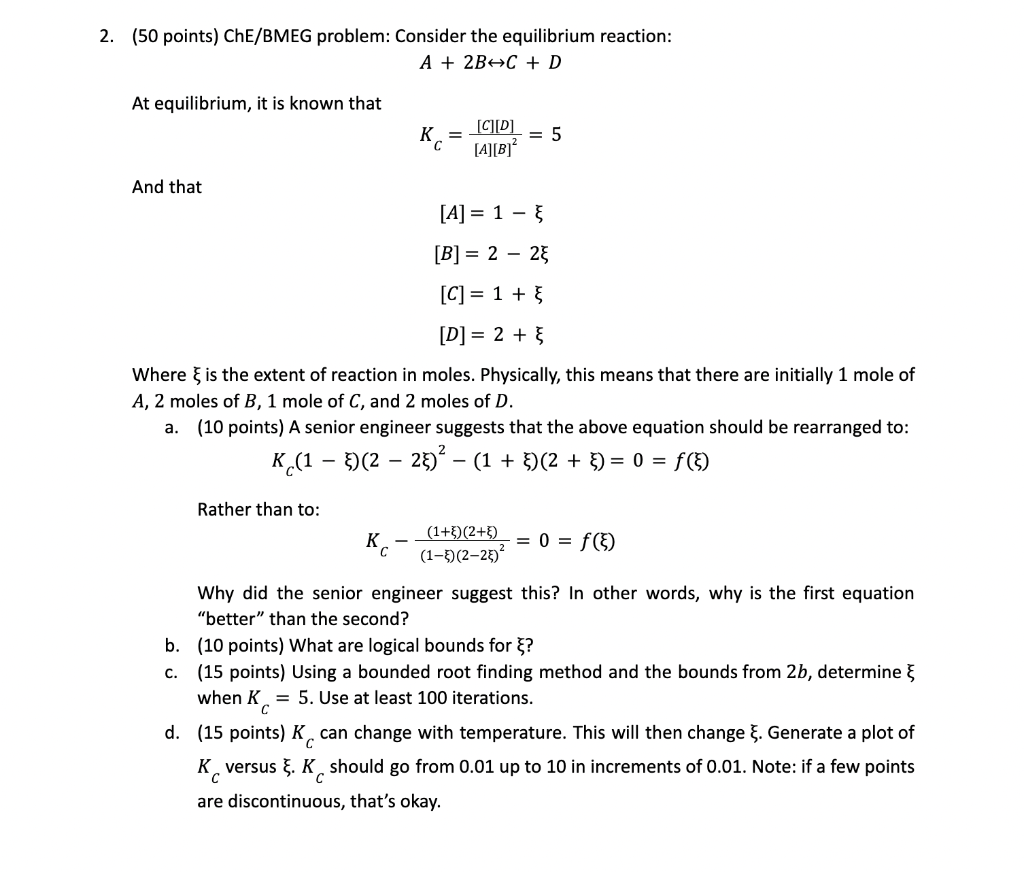
Question: WRITE AN ACTUAL CODE USING MATLAB (50 points) ChE/BMEG problem: Consider the equilibrium reaction: A+2BC+D At equilibrium, it is known that KC=[A][B]2[C][D]=5 And that [A]=1[B]=22[C]=1+[D]=2+
WRITE AN ACTUAL CODE USING MATLAB
(50 points) ChE/BMEG problem: Consider the equilibrium reaction: A+2BC+D At equilibrium, it is known that KC=[A][B]2[C][D]=5 And that [A]=1[B]=22[C]=1+[D]=2+ Where is the extent of reaction in moles. Physically, this means that there are initially 1 mole of A,2 moles of B,1 mole of C, and 2 moles of D. a. (10 points) A senior engineer suggests that the above equation should be rearranged to: KC(1)(22)2(1+)(2+)=0=f() Rather than to: KC(1)(22)2(1+)(2+)=0=f() Why did the senior engineer suggest this? In other words, why is the first equation "better" than the second? b. (10 points) What are logical bounds for ? c. (15 points) Using a bounded root finding method and the bounds from 2b, determine when KC=5. Use at least 100 iterations. d. (15 points) KC can change with temperature. This will then change . Generate a plot of KC versus .KC should go from 0.01 up to 10 in increments of 0.01. Note: if a few points are discontinuous, that's okay
Step by Step Solution
There are 3 Steps involved in it

Get step-by-step solutions from verified subject matter experts
 Study Help