







Question: Write an assembly code program that subtracts the 5-byte number called NUM_X from the 5-byte number called NUM_Y, as shown in the test cases below.
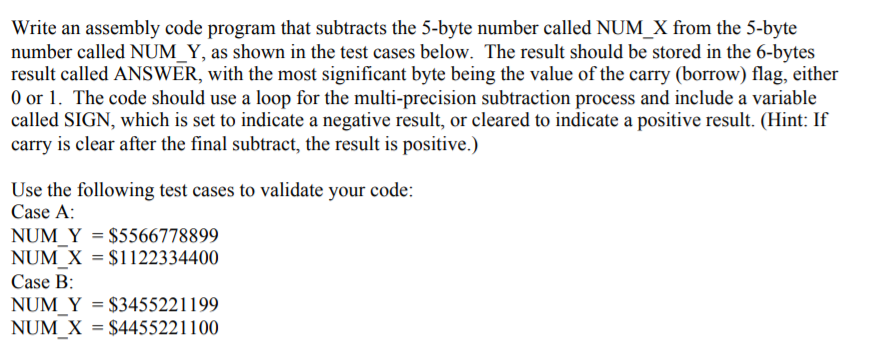
Write an assembly code program that subtracts the 5-byte number called NUM_X from the 5-byte number called NUM_Y, as shown in the test cases below. The result should be stored in the 6-bytes result called ANSWER, with the most significant byte being the value of the carry (borrow) flag, either 0 or 1. The code should use a loop for the multi-precision subtraction process and include a variable called SIGN, which is set to indicate a negative result, or cleared to indicate a positive result. (Hint: If carry is clear after the final subtract, the result is positive.) Use the following test cases to validate your codo: Case A NUM Y $5566778899 NUMX $1122334400 Case B: NUM Y 3455221199 NUM_X -$4455221100 Write an assembly code program that subtracts the 5-byte number called NUM_X from the 5-byte number called NUM_Y, as shown in the test cases below. The result should be stored in the 6-bytes result called ANSWER, with the most significant byte being the value of the carry (borrow) flag, either 0 or 1. The code should use a loop for the multi-precision subtraction process and include a variable called SIGN, which is set to indicate a negative result, or cleared to indicate a positive result. (Hint: If carry is clear after the final subtract, the result is positive.) Use the following test cases to validate your codo: Case A NUM Y $5566778899 NUMX $1122334400 Case B: NUM Y 3455221199 NUM_X -$4455221100
Step by Step Solution
There are 3 Steps involved in it

Get step-by-step solutions from verified subject matter experts
 Study Help