







Question: Write an executive summary for this report that makes an effective appeal to the audience, but first, think through the important issues posted by this
Write an executive summary for this report that makes an effective appeal to the audience, but first, think through the important issues posted by this report. obviously, the executive summary will summarize the main points of the report, but you have power to add facts from the report and rewrite sentences so you are making an argument center.
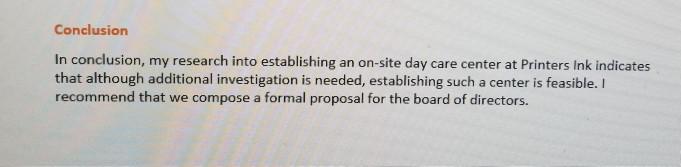
Feasibility Report Establishing an On-site Day Care Center at Printers Ink Introduction With the closure of WeeTots Day Care Center on January 30, 2019, child care capacity in the area has been reduced 20%. Fifteen children of Printers Ink employees were directly affected by the closure. Several employees have been unsuccessful in securing alternative day care; absenteeism among these employees has increased about 10% since the closing of WeeTots. One employee has requested an extended leave of absence. Although these factors have not directly affected production and profits to date, increased absenteeism and additional requests for leave will Although child care isn't the company's responsibility, we cannot afford to lose employees or to have high absenteeism. Perhaps we can help our employees by establishing an on-site day care center. I have reviewed the legal, educational, and physical needs of establishing and maintaining a day care center and present herein the basic information relevant to establishing an on-site day care center at Printers Ink. This information will help us determine the feasibility of establishing such a center. This report contains sections on the potential clientele, housing and facilities, and operating budget of this proposed day care center. If we decide to create the center, this report will help us make decisions about cliental, staffing, facility, and equipment needs. Potential clientele [To facilitate discussion, I am limiting discussion for reasons that will become clear later in the report-to 2- to 4-year-olds.] The 35 on-site employees have a total of 43 children; 25 of those children are 5 or under. Of the 35 on-site employees, 28 (80%) responded to the survey. Among the responders, 12 employees (with a total of 14 children in the 2- to 4-year range) said they would use an on-site day care center if available. This is only a preliminary poll and does not represent commitments on the part of those claiming they would or would not use the center. Complications, of course, arise from the fact that the number of potential clientele (children of the appropriate age) will fluctuate. I believe, however, that we can reasonably predict a range of potential clientele for successive years based on our knowledge of the number of children of appropriate age. Preregistration would help with making these predictions. Related complications arise from the regulations concerning mixing of age groups, staff/child ratios, and maximum enrollments. Staff/Child Ratios, Maximum Enrollments, and Mixed Age Groups Day care center regulations concerning numbers of children are based on the ages of children. National Health and Safety Performance Standards specify the staff/child ratio and maximum roup size according to the age(s) of children: Children of different ages may be combined in the following ways: Age of Children Staff/Child Ratio Maximum Group Size Infants (6 wks thru 14 mos) Toddlers (15 thru 23 mos) 1 to 4 12 1 to 5 15 2 years 1 to 8 16 years 1 to 10 20 4 years 1 to 10 20 5 years (preschool) 1 to 20 20 Infants, toddlers, and 2-year-olds. 2-year-olds through 5-year-old preschool children. Children of all ages may be mixed during the first hour and last hour of programs that operate 10 or more hours per day. When children of different ages are combined, the staff/child ratio and maximum group size shall be based on the age of the youngest child in the group. What this means is that centers that group 2- to 4-year-olds have a maximum enrollment of 16 and a staff/child ratio of 1 to 8. Given the small numbers with which we will be dealing initially and the need to mix ages, we will need to plan carefully the ages we wish to service. Of course, this decision will also be affected by the ages and numbers represented by interested clientele. . Staffing Needs An on-site day care center would increase staffing needs as follows: Director -Because of the small numbers of children the center would be servicing, the director could serve in two capacities, as director and as a member of the child care staff. However, the director must be on-site at all times during the day. Staff members/teachers - Depending on the maximum number of children serviced, the center will need two to three teachers in addition to the part-time director. (Note: If the director is also a staff member, only 1-to 2-staff members/teachers will be needed.) State-Certified Food Service Manager - Serving food requires an on-site person certified in food service sanitation to manage the preparation and/or service of food. However, serving only prepackaged prepared snacks will not necessitate a food service person. (At this time, I am unable to discuss how parents preparing food and feeding their own children affects this restriction. I am waiting for a response from the licensing board.) Maintenance - An additional half-time maintenance person, or the equivalent thereof, would be needed to maintain the facility. . Housing and Facilities Because the administration moved into the main building last spring, some employees have been using the Samson House (the old administrative building) as a makeshift recreation room. They have maintained the building. The Samson House, now commonly referred to as the "Rec Room," is a sound structure and one that could be readily converted into a day care center for a minimum of $8,000 (see architect's estimates in Appendix B for specific cost breakdown - just a placeholder so you know it is included in the "real report."). The conversion would take approximately 3 months. The conversion would require no major structural changes; that is, the changes can be made within the current structure, and no main walls would be changed. The structure is already divided into four rooms plus a kitchenette and restrooms; it provides ample space for maintaining a day care center for 16-20 children. Restrooms would need to be adapted to accommodate small children, a partition would be needed to create a sufficient number of classrooms, and appropriate furniture and equipment purchased. An external play area would need to be created; the area in the northwest corner of the plant yard, next to Stone House, would make an appropriate place. Space and Facility Requirements Recommended space specifications vary somewhat and are based on numbers and ages of children involved. Typically, minimum requirements for 3- to 5-year-olds are 35 to 50 square feet per child inside and 60 to 75 square feet of space per child outside. Because younger children often require cribs, feeding tables, and diaper changing areas, 2-year-olds require additional inside space. To meet minimum requirements for a mixed group of 2- to 4-year-olds, 16 to 20 in number, we would require a minimum indoor space of 1,000 square feet and a minimum outdoor space of 1,500 square feet. Regulations for lavatory and toilet facilities are intended to ensure adequate sanitation facilities and are based on overall enrollment. For example, a child care center with an enrollment between 11 and 25 requires a minimum of two lavatories and two toilet facilities. Urinals may constitute 25% of the required toilets in day care centers with restrooms shared by both genders and 50% of the required toilets in boy's restrooms in day care centers with gender- specific restrooms. Infants and toddlers wearing diapers require changing tables and additional lavatories. Operating Budget Liabilities For day care centers, salaries can comprise 80% of the budget. At this stage of the planning, can only provide general estimates for budgeting: $133,000 in salaries and $21,200 in supplies and equipment for a minimum budget of $154,200. Whatever maintenance, utility, and cleaning expenses the center incurs would be on top of that minimum budget. Two factors will make it possible for us to run our day care center on a smaller than average budget. The fact that the facilities are combined with the company's buildings reduces costs: Maintenance and janitorial services can be subsumed into the company maintenance and janitorial budget, as can utilities, phone, and bookkeeping: further, no rent will be required. The second factor is the workshare program, which will provide some staffing for the center. Assets Although Pil will not be a for-profit day care center, tuition, application fees, and the like will provide us some income. Typical tuition runs from $6,000 to $8,000. We may choose, however, not to charge typical tuition and fees because Pll will be for Printers Ink employees. Additionally, we may want to offer some discounts for various considerations (e.g., workshare employees who spend part of the day in the center; families who have more than one child in PIU). Conclusion In conclusion, my research into establishing an on-site day care center at Printers Ink indicates that although additional investigation is needed, establishing such a center is feasible. I recommend that we compose a formal proposal for the board of directors
Step by Step Solution
There are 3 Steps involved in it
1 Expert Approved Answer
Step: 1 Unlock

Question Has Been Solved by an Expert!
Get step-by-step solutions from verified subject matter experts
Step: 2 Unlock
Step: 3 Unlock
 Study Help