







Question: Write an x86-64 procedure/function called computePolynomial that does the following: a. It is passed four 8 byte parameters, coefX, coefY, x, and y by the
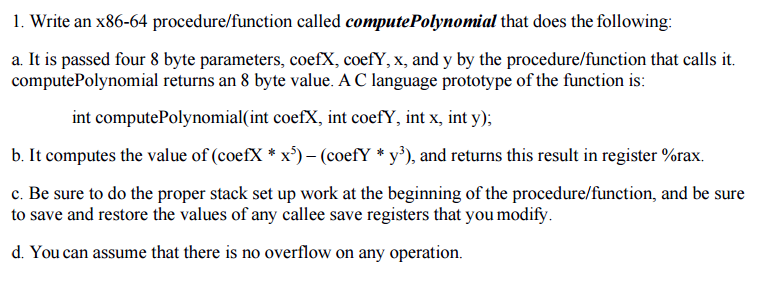
Write an x86-64 procedure/function called computePolynomial that does the following: a. It is passed four 8 byte parameters, coefX, coefY, x, and y by the procedure/function that calls it. computePolynomial returns an 8 byte value. A C language prototype of the function is: int computePolynomial(int coefX, int coefY, int x, int y); b. It computes the value of (coefX * x^5) - (coefY * y^3), and returns this result in register %rax. c. Be sure to do the proper stack set up work at the beginning of the procedure/function, and be sure to save and restore the values of any callee save registers that you modify. d. You can assume that there is no overflow on any operation. Write an x86-64 procedure/function called computePolynomial that does the following: a. It is passed four 8 byte parameters, coefX, coefY, x, and y by the procedure/function that calls it. computePolynomial returns an 8 byte value. A C language prototype of the function is: int computePolynomial(int coefX, int coefY, int x, int y); b. It computes the value of (coefX * x^5) - (coefY * y^3), and returns this result in register %rax. c. Be sure to do the proper stack set up work at the beginning of the procedure/function, and be sure to save and restore the values of any callee save registers that you modify. d. You can assume that there is no overflow on any operation
Step by Step Solution
There are 3 Steps involved in it

Get step-by-step solutions from verified subject matter experts
 Study Help