







Question: Write and discuss 5 or more ideas regarding The Buying Process (page 110-112). Identify at least 3-4 specific ways a professional marketer can use this
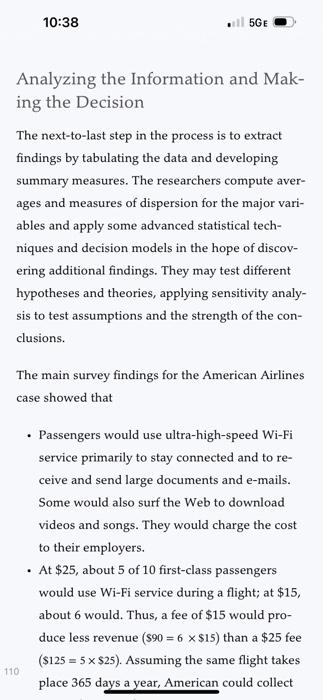
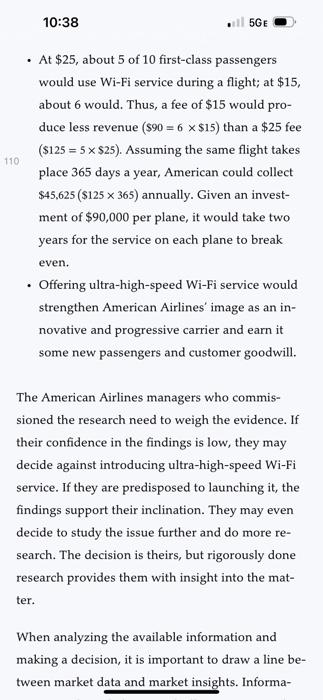
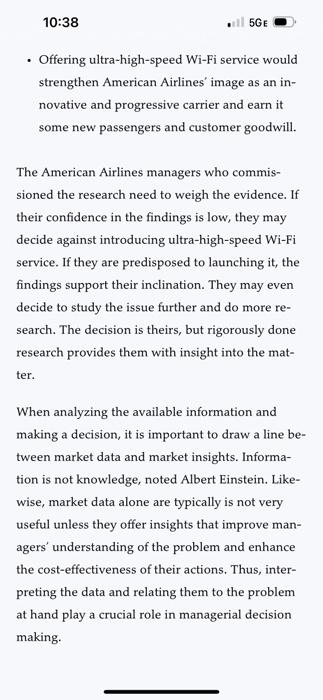
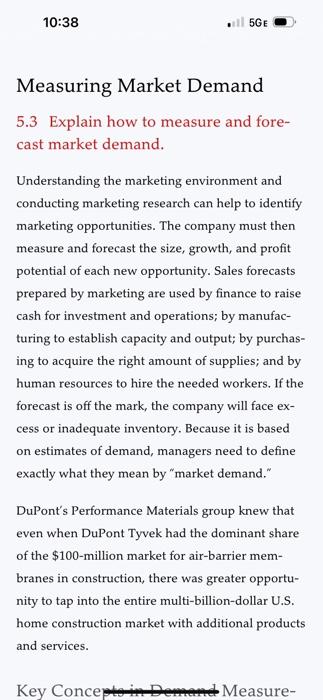
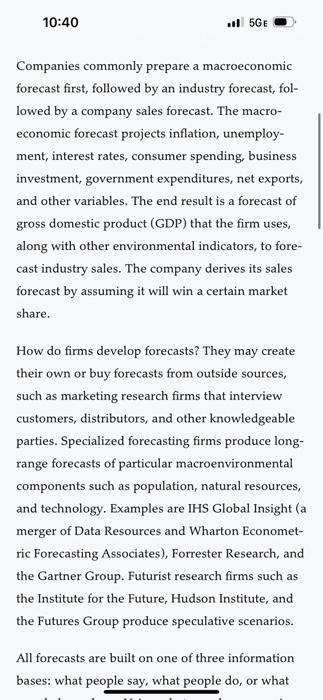
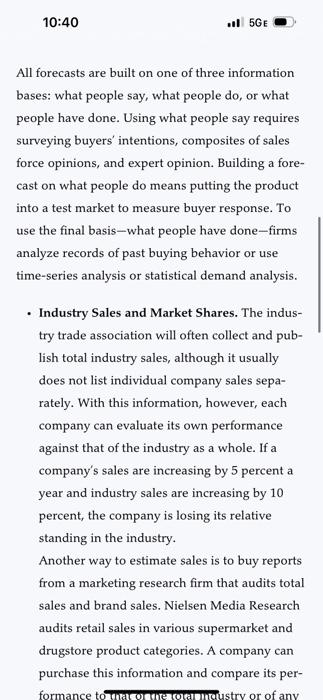
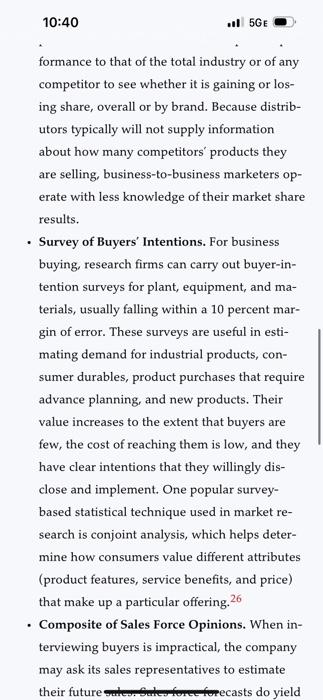
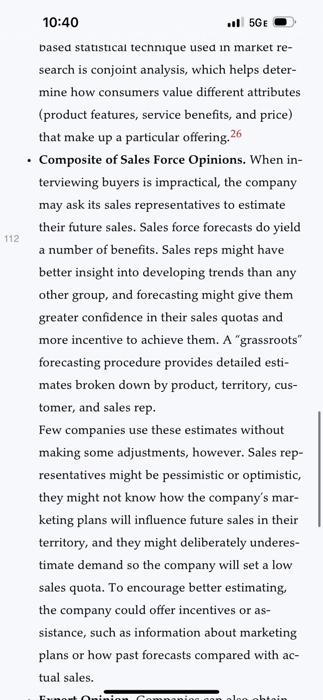
Analyzing the Information and Making the Decision The next-to-last step in the process is to extract findings by tabulating the data and developing summary measures. The researchers compute averages and measures of dispersion for the major variables and apply some advanced statistical techniques and decision models in the hope of discovering additional findings. They may test different hypotheses and theories, applying sensitivity analysis to test assumptions and the strength of the conclusions. The main survey findings for the American Airlines case showed that - Passengers would use ultra-high-speed Wi-Fi service primarily to stay connected and to receive and send large documents and e-mails. Some would also surf the Web to download videos and songs. They would charge the cost to their employers. - At $25, about 5 of 10 first-class passengers would use Wi-Fi service during a flight; at $15, about 6 would. Thus, a fee of $15 would produce less revenue ($90=6$15) than a $25 fee ($125=5$25). Assuming the same flight takes place 365 days a year, American could collect 10:38 - Il 5GE - At $25, about 5 of 10 first-class passengers would use Wi-Fi service during a flight; at $15, about 6 would. Thus, a fee of $15 would produce less revenue ($90=6$15) than a $25 fee ($125=5$25). Assuming the same flight takes place 365 days a year, American could collect $45,625($125365) annually. Given an investment of $90,000 per plane, it would take two years for the service on each plane to break even. - Offering ultra-high-speed Wi-Fi service would strengthen American Airlines' image as an innovative and progressive carrier and earn it some new passengers and customer goodwill. The American Airlines managers who commissioned the research need to weigh the evidence. If their confidence in the findings is low, they may decide against introducing ultra-high-speed Wi-Fi service. If they are predisposed to launching it, the findings support their inclination. They may even decide to study the issue further and do more research. The decision is theirs, but rigorously done research provides them with insight into the matter. When analyzing the available information and making a decision, it is important to draw a line between market data and market insights. Informa- - Offering ultra-high-speed Wi-Fi service would strengthen American Airlines' image as an innovative and progressive carrier and earn it some new passengers and customer goodwill. The American Airlines managers who commissioned the research need to weigh the evidence. If their confidence in the findings is low, they may decide against introducing ultra-high-speed Wi-Fi service. If they are predisposed to launching it, the findings support their inclination. They may even decide to study the issue further and do more research. The decision is theirs, but rigorously done research provides them with insight into the matter. When analyzing the available information and making a decision, it is important to draw a line between market data and market insights. Information is not knowledge, noted Albert Einstein. Likewise, market data alone are typically is not very useful unless they offer insights that improve managers' understanding of the problem and enhance the cost-effectiveness of their actions. Thus, interpreting the data and relating them to the problem at hand play a crucial role in managerial decision making. Measuring Market Demand 5.3 Explain how to measure and forecast market demand. Understanding the marketing environment and conducting marketing research can help to identify marketing opportunities. The company must then measure and forecast the size, growth, and profit potential of each new opportunity. Sales forecasts prepared by marketing are used by finance to raise cash for investment and operations; by manufacturing to establish capacity and output; by purchasing to acquire the right amount of supplies; and by human resources to hire the needed workers. If the forecast is off the mark, the company will face excess or inadequate inventory. Because it is based on estimates of demand, managers need to define exactly what they mean by "market demand." DuPont's Performance Materials group knew that even when DuPont Tyvek had the dominant share of the $100-million market for air-barrier membranes in construction, there was greater opportunity to tap into the entire multi-billion-dollar U.S. home construction market with additional products and services. 10:39 5GE Key Concepts in Demand Measurement The major concepts in demand measurement are market/company demand, market forecast, company sales forecast, market potential, and company sales potential. We discuss these concepts in more detail next. Market demand for an offering is the total volume that could be bought by a defined customer group in a defined geographic area in a defined time period in a defined marketing environment under a defined marketing program. Company demand is the company's estimated share of market demand at alternative levels of company marketing effort in a given time period. It depends on how the company's products, services, prices, and communications are perceived relative to those of competitors. Other things equal, the company's market share depends on the relative scale and effectiveness of its market expenditures. As noted previously, marketing model builders have developed sales response functions to measure how a company's sales are affected by its marketing expenditure level, marketing mix, and marketing effectiveness. 25 The market demand corresponding to the actual The market demand corresponding to the actual level of industry marketing expenditure is called the market forecast The company sales forecast is the expected level of company sales based on a chosen marketing plan and an assumed marketing environment. Two other concepts are important here. A sales quota is the sales goal set for a product line, company division, or sales representative. It is primarily a managerial device for defining and stimulating sales effort, and it is often set slightly higher than estimated sales to stretch the sales force's effort. A sales budget is a conservative estimate of the expected volume of sales, primarily for making current purchasing, production, and cash flow decisions. It's based on the need to avoid excessive risk and is generally set slightly lower than the sales forecast. Total market potential consists of the maximum sales available to all firms in an industry during a given period, under a given level of industry marketing effort, and under extant environmental conditions. The market forecast shows expected market demand, not maximum market demand. For the latter, we need to visualize the level of market demand resulting from a very high level of industry marketing expenditure, where further increases in marketing effortwould have little effect. Market 10:39 .II 5GE mand resulting from a very high level of industry marketing expenditure, where further increases in marketing effort would have little effect. Market potential is the limit approached by market demand as industry marketing expenditures approach infinity for a given marketing environment. The phrase "for a given market environment" is crucial. Consider the market potential for automobiles. It's higher during prosperity than during a recession. A common way to estimate total market potential is to multiply the potential number of buyers by the average quantity each buyer purchases and then by the price. Company sales potential is the sales limit approached by company demand as company marketing effort increases relative to that of competitors. The absolute limit of company demand is, of course, the market potential. The two would be equal if the company captured 100 percent of the market. In most cases, company sales potential is less than the market potential, even when company marketing expenditures increase considerably. Each competitor has a hard core of loyal buyers unresponsive to other companies' efforts to woo them, which makes it challenging to capture all competitors' customers in the market. Forecasting Market Demand Forecasting is the art of anticipating what buyers are likely to do under a given set of conditions. For major consumer durables such as appliances, research organizations conduct periodic surveys of consumer buying intentions, asking questions like Do you intend to buy an automobile within the next six months? Surveys also inquire into consumers' present and future personal finances and expectations about the economy. They combine bits of information into a consumer confidence measure (Conference Board) or a consumer sentiment measure (Survey Research Center of the University of Michigan). In most markets, good forecasting is a key factor in success. Companies commonly prepare a macroeconomic forecast first, followed by an industry forecast, followed by a company sales forecast. The macroeconomic forecast projects inflation, unemployment, interest rates, consumer spending, business investment, government expenditures, net exports, and other variables. The end result is a forecast of gross domestic product (GDP) that the firm uses, along with other environmental indicators, to forecast industry sales. The company derives its sales forecast by assuming it will win a certain market share. Companies commonly prepare a macroeconomic forecast first, followed by an industry forecast, followed by a company sales forecast. The macroeconomic forecast projects inflation, unemployment, interest rates, consumer spending, business investment, government expenditures, net exports, and other variables. The end result is a forecast of gross domestic product (GDP) that the firm uses, along with other environmental indicators, to forecast industry sales. The company derives its sales forecast by assuming it will win a certain market share. How do firms develop forecasts? They may create their own or buy forecasts from outside sources, such as marketing research firms that interview customers, distributors, and other knowledgeable parties. Specialized forecasting firms produce longrange forecasts of particular macroenvironmental components such as population, natural resources, and technology. Examples are IHS Global Insight (a merger of Data Resources and Wharton Econometric Forecasting Associates), Forrester Research, and the Gartner Group. Futurist research firms such as the Institute for the Future, Hudson Institute, and the Futures Group produce speculative scenarios. All forecasts are built on one of three information bases: what people say, what people do, or what 10:40 5GE All forecasts are built on one of three information bases: what people say, what people do, or what people have done. Using what people say requires surveying buyers' intentions, composites of sales force opinions, and expert opinion. Building a forecast on what people do means putting the product into a test market to measure buyer response. To use the final basis-what people have done-firms analyze records of past buying behavior or use time-series analysis or statistical demand analysis. - Industry Sales and Market Shares. The industry trade association will often collect and publish total industry sales, although it usually does not list individual company sales separately. With this information, however, each company can evaluate its own performance against that of the industry as a whole. If a company's sales are increasing by 5 percent a year and industry sales are increasing by 10 percent, the company is losing its relative standing in the industry. Another way to estimate sales is to buy reports from a marketing research firm that audits total sales and brand sales. Nielsen Media Research audits retail sales in various supermarket and drugstore product categories. A company can purchase this information and compare its per- 10:40 5GE formance to that of the total industry or of any competitor to see whether it is gaining or losing share, overall or by brand. Because distributors typically will not supply information about how many competitors' products they are selling, business-to-business marketers operate with less knowledge of their market share results. - Survey of Buyers' Intentions. For business buying, research firms can carry out buyer-intention surveys for plant, equipment, and materials, usually falling within a 10 percent margin of error. These surveys are useful in estimating demand for industrial products, consumer durables, product purchases that require advance planning, and new products. Their value increases to the extent that buyers are few, the cost of reaching them is low, and they have clear intentions that they willingly disclose and implement. One popular surveybased statistical technique used in market research is conjoint analysis, which helps determine how consumers value different attributes (product features, service benefits, and price) that make up a particular offering. 26 - Composite of Sales Force Opinions. When interviewing buyers is impractical, the company may ask its sales representatives to estimate their future suents do yield 10:40 .1I 5GE based statistical technique used in market research is conjoint analysis, which helps determine how consumers value different attributes (product features, service benefits, and price) that make up a particular offering. 26 - Composite of Sales Force Opinions. When interviewing buyers is impractical, the company may ask its sales representatives to estimate their future sales. Sales force forecasts do yield a number of benefits. Sales reps might have better insight into developing trends than any other group, and forecasting might give them greater confidence in their sales quotas and more incentive to achieve them. A "grassroots" forecasting procedure provides detailed estimates broken down by product, territory, customer, and sales rep. Few companies use these estimates without making some adjustments, however. Sales representatives might be pessimistic or optimistic, they might not know how the company's marketing plans will influence future sales in their territory, and they might deliberately underestimate demand so the company will set a low sales quota. To encourage better estimating, the company could offer incentives or assistance, such as information about marketing plans or how past forecasts compared with actual sales. 10:40 5Ge - Expert Opinion. Companies can also obta forecasts from experts, including dealers, ' tributors, suppliers, marketing consultants trade associations. Dealer estimates are su to the same strengths and weaknesses as s force estimates. Many companies buy ecoI ic and industry forecasts from well-known nomic-forecasting firms that have more dz available and offer more forecasting exper Occasionally, companies will invite a grou experts to prepare a forecast. The experts change views and produce an estimate as group (group-discussion method) or individ in which case another analyst might comb AA the results into a single estimate (poolingo. dividual estimates). Further rounds of estir ing and refining follow (the Delphi metho - Past-Sales Analysis. Firms can develop sa forecasts on the basis of past sales. Time-st analysis breaks past sales into four compo: (trend, cycle, seasonal, and erratic) and projects them into the future. Exponential smoothing projects the next period's sales 1 combining and the most recent sales, givir more weight to the latter. Statistical deman analysis measures the impact of a set of ca factors (such as income, marketing expenditures, and price) on the sales level. Econometric analusis buirusses or equanons that describe a 10:40 .1I 5GGe the results into a single estimate (pooling of individual estimates). Further rounds of estimating and refining follow (the Delphi method). 27 - Past-Sales Analysis. Firms can develop sales forecasts on the basis of past sales. Time-series analysis breaks past sales into four components (trend, cycle, seasonal, and erratic) and projects them into the future. Exponential smoothing projects the next period's sales by combining and the most recent sales, giving more weight to the latter. Statistical demand analysis measures the impact of a set of causal factors (such as income, marketing expenditures, and price) on the sales level. Econometric analysis builds sets of equations that describe a system and statistically derives the different parameters that make up the equations. Advanced machine learning techniques are revolutionizing marketing by automating and speeding up tasks that range from analyzing sales and revenue to spotting industry trends. - Market-Test Method. When buyers don't plan their purchases carefully or experts are unavailable or unreliable, a direct market test can help forecast new-product sales or the sales of established products in a new distribution channel or territory
Step by Step Solution
There are 3 Steps involved in it

Get step-by-step solutions from verified subject matter experts
 Study Help