







Question: Write C functions to implement stack using singly linked list without a header node and the list is not circular. The prototype of stack operations
Write C functions to implement stack using singly linked list without a header node and the list is not circular. The prototype of stack operations are void push (int data struct node s) and int pop (struct node **s 3B. 3C. You are given two sorted stacks A and B as singly linked lists without a header node and the list is not circular whose prototypes are shown in Question 3B. The node pointers S1 and S2 point to the top of each stack. In both stacks, minimum element is on top of the stack. Create a new sorted stack C with minimum element on top using a C function. You can only make use of stack data structure shown above and no other data structure including arrays is allowed. Make use of push and pop functions defined in Question 3B and any other required functions need to be shown completely. of representing in memory? Which is preferred
3B,3C answer plz...
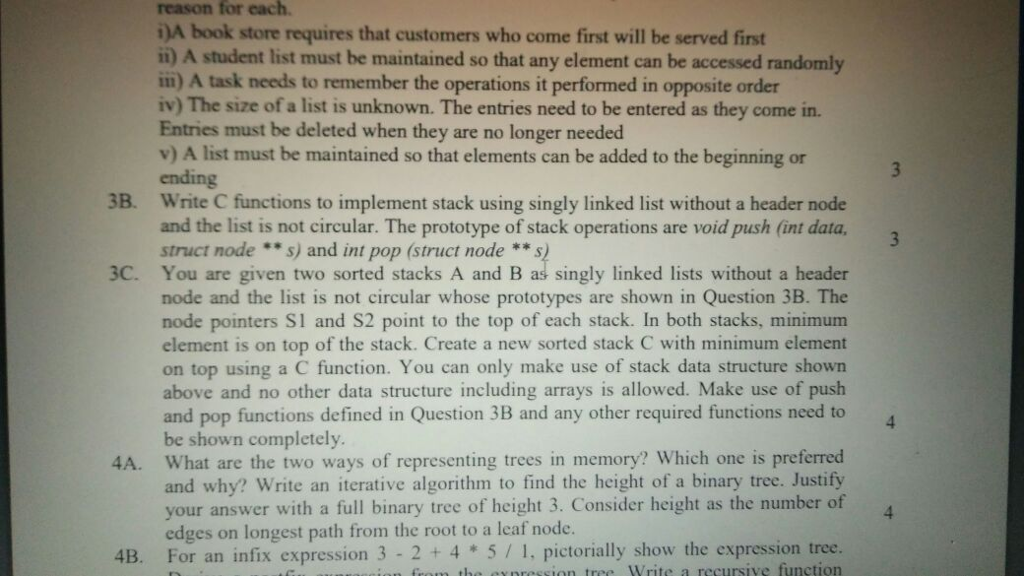
reason for each i)A book store requires that customers who come first will be served first A student list must be maintained so that any element can be accessed randomly in) A task needs to remember the operations it performed in opposite order iv) The size of a list is unknown. The entries need to be entered as they come in. Entries must be deleted when they are no longer needed v) A list must be maintained so that elements can be added to the beginning or ending Write C functions to implement stack using singly linked list without a header node and the list is not circular. The prototype of stack operations are void push (int data, struct node *s) and int pop (struct node **s 3B. 3C. You are given two sorted stacks A and B as singly linked lists without a header node and the list is not circular whose prototypes are shown in Question 3B. The node pointers S1 and S2 point to the top of each stack. In both stacks, minimum element is on top of the stack. Create a new sorted stack C with minimum element on top using a C function. You can only make use of stack data structure shown above and no other data structure including arrays is allowed. Make use of push and pop functions defined in Question 3B and any other required functions need to be shown completely. What are the two ways of representing trees in memory? Which one is preferred and why? Write an iterative algorithm to find the height of a binary tree. Justify your answer with a full binary tree of height 3. Consider height as the number of edges on longest path from the root to a leaf node. 4A. 4B. For an infix expression 3 -2+4 5/1, pictorially show the expression tree. Write a recursive function reason for each i)A book store requires that customers who come first will be served first A student list must be maintained so that any element can be accessed randomly in) A task needs to remember the operations it performed in opposite order iv) The size of a list is unknown. The entries need to be entered as they come in. Entries must be deleted when they are no longer needed v) A list must be maintained so that elements can be added to the beginning or ending Write C functions to implement stack using singly linked list without a header node and the list is not circular. The prototype of stack operations are void push (int data, struct node *s) and int pop (struct node **s 3B. 3C. You are given two sorted stacks A and B as singly linked lists without a header node and the list is not circular whose prototypes are shown in Question 3B. The node pointers S1 and S2 point to the top of each stack. In both stacks, minimum element is on top of the stack. Create a new sorted stack C with minimum element on top using a C function. You can only make use of stack data structure shown above and no other data structure including arrays is allowed. Make use of push and pop functions defined in Question 3B and any other required functions need to be shown completely. What are the two ways of representing trees in memory? Which one is preferred and why? Write an iterative algorithm to find the height of a binary tree. Justify your answer with a full binary tree of height 3. Consider height as the number of edges on longest path from the root to a leaf node. 4A. 4B. For an infix expression 3 -2+4 5/1, pictorially show the expression tree. Write a recursive function
Step by Step Solution
There are 3 Steps involved in it

Get step-by-step solutions from verified subject matter experts
 Study Help