







Question: Write code in java and answer a and b . Problem 2 . Design two algorithms, one using breadth - first search ( BFS )
Write code in java and answer a and b Problem Design two algorithms, one using breadthfirst search BFS and the other using depthfirst
search DFS to determine whether an input graph is colorable. A graph is called colorable or
bipartite if all its vertices can be colored using two different colors such that every edge has its two
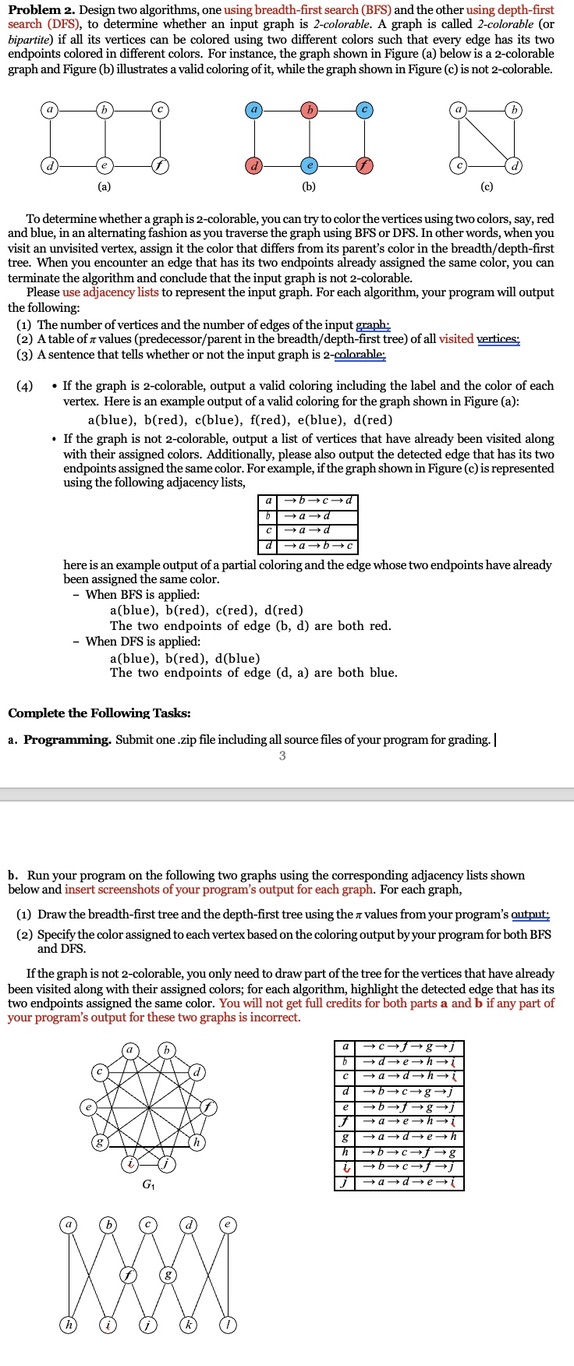
endpoints colored in different colors. For instance, the graph shown in Figure a below is a colorable
graph and Figure b illustrates a valid coloring of it while the graph shown in Figure c is not colorable.
To determine whether a graph is colorable, you can try to color the vertices using two colors, say, red
and blue, in an alternating fashion as you traverse the graph using BFS or DFS In other words, when you
visit an unvisited vertex, assign it the color that differs from its parent's color in the breadthdepthfirst
tree. When you encounter an edge that has its two endpoints already assigned the same color, you can
terminate the algorithm and conclude that the input graph is not colorable.
Please use adjacency lists to represent the input graph. For each algorithm, your program will output
the following:
The number of vertices and the number of edges of the input graph:
A table of values predecessorparent in the breadthdepthfirst tree of all visited vertices:
A sentence that tells whether or not the input graph is colorable:
If the graph is colorable, output a valid coloring including the label and the color of each
vertex. Here is an example output of a valid coloring for the graph shown in Figure a:
ablue bred cblue fred eblue dred
If the graph is not colorable, output a list of vertices that have already been visited along
with their assigned colors. Additionally, please also output the detected edge that has its two
endpoints assigned the same color. For example, if the graph shown in Figure c is represented
using the following adjacency lists,
here is an example output of a partial coloring and the edge whose two endpoints have already
been assigned the same color.
When BFS is applied:
ablue bred cred dred
The two endpoints of edge b d are both red.
When DFS is applied:
ablue bred dblue
The two endpoints of edge are both blue.
Complete the Following Tasks:
a Programming. Submit one zip file including all source files of your program for grading.
b Run your program on the following two graphs using the corresponding adjacency lists shown
below and insert screenshots of your program's output for each graph. For each graph,
Draw the breadthfirst tree and the depthfirst tree using the values from your program's autput:
Specify the color assigned to each vertex based on the coloring output by your program for both BFS
and DFS
If the graph is not colorable, you only need to draw part of the tree for the vertices that have already
been visited along with their assigned colors; for each algorithm, highlight the detected edge that has its
two endpoints assigned the same color. You will not get full credits for both parts a and if any part of
your program's output for these two graphs is incorrect.
Step by Step Solution
There are 3 Steps involved in it
1 Expert Approved Answer
Step: 1 Unlock

Question Has Been Solved by an Expert!
Get step-by-step solutions from verified subject matter experts
Step: 2 Unlock
Step: 3 Unlock
 Study Help