







Question: Write code that finds a maximum flow in a directed graph, using the Ford-Fulkerson algorithm on capacities given as matrix void maximum.flow(int n, int s,
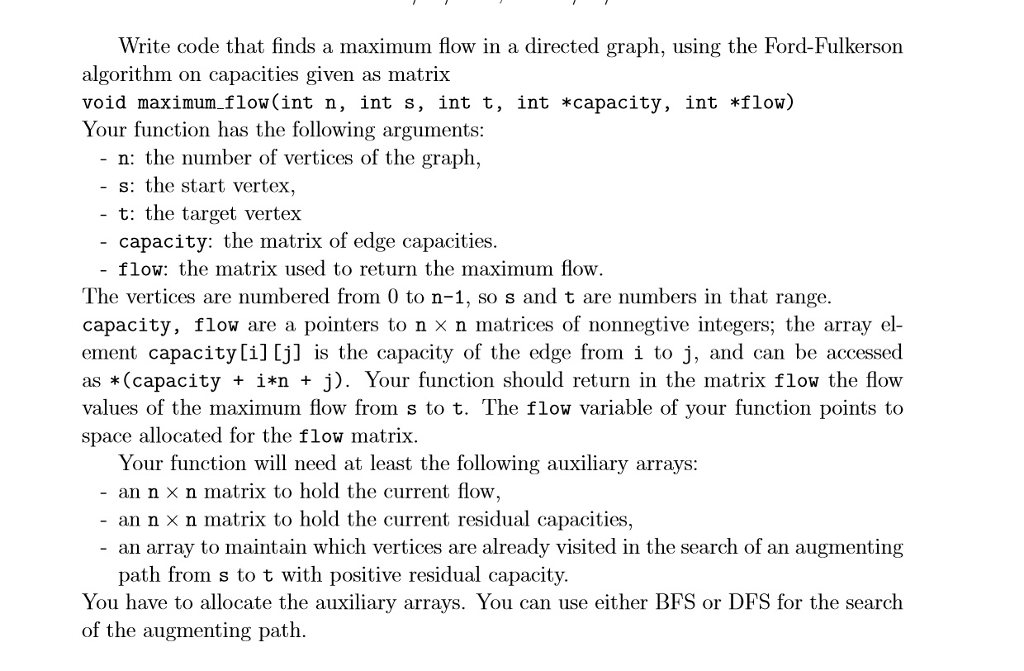
Write code that finds a maximum flow in a directed graph, using the Ford-Fulkerson algorithm on capacities given as matrix void maximum.flow(int n, int s, int t, int capacity, int *low) Your function has the following arguments: n: the number of vertices of the graph, - s: the start vertex - t: the target vertex capacity: the matrix of edge capacities. - flow: the matrix used to return the maximum flow. The vertices are numbered from 0 to n-1, so s and t are numbers in that range. capacity, flow are a pointers to n n matrices of non negtive integers, the array el- ement capacity[i] [jl is the capacity of the edge from i to j, and can be accessed as (capacity + i*n j). Your function should return in the matrix flow the flow values of the maximum flow from s to t. The flow variable of your function points to space allocated for the flow matrix. Your function will need at least the following auxiliary arrays: -an n n matrix to hold the current flow, -an n n matrix to hold the current residual capacities, - an array to maintain which vertices are already visited in the search of an augmenting path from s to t with positive residual capacity. You have to allocate the auxiliary arrays. You can use either BFS or DFS for the search of the augmenting path Write code that finds a maximum flow in a directed graph, using the Ford-Fulkerson algorithm on capacities given as matrix void maximum.flow(int n, int s, int t, int capacity, int *low) Your function has the following arguments: n: the number of vertices of the graph, - s: the start vertex - t: the target vertex capacity: the matrix of edge capacities. - flow: the matrix used to return the maximum flow. The vertices are numbered from 0 to n-1, so s and t are numbers in that range. capacity, flow are a pointers to n n matrices of non negtive integers, the array el- ement capacity[i] [jl is the capacity of the edge from i to j, and can be accessed as (capacity + i*n j). Your function should return in the matrix flow the flow values of the maximum flow from s to t. The flow variable of your function points to space allocated for the flow matrix. Your function will need at least the following auxiliary arrays: -an n n matrix to hold the current flow, -an n n matrix to hold the current residual capacities, - an array to maintain which vertices are already visited in the search of an augmenting path from s to t with positive residual capacity. You have to allocate the auxiliary arrays. You can use either BFS or DFS for the search of the augmenting path
Step by Step Solution
There are 3 Steps involved in it

Get step-by-step solutions from verified subject matter experts
 Study Help