







Question: write in java source code. thank you Lab3A: Credit Cards. Financial advisors will almost always tell you that you should pay for things in cash
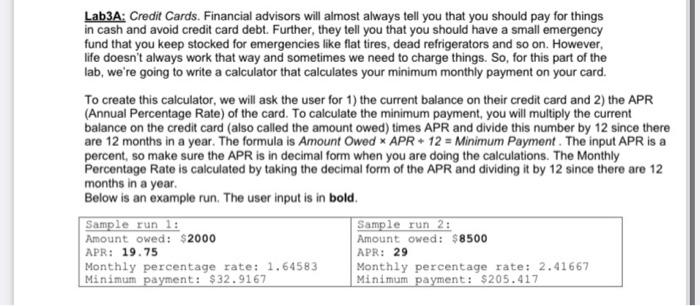
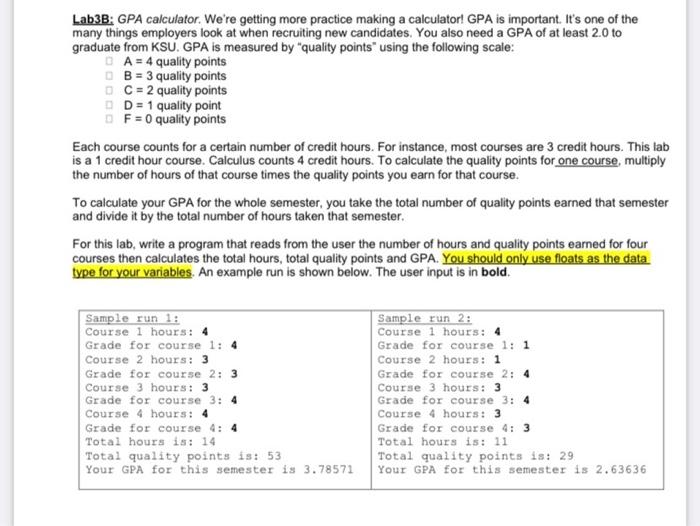
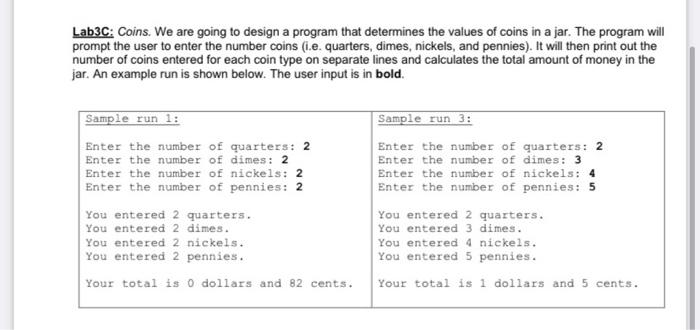
Lab3A: Credit Cards. Financial advisors will almost always tell you that you should pay for things in cash and avoid credit card debt. Further, they tell you that you should have a small emergency fund that you keep stocked for emergencies like flat tires, dead refrigerators and so on. However, life doesn't always work that way and sometimes we need to charge things. So, for this part of the lab, we're going to write a calculator that calculates your minimum monthly payment on your card. To create this calculator, we will ask the user for 1) the current balance on their credit card and 2) the APR (Annual Percentage Rate) of the card. To calculate the minimum payment, you will multiply the current balance on the credit card (also called the amount owed) times APR and divide this number by 12 since there are 12 months in a year. The formula is Amount Owed * APR + 12 = Minimum Payment. The input APR is a percent, so make sure the APR is in decimal form when you are doing the calculations. The Monthly Percentage Rate is calculated by taking the decimal form of the APR and dividing it by 12 since there are 12 months in a year. Below is an example run. The user input is in bold. Sample run 1: Sample run 2: Amount owed: $2000 Amount owed: $8500 APR: 19.75 APR: 29 Monthly percentage rate: 1.64583 Monthly percentage rate: 2.41667 Minimum payment: $32.9167 Minimum payment: $205.417 Lab3B: GPA calculator. We're getting more practice making a calculator! GPA is important. It's one of the many things employers look at when recruiting new candidates. You also need a GPA of at least 2.0 to graduate from KSU. GPA is measured by "quality points" using the following scale: D A = 4 quality points O B = 3 quality points C = 2 quality points DD = 1 quality point F = 0 quality points Each course counts for a certain number of credit hours. For instance, most courses are 3 credit hours. This lab is a 1 credit hour course. Calculus counts 4 credit hours. To calculate the quality points for one course, multiply the number of hours of that course times the quality points you earn for that course. To calculate your GPA for the whole semester, you take the total number of quality points earned that semester and divide it by the total number of hours taken that semester. For this lab, write a program that reads from the user the number of hours and quality points earned for four courses then calculates the total hours, total quality points and GPA. You should only use floats as the data type for your variables. An example run is shown below. The user input is in bold. Sample run 1: Course 1 hours: 4 Grade for course 1: 4 Course 2 hours: 3 Grade for course 2: 3 Course 3 hours: 3 Grade for course 3: 4 Course 4 hours: 4 Grade for course 4: 4 Total hours is: 14 Total quality points is: 53 Your GPA for this semester is 3.78571 Sample run 2: Course 1 hours: 4 Grade for course 1: 1 Course 2 hours: 1 Grade for course 2: 4 Course 3 hours: 3 Grade for course 3: 4 Course 4 hours: 3 Grade for course 4: 3 Total hours is: 11 Total quality points is: 29 Your GPA for this semester is 2.63636 Lab3C: Coins. We are going to design a program that determines the values of coins in a jar. The program will prompt the user to enter the number coins (i.e. quarters, dimes, nickels, and pennies). It will then print out the number of coins entered for each coin type on separate lines and calculates the total amount of money in the jar. An example run is shown below. The user input is in bold. Sample run 1: Enter the number of quarters: 2 Enter the number of dimes: 2 Enter the number of nickels: 2 Enter the number of pennies: 2 You entered 2 quarters. You entered 2 dimes. You entered 2 nickels. You entered 2 pennies. Sample run 3: Enter the number of quarters: 2 Enter the number of dimes: 3 Enter the number of nickels: 4 Enter the number of pennies: 5 You entered 2 quarters. You entered 3 dimes. You entered 4 nickels. You entered 5 pennies. Your total is 0 dollars and 82 cents. Your total is 1 dollars and 5 cents
Step by Step Solution
There are 3 Steps involved in it

Get step-by-step solutions from verified subject matter experts
 Study Help