



Question: Write no more than one page about the possible areas where internala controls should be instituted in the following business described briefly. Keep in mind
Write no more than one page about the possible areas where internala controls should be instituted in the following business described briefly. Keep in mind the size of the business, and do not suggest controls of a type impossible to set up in a firm of this sort. Make any reasonable assumptions about management duties to set up in a firm of this sort. make any reasonable assumptions about management duties and policies not expressly described.
You have a film-developing service in Houston, with 12 employees friving their own cars 6 days a week to contact about 40 stores each, where film is picked up and developed. Drivers bring in film in one day and return the processed film the second or third day. Store managers pay the drivers in cash the amount customers pay for the developing, less a percentag for the stores' work agents. The driver then turns this cash in to the the Houston office, where all the film is being developed and books are kept. Between 6 and 10 employees work at the Houston office, depending on the volume of work. You run the office and have one full-time accounting-clerical employee. Route drivers are paid monthly by miles of route covered.
Use the following internal control. Explain the purpose and the procedure.
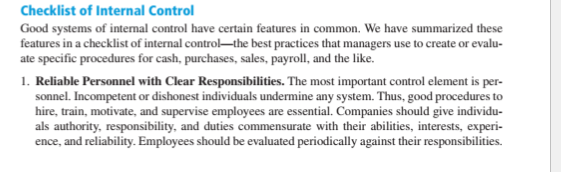
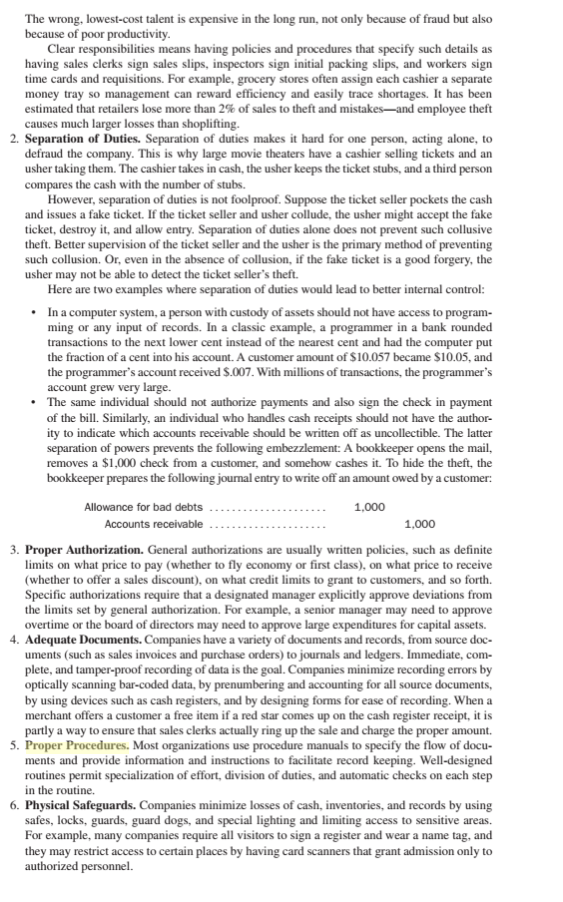
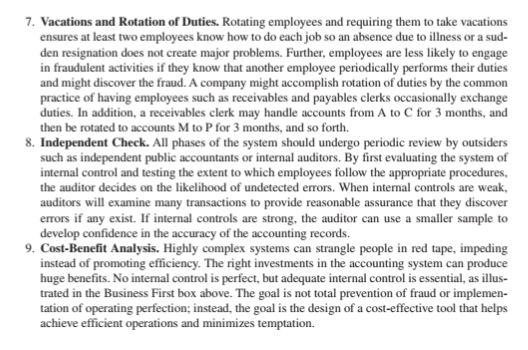
Checklist of Internal Control Good systems of internal control have certain features in common. We have summarized these features in a checklist of internal control-the best practices that managers use to create or evaluate specific procedures for cash, purchases, sales, payroll, and the like. 1. Reliable Personnel with Clear Responsibilities. The most important control element is personnel. Incompetent or dishonest individuals undermine any system. Thus, good procedures to hire, train, motivate, and supervise employees are essential. Companies should give individuals authority, responsibility, and duties commensurate with their abilities, interests, experience, and reliability. Employees should be evaluated periodically against their responsibilities. 7. Vacations and Rotation of Duties. Rotating employees and requiring them to take vacations ensures at least two employees know how to do each job so an absence due to illness or a sudden resignation does not create major problems. Further, employees are less likely to engage in fraudulent activities if they know that another employee periodically performs their duties and might discover the fraud. A company might accomplish rotation of duties by the common practice of having employees such as receivables and payables clerks occasionally exchange duties. In addition, a receivables clerk may handle accounts from A to C for 3 months, and then be rotated to accounts M to P for 3 months, and so forth. 8. Independent Check. All phases of the system should undergo periodic review by outsiders such as independent public accountants or internal auditors. By first evaluating the system of internal control and testing the extent to which employees follow the appropriate procedures, the auditor decides on the likelihood of undetected errors. When internal controls are weak, auditors will examine many transactions to provide reasonable assurance that they discover errors if any exist. If internal controls are strong, the auditor can use a smaller sample to develop confidence in the accuracy of the accounting records. 9. Cost-Benefit Analysis. Highly complex systems can strangle people in red tape, impeding instead of promoting efficiency. The right investments in the accounting system can produce huge benefits. No internal control is perfect, but adequate internal control is essential, as illustrated in the Business First box above. The goal is not total prevention of fraud or implementation of operating perfection; instead, the goal is the design of a cost-effective tool that helps achieve efficient operations and minimizes temptation. The wrong, lowest-cost talent is expensive in the long run, not only because of fraud but also because of poor productivity. Clear responsibilities means having policies and procedures that specify such details as having sales clerks sign sales slips, inspectors sign initial packing slips, and workers sign time cards and requisitions. For example, grocery stores often assign each cashier a separate money tray so management can reward efficiency and easily trace shortages. It has been estimated that retailers lose more than 2% of sales to theft and mistakes-and employee theft causes much larger losses than shoplifting. 2. Separation of Duties. Separation of duties makes it hard for one person, acting alone, to defraud the company. This is why large movie theaters have a cashier selling tickets and an usher taking them. The cashier takes in cash, the usher keeps the ticket stubs, and a third person compares the cash with the number of stubs. However, separation of duties is not foolproof. Suppose the ticket seller pockets the cash and issues a fake ticket. If the ticket seller and usher collude, the usher might accept the fake ticket, destroy it, and allow entry. Separation of duties alone does not prevent such collusive theft. Better supervision of the ticket seller and the usher is the primary method of preventing such collusion. Or, even in the absence of collusion, if the fake ticket is a good forgery, the usher may not be able to detect the ticket seller's theft. Here are two examples where separation of duties would lead to better internal control: - In a computer system, a person with custody of assets should not have access to programming or any input of records. In a classic example, a programmer in a bank rounded transactions to the next lower cent instead of the nearest cent and had the computer put the fraction of a cent into his account. A customer amount of $10.057 became $10.05, and the programmer's account received $.007. With millions of transactions, the programmer's account grew very large. - The same individual should not authorize payments and also sign the check in payment of the bill. Similarly, an individual who handles cash receipts should not have the authority to indicate which accounts receivable should be written off as uncollectible. The latter separation of powers prevents the following embezzlement: A bookkeeper opens the mail, removes a $1,000 check from a customer, and somehow cashes it. To hide the theft, the bookkeeper prepares the following journal entry to write off an amount owed by a customer: Allowance for bad debts 1,000 Accounts receivable 1,000 3. Proper Authorization. General authorizations are usually written policies, such as definite limits on what price to pay (whether to fly economy or first class), on what price to receive (whether to offer a sales discount), on what credit limits to grant to customers, and so forth. Specific authorizations require that a designated manager explicitly approve deviations from the limits set by general authorization. For example, a senior manager may need to approve overtime or the board of directors may need to approve large expenditures for capital assets. 4. Adequate Documents. Companies have a variety of documents and records, from source documents (such as sales invoices and purchase orders) to journals and ledgers. Immediate, complete, and tamper-proof recording of data is the goal. Companies minimize recording errors by optically scanning bar-coded data, by prenumbering and accounting for all source documents, by using devices such as cash registers, and by designing forms for ease of recording. When a merchant offers a customer a free item if a red star comes up on the cash register receipt, it is partly a way to ensure that sales clerks actually ring up the sale and charge the proper amount. 5. Proper Procedures. Most organizations use procedure manuals to specify the flow of documents and provide information and instructions to facilitate record keeping. Well-designed routines permit specialization of effort, division of duties, and automatic checks on each step in the routine. 6. Physical Safeguards. Companies minimize losses of cash, inventories, and records by using safes, locks, guards, guard dogs, and special lighting and limiting access to sensitive areas. For example, many companies require all visitors to sign a register and wear a name tag, and they may restrict access to certain places by having card scanners that grant admission only to authorized personnel
Step by Step Solution
There are 3 Steps involved in it

Get step-by-step solutions from verified subject matter experts