







Question: write one similarity and one difference between the red and blue paragraphs Conflict in the workplace can lead to decreases in productivity and increases in
write one similarity and one difference between the red and blue paragraphs 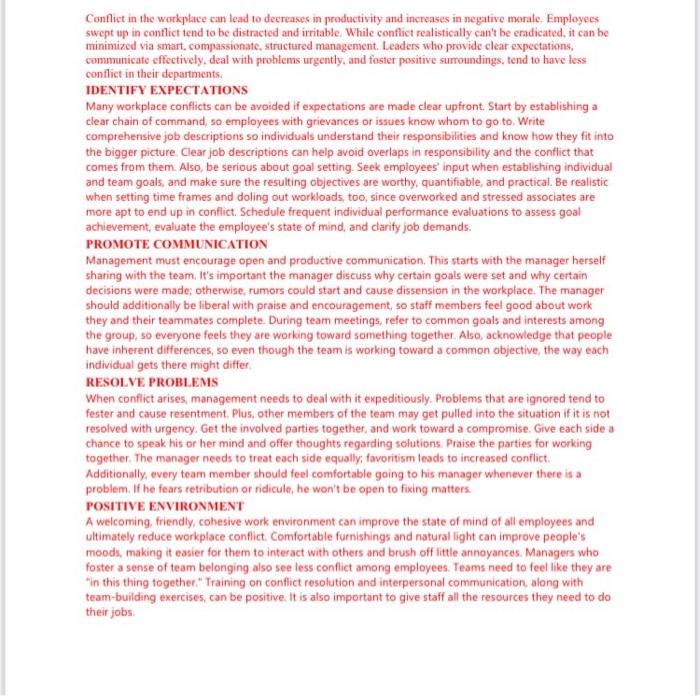
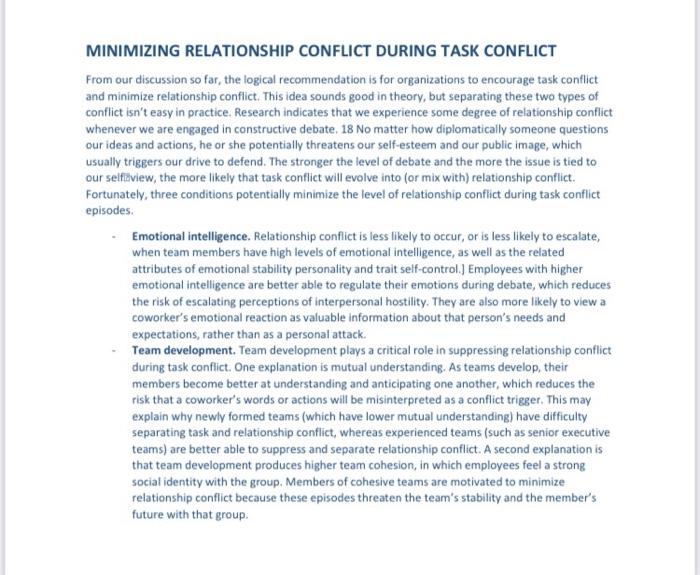
Conflict in the workplace can lead to decreases in productivity and increases in negative morale. Employees swept up in conflict tend to be distracted and irritable. While conflict realistically can't be endicated, it can be minimized via smart, compassionate, structured management. Leaders who provide clear expectations, communicate effectively, deal with problems urgently, and foster positive surroundings, tend to have less conflict in their departments. IDENTIFY EXPECTATIONS Many workplace conflicts can be avoided if expectations are made clear upfront. Start by establishing a clear chain of command, so employees with grievances or issues know whom to go to. Write comprehensive job descriptions so individuals understand their responsibilities and know how they fit into the bigger picture. Clear job descriptions can help avoid overlaps in responsibility and the conflict that comes from them. Also, be serious about goal setting. Seek employees' input when establishing individual and team goals, and make sure the resulting objectives are worthy, quantifiable, and practical. Be realistic when setting time frames and doling out workloads, too, since overworked and stressed associates are more apt to end up in conflict. Schedule frequent individual performance evaluations to assess goal achievement, evaluate the employee's state of mind, and clarify job demands. PROMOTE COMMUNICATION Management must encourage open and productive communication, This starts with the manager herself sharing with the team. It's important the manager discuss why certain goals were set and why certain decisions were made; otherwise, rumors could start and cause dissension in the workplace. The manager should additionally be liberal with praise and encouragement, so staff members feel good about work they and their teammates complete. During team meetings, refer to common goals and interests among the group, so everyone feels they are working toward something together. Also, acknowledge that people have inherent differences, so even though the team is working toward a common objective, the way each individual gets there might differ. RESOLVE PROBLEMS When confict arises, management needs to deal with it expeditiously. Problems that are ignored tend to fester and cause resentment. Plus, other members of the team may get pulled into the situation if it is not resolved with urgency. Get the involved parties together, and work toward a compromise. Give each side a chance to speak his or her mind and offer thoughts regarding solutions. Praise the parties for working together. The manager needs to treat each side equally; favoritism leads to increased conflict. Additionally, every team member should feel comfortable going to his manager whenever there is a problem. If he fears retribution or ridicule, he won't be open to fixing matters. POSITIVE ENVIRONMENT A welcoming, friendly, cohesive work environment can improve the state of mind of all employees and ultimately reduce workplace conflict. Comfortable furnishings and natural light can improve people's moods, making it easier for them to interact with others and brush off little annoyances. Managers who foster a sense of team belonging also see less conflict among employees. Teams need to feel like they are "in this thing together." Training on conflict resolution and interpersonal communication, along with team-building exercises, can be positive. It is also important to give staff all the resources they need to do their jobs. MINIMIZING RELATIONSHIP CONFLICT DURING TASK CONFLICT From our discussion so far, the logical recommendation is for organizations to encourage task conflict and minimize relationship conflict. This idea sounds good in theory, but separating these two types of conflict isn't easy in practice. Research indicates that we experience some degree of relationship conflict whenever we are engaged in constructive debate, 18 No matter how diplomatically someone questions our ideas and actions, he or she potentially threatens our self-esteem and our public image, which usually triggers our drive to defend. The stronger the level of debate and the more the issue is tied to our selfiliview, the more likely that task conflict will evolve into (or mix with) relationship conflict. Fortunately, three conditions potentially minimize the level of relationship conflict during task conflict episodes. - Emotional intelligence. Relationship conflict is less likely to occur, or is less likely to escalate, when team members have high levels of emotional intelligence, as well as the related attributes of emotional stability personality and trait self-control.] Employees with higher emotional intelligence are better able to regulate their emotions during debate, which reduces the risk of escalating perceptions of interpersonal hostility. They are also more likely to view a coworker's emotional reaction as valuable information about that person's needs and expectations, rather than as a personal attack. - Team development. Team development plays a critical role in suppressing relationship conflict during task conflict. One explanation is mutual understanding. As teams develop, their members become better at understanding and anticipating one another, which reduces the risk that a coworker's words or actions will be misinterpreted as a conflict trigger. This may explain why newly formed teams (which have lower mutual understanding) have difficulty separating task and relationship conflict, whereas experienced teams (such as senior executive teams) are better able to suppress and separate relationship conflict. A second explanation is that team development produces higher team cohesion, in which employees feel a strong social identity with the group. Members of cohesive teams are motivated to minimize relationship conflict because these episodes threaten the team's stability and the member's future with that group Step by Step Solution
There are 3 Steps involved in it
1 Expert Approved Answer
Step: 1 Unlock

Question Has Been Solved by an Expert!
Get step-by-step solutions from verified subject matter experts
Step: 2 Unlock
Step: 3 Unlock
 Study Help