







Question: Write out appropriate formula, then plug in numbers (show complete steps for each question) Objective: Investigation of the relationship between the stretch of a spring
Write out appropriate formula, then plug in numbers (show complete steps for each question)
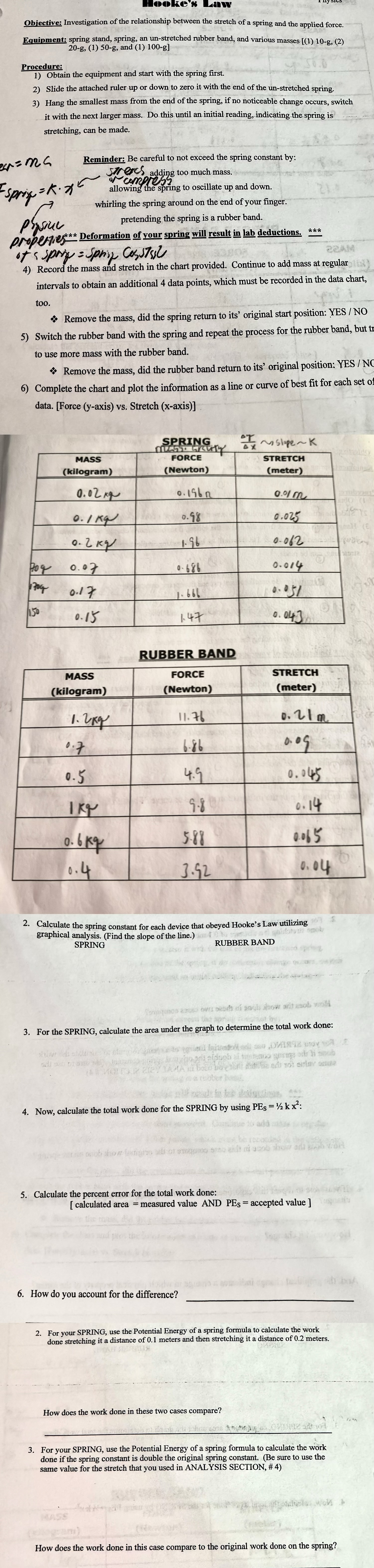
Objective: Investigation of the relationship between the stretch of a spring and the applied force. Equipment: spring stand, spring, an un-stretched rubber band, and various masses [(1) 10-g, (2) 20-g, (1) 50-g, and (1) 100-g] Procedure: 1) Obtain the equipment and start with the spring first. 2) Slide the attached ruler up or down to zero it with the end of the un-stretched spring. 3) Hang the smallest mass from the end of the spring, if no noticeable change occurs, switch it with the next larger mass. Do this until an initial reading, indicating the spring is stretching, can be made car = MG Reminder: Be careful to not exceed the spring constant by: Siceres adding too much mass. Esprit = K. 8 6 allowing the spring to oscillate up and down. 21.8 whirling the spring around on the end of your finger. pretending the spring is a rubber band properties** Deformation of your spring will result in lab deductions. ** * of s sprig = sprig Costsil 22AM 4) Record the mass and stretch in the chart provided. Continue to add mass at regular intervals to obtain an additional 4 data points, which must be recorded in the data chart, too. Remove the mass, did the spring return to its' original start position: YES / NO 5) Switch the rubber band with the spring and repeat the process for the rubber band, but to use more mass with the rubber band. * Remove the mass, did the rubber band return to its' original position: YES / N 6) Complete the chart and plot the information as a line or curve of best fit for each set o data. [Force (y-axis) vs. Stretch (x-axis)] SPRING ox ~slope~ K MASS FORCE STRETCH (kilogram) (Newton) (meter) 0.02 Rq 0. 196 n 0.01 m 0 . 1 Kq 0. 98 0.025 0 . 2 Kq 1:96 0 - 062 104 0.07 0.686 0.014 0.17 1. 661 50 0.15 1.47 0 . 043 RUBBER BAND MASS FORCE STRETCH (kilogram) (Newton) (meter) 1. Ung 11.76 0. 21 m 6.86 0.5 4.9 0. 045 9.8 0 0. 14 0 . 6 Kq 5-88 0.065 10.4 3.92 10. 04 2. Calculate the spring constant for each device that obeyed Hooke's Law utilizing graphical analysis. (Find the slope of the line.) SPRING RUBBER BAND h gi soul show sritas 3. For the SPRING, calculate the area under the graph to determine the total work done: 4. Now, calculate the total work done for the SPRING by using PEs = 1/2 k x2: 5. Calculate the percent error for the total work done: [ calculated area = measured value AND PEs = accepted value ] 6. How do you account for the difference? 2. For your SPRING, use the Potential Energy of a spring formula to calculate the work done stretching it a distance of 0.1 meters and then stretching it a distance of 0.2 meters. How does the work done in these two cases compare? 3. For your SPRING, use the Potential Energy of a spring formula to calculate the work done if the spring constant is double the original spring constant. (Be sure to use the same value for the stretch that you used in ANALYSIS SECTION, # 4) MASS How does the work done in this case compare to the original work done on the spring
Step by Step Solution
There are 3 Steps involved in it

Get step-by-step solutions from verified subject matter experts
 Study Help